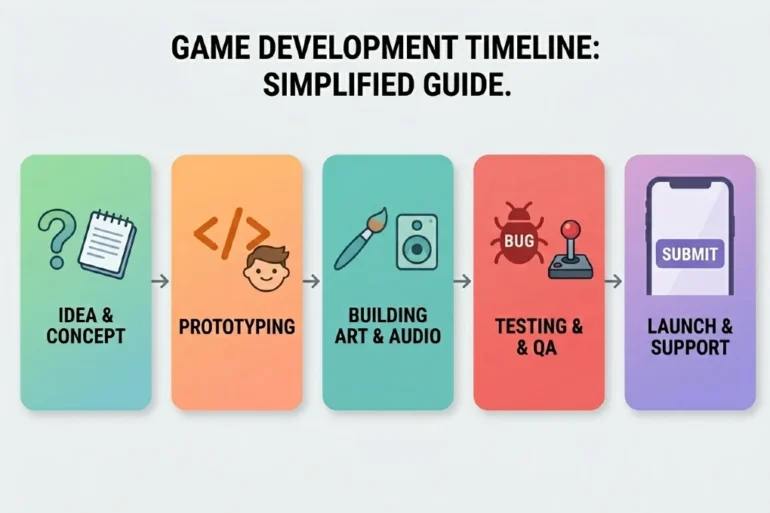
Most first-time mobile game founders budget for the build. They rarely budget for the wait — device certification queues, backend stress tests, App Store review cycles, and soft launch iteration that together add two to four months most initial plans don’t account for. The mistake isn’t optimism. It’s that the phases they plan for aren’t the phases that actually consume time.
Pre-production looks short on paper. Production seems manageable. Then soft launch arrives and the team realizes they’ve been testing assumptions, not a finished product. Understanding where time actually goes is the difference between a roadmap that survives contact with reality and one that gets rewritten every quarter.
Why Timeline Estimates Are Almost Always Wrong
The industry shorthand is that simple mobile games take three to six months, and mid-complexity titles run nine to twelve months. Those numbers aren’t wrong — they’re just incomplete. They describe what’s technically possible under favorable conditions: a clear brief, a focused team, no scope changes, and clean QA cycles. Most projects don’t have all four.
The two biggest timeline killers aren’t bugs or art revisions. They’re late-stage scope additions and the period between builds that developers underestimate: integration, device testing across multiple Android SKUs, and backend stability under real load. A feature that takes three days to build can take two weeks to stabilize across devices. Multiply that by every system in the game and you start to understand where the months go.
Real timelines also depend on what you’re measuring. Concept to first playable prototype is a very different number than concept to App Store submission. Most estimates reference the former. The latter includes soft launch, iteration based on live data, certification prep, and review periods, all of which add weeks that rarely appear in initial project plans.
The Phase Breakdown: What Each Stage Actually Takes
Pre-production, which includes concept definition, game design documentation, core loop prototyping, and engine selection, typically runs four to eight weeks. It’s the most compressible phase on paper and the most dangerous one to rush. Validating the core mechanic through a prototype before any art budget is committed is what saves months later. Studios that skip proper prototyping and jump into full production often discover, six months in, that the loop doesn’t retain players.
Production is the longest phase. For a mid-complexity title like a casual RPG or a strategy game with three to five systems, expect six to ten months. This covers art pipeline, character and environment builds, audio integration, UI, backend, monetization integration, and QA cycles. The art pipeline is consistently underestimated. Character models, animations, and environment assets for a mid-core mobile game can take two to three months on their own, even with a dedicated art team.
Soft launch adds another six to twelve weeks on top of production. This is not a formality. It’s where you find out whether players complete the tutorial, whether your Day 7 retention is above the genre floor, and whether your monetization mechanics convert at all. Games that skip soft launch and go straight to global release trade iteration time for launch risk.
Production Is Where Timelines Actually Slip
The production phase has one fundamental tension: scope and schedule move in opposite directions. Every feature added to the game design document pushes the launch date out. Every feature cut feels like a compromise on the vision. Studios that ship on time aren’t the ones that never cut features; they’re the ones that make those calls early and deliberately, rather than reactively when the deadline is already past.
Platform fragmentation is the other slow drain. Android testing across a representative device set, covering different chipsets, RAM tiers, and OS versions, is a different exercise than testing on a handful of iOS devices. Performance issues that don’t surface on developer hardware often appear on mid-tier Android phones with 3GB RAM and a two-year-old GPU. Teams that haven’t built this into their QA plan discover it at the worst possible time: the week before submission.
Studios working with an external mobile game development company on production often gain meaningful time savings in specific areas: optimized art pipelines, pre-built backend architecture, and QA coverage across a wider device library than most in-house teams maintain. The tradeoff is onboarding time and communication overhead, which is why handoffs defined clearly in pre-production recover more time than ambiguous ones defined mid-production.
Soft Launch Is Not Optional — It’s the Real QA
Soft launch changes the nature of QA from “is the game working?” to “is the game working for players?”. Those are different questions with different answers. A six-week regional soft launch in two or three markets gives you enough data to make informed decisions about monetization tuning, tutorial drop-off, and first session length, all of which affect long-term performance more than most technical fixes. Games that skip this step and launch globally tend to get one shot at chart positioning. Games that soft launch correctly get a second shot based on data.
The App Store review process for a new submission typically takes one to three days for iOS and a few hours for Android, once the build is clean. The review period isn’t the bottleneck. The bottleneck is everything that has to be true before you submit: a stable build across target devices, App Store assets prepared (icon, screenshots, preview video, localized descriptions), backend infrastructure stress-tested, and analytics instrumented well enough to read Day 1 data.
The studios that consistently meet their launch windows are the ones treating soft launch as a planned phase, not a reactive one. Experienced game development studios build soft launch metrics like Day 1, Day 7, and Day 30 retention targets, CPI benchmarks, and monetization conversion floors into the project plan before a line of code is written. That way, the soft launch decision tree is already defined: hit the metrics and go global, miss them and iterate.
What a Realistic Timeline Actually Looks Like
A mid-complexity mobile game, built by a focused team with a clear brief and proper pre-production, realistically runs twelve to sixteen months from concept to global launch. Broken down: four to eight weeks of pre-production, six to ten months of production, six to twelve weeks of soft launch, and two to four weeks of certification prep and final submission cycles. It does not include post-launch live-ops, which begins the moment the game goes live and doesn’t have an end date.
The teams that ship on time aren’t building faster; they’re building with less ambiguity. They know before production starts what the core loop is, what’s in the launch build and what isn’t, and what their soft launch success criteria look like. The timeline isn’t the hard part. The decisions that compress or extend it are made in the first eight weeks.
Conclusion
The timeline is rarely the problem. The decisions made or avoided in the first eight weeks are.
Build the timeline backward from your target launch date. Define what the game is and is not at launch before production starts. Treat soft launch as a product phase, not a checkbox. Studios that do all three ship closer to their plan than those that treat the timeline as a best guess and adjust as they go.
Frequently Asked Questions
How long does it take to develop a mobile game in 2026?
Simple casual games typically take three to six months from concept to launch. Mid-complexity titles like casual RPGs, strategy games, or titles with live-service components generally run nine to sixteen months including soft launch. The most accurate estimate comes from scoping the production phase specifically: art pipeline volume, backend complexity, and the number of distinct systems all drive the timeline more than genre alone.
What’s the biggest cause of mobile game development delays?
Late-stage scope additions and underestimated QA cycles are the most common culprits. Features added after the production phase starts push the schedule in both directions, adding build time and requiring re-testing systems that are already validated. Android device fragmentation is the second most cited issue – performance problems that don’t appear on developer hardware often surface on mid-tier devices during final QA, the worst possible time to discover them.
Is soft launch mandatory for mobile games?
It’s not mandatory in the technical sense, but skipping it is rarely the right call for any title with monetization. Soft launch gives you Day 1, Day 7, and Day 30 retention data before global release, which is the only reliable way to know whether the game’s economy and core loop are working at scale. Studios that go straight to global release get one shot at chart positioning. Soft launch gives you a data-informed second one.
How does team size affect the development timeline?
Significantly, but not linearly. A team of three that’s done it before will often outship a team of ten dealing with a first-time coordination overhead. The more useful metric is role coverage: does the team have dedicated slots for art, engineering, design, and QA, or are people covering multiple functions? Gaps in role coverage, especially QA, which is chronically understaffed on early-stage mobile projects, show up in the timeline as late-discovered bugs and certification rejections.