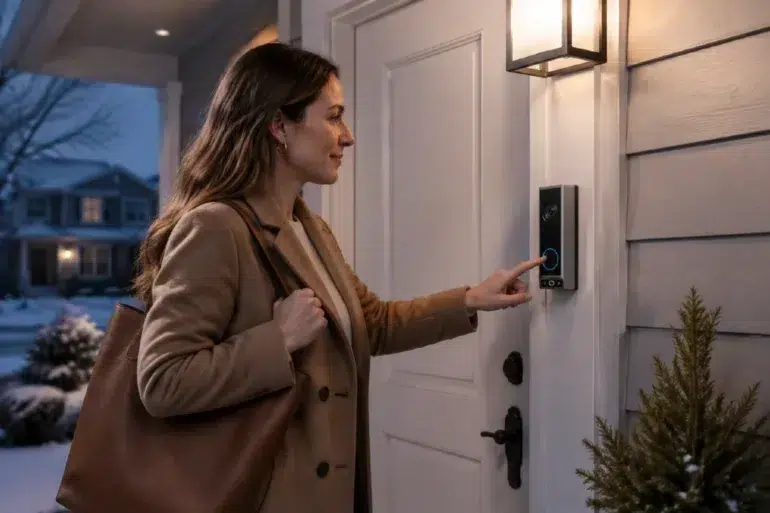
How Cold Weather Changes the Case for Battery vs Wired Doorbells
Cold weather changes the case for battery vs wired doorbells because power becomes less predictable just as the front door gets busier. Holiday deliveries, darker evenings, and frozen walkways all put more pressure on a doorbell camera. A wireless video doorbell may still fit when wiring is missing or rental rules limit installation. Wired or dual-powered hardware may suit long winters, busy porches, or mid-winter charging you would rather avoid. This guide walks through cold battery behavior, transformer checks, installation paths, winter signal and storage, and dual-powered options.
How cold affects battery life and alert speed
A wireless video doorbell depends on a battery that can wake the camera, power the sensor, connect to Wi-Fi, and record when motion is detected. In mild weather, that burst of work can feel instant. In cold weather, the same task may ask more from the battery.
Lithium-ion cells are sensitive to temperature. In cold conditions, battery chemistry can become less responsive, so the device may have less usable power for quick wake-ups, recording, and wireless transmission. For a doorbell, that usually means the battery percentage in the app does not always tell the whole story.
The problem usually shows up in ordinary moments. A delivery driver walks up, the camera wakes a little slower than usual, and the clip starts after the person is already close to the door. On a quiet street, that may be acceptable. On a busy porch where packages arrive after dark, those lost seconds matter more.
Check existing doorbell wiring and transformer voltage
Existing wiring changes the decision, but only if the circuit is actually ready for a camera. A traditional doorbell button needed enough power to ring a chime for a second. A video doorbell has a camera, processor, microphone, speaker, night vision, and Wi-Fi radio. The old transformer may not be sized for that kind of load.
Before buying, check the parts you already have.
- Transformer rating: look for the voltage and VA rating stamped on the transformer body.
- Chime type: mechanical chimes, digital chimes, and plug-in chimes behave differently.
- Wire condition: brittle, corroded, or very short wires can turn a simple swap into a repair.
- Breaker location: know which circuit feeds the transformer before loosening anything.
- Wi-Fi at the door: power does not help if the signal is weak at the actual mounting spot.
If testing the transformer or working near the panel feels uncomfortable, use an electrician. Doorbell circuits are low voltage, but transformer location, chime wiring, and old repairs can be confusing. Guessing is how people end up with buzzing chimes, rebooting cameras, or an installation that works for two days and fails on the first cold night.
Choose the no wiring path for flexible installation
If the home has no usable doorbell wiring, the battery path is usually the cleanest route. A wireless doorbell camera outdoor setup lets you mount the camera where the view is best rather than where an old button happened to be. Many installs are closer to a drill-and-mount project than electrical work, which matters on brick fronts, side-entry porches, rentals, and homes where the original doorbell sits too low or too far from the package drop spot.
The trade-off arrives later. Winter shortens the margin for casual charging habits. A battery that feels safe at 35 percent in October may not feel safe during a week of freezing nights, frequent alerts, and extra delivery traffic. If you travel during the holidays, charge earlier than you think you need to. A battery doorbell that runs out while you are away leaves very little room to recover.
The no-wiring path works best when the porch has lower daily traffic, winter is moderate, or installation rules matter more than constant power. If you are comparing battery-first models, the eufy video doorbell is a useful place to compare field of view, storage style, chime support, and whether a model can also use wiring later.
Compare battery, wired and dual-powered paths
The winter decision is easier when you split it into two paths. If there is no wiring, choose a battery model and plan around cold-weather charging. If there is existing wiring, check the transformer before assuming a wired or dual-powered model will work. In practice, battery solves placement first, while wiring solves long-term power consistency. A dual-powered doorbell sits between the two because it still uses a battery, but the existing low-voltage wiring helps keep that battery topped up.
| Door condition | Better path | Winter note |
|---|---|---|
| No doorbell wiring | Battery model | Easier install, but charging matters more in cold weather |
| Existing wiring below spec | Battery now or transformer upgrade first | Avoid unstable wired installs |
| Existing wiring in spec | Wired or dual-powered model | Less charging work during long freezes |
| Rental or strict exterior rules | Battery model | Mounting and removal may matter more than power |
| Busy porch with frequent deliveries | Wired or dual-powered model | Steadier power helps with repeated wake events |
Wired installation has more friction up front. It may require turning off a circuit, checking transformer voltage, adding a chime adapter, or calling an electrician. Battery installation feels easier on day one. Winter is where the maintenance cost shows up.
Check wireless signals and storage before winter
Cold weather can expose weak parts of the whole front-door setup, not just the battery. A thick exterior wall, a metal storm door, or a router at the back of the house may already be hurting the signal. During winter delivery traffic, the doorbell has to wake, connect, process motion, and push alerts more often. Any weak link in that chain can make notification delay more noticeable.
Storage is part of the same setup, but a full comparison belongs in another guide. Cloud-first systems can work well, but the clip has to leave the camera and return through a server before you review it. A video doorbell no subscription setup with local storage keeps more of the process inside your home network. For larger entry planning, the eufy security camera can help when a driveway camera, porch camera, or floodlight camera is better suited to angles the doorbell should not handle alone.
A few simple checks go a long way. Stand outside with your phone and test Wi-Fi where the doorbell will mount. Watch whether the live view loads near the door, not just in the hallway. If the house has a busy street in view, narrow the detection zone before winter traffic starts filling the event log with clips you do not need.
Use dual-powered doorbells when wiring is usable
Dual-powered models make sense when you want battery installation flexibility but have existing wiring that can help with winter charging. They are not a shortcut around a weak transformer. The wiring still has to meet the product requirement, and some models still need the battery installed even in wired mode.
This setup is especially useful when the old doorbell location still works, but you want a battery-backed design for easier setup and fewer charging surprises. In winter, the battery does not disappear from the equation. The wiring simply helps reduce how often you have to remove the doorbell or think about its charge level during busy delivery weeks.
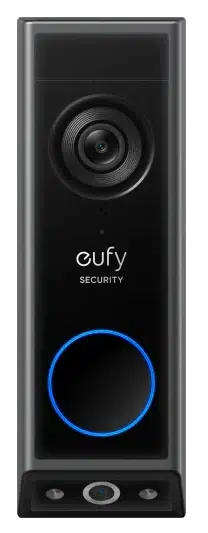
The eufy Video Doorbell E340 fits that middle ground. Battery mode helps when the best viewing angle is not where the old button sits, while wired mode can keep the battery topped up when connected to an 8-24V power source rated above 10VA. The battery still has to stay installed in wired mode, which matters for winter planning. Its dual cameras cover both visitors and the package area; 2K clarity helps when you need a sharper look at a face or delivery label, and built-in 8GB local storage supports no-subscription recording for everyday front-door events.
Conclusion
Cold weather does not make battery doorbells wrong. It makes the power decision more visible. If the porch is quiet, the winter is mild, and wiring is not available, a battery model can still be the cleanest answer. If the door sees frequent motion, long freezes, holiday travel, or high package volume, wired or dual-powered hardware deserves a closer look. Start with the house by checking transformer voltage, chime type, wiring condition, Wi-Fi at the door, and the way people actually approach the porch. A front-door camera is easier to trust when winter is part of the decision from the start.