
Schalungssteine are a practical building option for homeowners who want stronger garden walls, retaining walls, basement areas, outdoor structures, or small concrete projects without starting from traditional timber formwork every time. The word may sound unfamiliar if you are used to English construction terms, but the idea is simple: these are hollow formwork blocks that are stacked in place and then filled with concrete, often with reinforcement added where strength is needed.
For many home projects, they sit somewhere between regular concrete blocks and poured concrete walls. They give you the shape and layout of a block wall, but once the hollow cores are filled, the wall can become much more solid and stable than a basic dry-stacked structure.
What Are Schalungssteine?
Schalungssteine are hollow concrete formwork blocks used to create walls, foundations, retaining structures, raised beds, and other load-bearing or semi-load-bearing construction elements. Instead of building a wooden mold, pouring concrete, and then removing the mold later, the block itself stays in place as part of the wall.
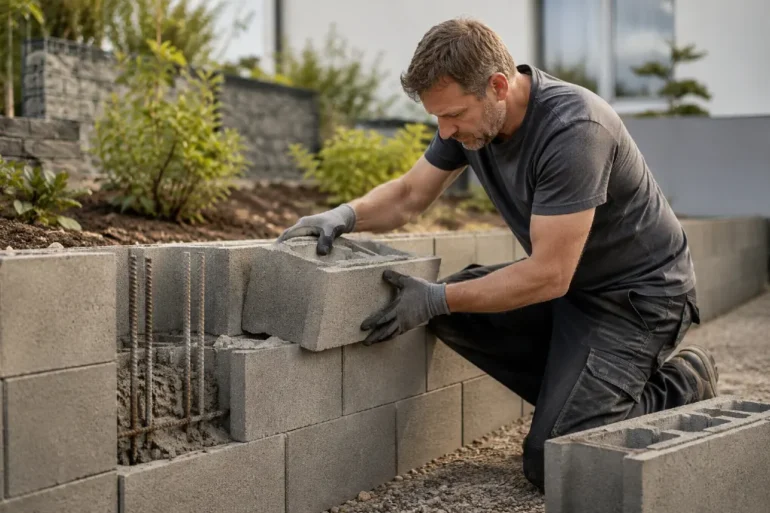
A homeowner or contractor usually stacks the blocks in rows, aligns them carefully, adds steel reinforcement if the project requires it, and fills the hollow spaces with concrete. Once cured, the wall becomes a combined system of concrete block shell, concrete fill, and sometimes rebar.
That is why these blocks are often used where a normal decorative block wall may not be strong enough. They are common in parts of Europe, especially in German-speaking construction markets, but the basic idea is familiar worldwide through hollow concrete masonry and stay-in-place formwork systems.
Why Homeowners Use Schalungssteine
Most homeowners are not trying to build skyscrapers. They want something simpler: a wall that does not lean, crack early, or fail after a few winters. That is where Schalungssteine can be useful.
They are popular because they make solid construction more manageable. You can build the shape of a wall block by block, check the alignment as you go, and then fill the structure with concrete once everything is in place.
For smaller residential projects, this can feel more approachable than full poured concrete work. You still need proper planning, level foundations, and the right concrete mix, but the blocks help control the form and thickness of the wall.
Common homeowner reasons include:
- Building stronger retaining walls
- Creating garden walls with more mass
- Supporting raised terraces or slopes
- Forming basement or garage wall sections
- Making pool walls or outdoor utility structures
- Reducing the need for removable wooden formwork
- Getting a cleaner, more predictable wall shape
Schalungssteine vs Regular Concrete Blocks
At first glance, Schalungssteine may look similar to ordinary hollow concrete blocks. The difference is in the purpose.
A standard concrete block wall may rely on mortar joints, block strength, and sometimes reinforcement. Schalungssteine are designed to act more like permanent formwork. Their hollow spaces are meant to receive concrete, and many types are shaped to allow reinforcement bars to pass through.
Here is a simple comparison:
| Feature | Schalungssteine | Regular Concrete Blocks |
|---|---|---|
| Main purpose | Permanent formwork for concrete-filled walls | General wall construction |
| Hollow cores | Designed for concrete filling | Often hollow, but not always filled |
| Reinforcement | Commonly used with rebar | Used when specified |
| Strength potential | High when filled and reinforced properly | Depends on block type and wall design |
| Home uses | Retaining walls, foundations, structural walls | Partitions, boundary walls, sheds, garages |
| Skill level | Moderate to advanced DIY or professional | Beginner to professional depending on project |
For a small garden divider, regular blocks may be enough. For a retaining wall holding soil pressure, Schalungssteine usually make more sense because the wall can be filled and reinforced.
Practical Uses of Schalungssteine Around the Home
The most valuable thing about these blocks is their flexibility. They are not only for major construction sites. Homeowners use them in many practical places where strength, shape, and durability matter.
Retaining Walls
Retaining walls are one of the most common uses for Schalungssteine. If your yard has a slope, a raised lawn, or a terrace, the wall has to resist pressure from soil and water. That pressure can be much stronger than people expect.
A decorative wall may look fine at first, but if it is not designed for lateral pressure, it can start leaning or cracking. With formwork blocks, the wall can be filled with concrete and strengthened with vertical and horizontal reinforcement.
For retaining walls, drainage is just as important as the blocks themselves. Water trapped behind a wall increases pressure. A proper gravel backfill, drainage pipe, and weep holes can make a huge difference.
Garden Walls and Raised Beds
Garden walls do not always need heavy engineering, but durability still matters. Schalungssteine can be useful for raised beds, especially when you want a clean, long-lasting structure that can handle soil weight.
Compared with timber beds, concrete formwork blocks are more resistant to rot, insects, and moisture. They can also be finished with render, stone veneer, tile, or paint if you want a cleaner outdoor look.
For edible gardens, it is worth thinking about surface finishes and drainage. A well-built block raised bed can last many years, but the base should not trap standing water.
Basement Walls and Foundation Sections
Some homeowners use Schalungssteine for basement wall sections, foundation stem walls, or supporting walls below ground level. This is where professional input becomes especially important.
Basement and foundation work must handle soil pressure, moisture, frost conditions, structural loads, and local building code requirements. The blocks can be very effective, but only when the footing, reinforcement, concrete fill, waterproofing, and drainage are properly designed.
If your project involves anything connected to the house structure, do not treat it as a casual DIY job. Bring in a structural engineer or experienced mason before building.
Pool Walls
In some European building systems, Schalungssteine are used for swimming pool walls. The blocks allow builders to form the pool shape, reinforce the walls, and fill them with concrete.
This can create a strong shell, but pool construction has extra demands. Water pressure, waterproof lining, fittings, pipes, filtration, and ground movement all matter. Even a small pool should be planned carefully.
For homeowners, the main benefit is shape control. Blocks can help create straight, solid pool walls without building and removing large timber forms.
Outdoor Kitchens and Utility Structures
Outdoor kitchens, grill stations, firewood storage walls, and equipment enclosures can also benefit from these blocks. They provide weight and stability, especially in areas exposed to weather.
For example, a homeowner building an outdoor cooking counter might use formwork blocks for the base, fill them selectively, and finish the surface with stone or render. This gives a more permanent feel than a lightweight timber frame.
Always keep heat, moisture, and ventilation in mind. If a structure will sit near a grill, pizza oven, or fireplace, use materials and spacing suitable for high temperatures.
Why Schalungssteine Can Be Strong
The strength of Schalungssteine does not come only from the block. It comes from the system.
A properly built wall may include:
- A stable concrete footing
- Level first course of blocks
- Staggered block joints
- Vertical reinforcement bars
- Horizontal reinforcement where needed
- Concrete fill inside the hollow cores
- Proper curing time
- Drainage and waterproofing when soil is involved
When these parts work together, the wall can resist loads better than a simple stacked block wall. The concrete fill ties the blocks into a more solid mass, while the steel reinforcement helps resist tension and movement.
This matters because concrete is strong under compression but weaker under tension. Reinforcement helps where bending or side pressure may occur, such as retaining walls or basement walls.
What Homeowners Should Know Before Building
Schalungssteine can make construction simpler, but they do not remove the need for planning. A wall is only as good as the base underneath it.
The first question should always be: what will this wall do?
A low garden border has different needs from a retaining wall. A raised bed is not the same as a garage foundation. A basement wall is far more demanding than an outdoor decorative wall.
Before starting, think through:
- Wall height
- Soil pressure
- Water drainage
- Frost depth in your area
- Nearby buildings or driveways
- Whether the wall supports anything
- Local permit requirements
- Access for concrete delivery
- Finishing style after construction
A common mistake is treating every wall like a simple garden project. Once a wall holds back soil or supports a structure, it becomes a serious construction element.
Installation Basics
The exact installation method depends on the block type and the project, but most builds follow a similar pattern.
First, the area is measured and marked. Then the base is excavated to the proper depth. For many walls, a concrete footing is poured first. This footing must be level, wide enough, and strong enough for the wall above.
After the footing cures, the first row of blocks is laid carefully. This first course controls the rest of the wall. If it is uneven, every row above it becomes harder to fix.
The blocks are then stacked, usually with staggered joints. Reinforcement bars may be placed vertically into the footing and horizontally through the block channels, depending on the design. Once the wall reaches the planned height, concrete is poured into the hollow spaces.
The concrete should be placed carefully so it fills the cores without leaving major voids. On taller walls, it may be filled in stages rather than all at once. After filling, the concrete needs time to cure before heavy loads or backfill are added.
Drainage Is Not Optional for Retaining Walls
If Schalungssteine are used for a retaining wall, drainage deserves serious attention. Soil behind a wall can hold a surprising amount of water. After heavy rain, that water adds pressure and can push the wall forward.
A good retaining wall usually includes gravel behind the wall, a perforated drainage pipe near the base, filter fabric to reduce clogging, and a safe outlet for water. In some cases, weep holes may also be used.
The wall itself may be strong, but poor drainage can still cause problems. Many retaining wall failures are not caused by weak blocks. They happen because water had nowhere to go.
Finishing Options
Schalungssteine are practical, but they are not always beautiful in their raw form. The good news is that they can be finished in several ways.
Common finishing choices include:
- Cement render
- Lime plaster
- Exterior masonry paint
- Stone veneer
- Brick slips
- Tile
- Timber cladding on non-structural faces
- Smooth concrete coating
For garden projects, many homeowners like a rendered finish because it looks clean and modern. For rustic homes, stone veneer can help the wall blend into the landscape.
Before choosing a finish, think about weather exposure. Outdoor finishes must handle rain, freeze-thaw cycles, sun, and temperature changes.
Cost Factors to Consider
The cost of Schalungssteine projects depends on more than block price. Many homeowners make the mistake of pricing only the blocks and forgetting the rest.
A realistic budget may include:
- Blocks
- Concrete fill
- Steel reinforcement
- Footing concrete
- Gravel and drainage pipe
- Waterproofing membrane
- Tools and cutting equipment
- Delivery fees
- Labor
- Engineering or permit costs
- Final surface finish
For a small raised bed, the cost may be manageable as a DIY project. For a retaining wall or foundation, labor and engineering can become a bigger part of the budget.
The best approach is to calculate the full wall system, not just the visible blocks.
DIY or Hire a Professional?
Some homeowners can handle small Schalungssteine projects, especially low garden walls or raised beds. The work is physical, but the process is understandable if you are careful with leveling, alignment, and concrete filling.
However, professional help is the smarter choice when the wall is tall, load-bearing, close to the house, retaining soil, or part of a foundation.
A simple rule works well: if failure would be expensive or dangerous, hire a professional.
DIY may be suitable for:
- Low garden borders
- Small raised beds
- Decorative outdoor walls
- Non-load-bearing utility structures
Professional help is recommended for:
- Retaining walls
- Basement walls
- Foundation work
- Pool walls
- Walls near driveways or buildings
- Any wall above local DIY height limits
- Projects requiring permits
Common Mistakes to Avoid
Schalungssteine are forgiving in some ways, but mistakes can still create weak walls.
One of the biggest mistakes is skipping a proper footing. A wall built on soft, uneven, or poorly compacted ground may shift even if the blocks themselves are strong.
Another mistake is ignoring reinforcement. Not every small wall needs heavy steel, but retaining and structural walls often do. Guessing is risky.
Poor concrete filling is also a problem. If concrete does not fully fill the hollow cores, the wall may have weak spots. For taller walls, filling too quickly can also create pressure that shifts blocks out of alignment.
Drainage is another frequent issue. A retaining wall without drainage is a wall waiting for trouble.
Real-World Example: A Sloped Backyard
Imagine a homeowner with a sloped backyard. The lawn drops about three feet near the patio, and soil keeps washing down after rain. A simple timber wall was installed years ago, but now it is rotting and leaning.
Schalungssteine could be a practical replacement because the wall needs strength and long-term stability. The homeowner would need a proper footing, reinforced block wall, gravel backfill, drainage pipe, and a finish that matches the patio.
The result would be more permanent than timber and more stable than a light decorative block wall. It would also create a cleaner edge for landscaping.
But this is not a project to guess through. Because the wall holds soil, local code, drainage, and engineering advice should be considered before work begins.
Real-World Example: A Raised Garden Bed
Now imagine a homeowner who wants a raised vegetable bed along a sunny fence line. The wall is only two or three blocks high, and it does not support a slope or building.
This is a more DIY-friendly use for Schalungssteine. The homeowner can prepare a compacted base, stack the blocks evenly, fill selected cores for stability, and finish the outer face with masonry paint or render.
In this case, the blocks provide a durable structure that will not rot like timber. The project still needs drainage, but the risk level is much lower than a retaining wall.
Are Schalungssteine Energy Efficient?
On their own, concrete blocks are not the best insulation material. Concrete has thermal mass, meaning it can store heat, but it does not insulate like foam, mineral wool, or other dedicated insulation products.
If the wall is part of a heated building, insulation must be planned separately. Some building systems combine formwork blocks with insulation, but standard Schalungssteine usually need additional thermal layers depending on the project.
For garages, basements, and occupied rooms, energy performance should be discussed with a building professional. A strong wall is not automatically an energy-efficient wall.
Maintenance After Installation
Once installed properly, these walls are fairly low maintenance. Still, homeowners should inspect them from time to time.
Look for cracks, leaning, water stains, loose finishes, or soil movement near the base. For retaining walls, check that drainage outlets are not blocked. After heavy storms, it is smart to walk around the wall and look for changes.
Small surface cracks in finishes may be cosmetic, but wider cracks or movement should be checked quickly. Early repairs are usually cheaper than waiting until the wall becomes unstable.
Frequently Asked Questions
Are Schalungssteine good for homeowners?
Yes, Schalungssteine can be useful for homeowners who need strong walls, raised beds, retaining walls, or outdoor structures. They are especially helpful when a project needs more strength than a regular garden wall.
Can I build with Schalungssteine myself?
You can use them for smaller, low-risk projects if you are comfortable with measuring, leveling, mixing concrete, and following proper construction steps. For retaining walls, foundations, pools, and structural walls, professional help is strongly recommended.
Do Schalungssteine need concrete inside?
In most practical uses, yes. These blocks are designed to be filled with concrete. The fill is what turns the stacked blocks into a stronger, more solid wall system.
Do they need reinforcement?
Many projects benefit from reinforcement, and structural or retaining walls often require it. The exact amount depends on wall height, load, soil conditions, and local building rules.
Are they better than regular blocks?
They are better for certain jobs, especially when a concrete-filled reinforced wall is needed. For simple non-structural walls, regular blocks may be enough and may cost less.
How long do Schalungssteine walls last?
A properly built wall can last for decades. Longevity depends on the footing, drainage, concrete quality, reinforcement, waterproofing, and exposure to weather.
Final Thoughts on Schalungssteine
Schalungssteine are a smart option when homeowners want a wall that feels solid, practical, and built to last. They are especially useful for retaining walls, raised beds, foundation sections, pool walls, and outdoor structures where strength matters.
The key is to treat the blocks as part of a complete building system. A strong wall needs a stable base, correct alignment, proper concrete filling, suitable reinforcement, and drainage where soil is involved. Skip those details, and even good blocks can disappoint.
For small garden projects, Schalungssteine can be a manageable DIY material. For anything structural or load-bearing, it is worth getting professional advice before the first block is placed. Construction materials like concrete blocks have been used widely because they offer strength, shape, and versatility, but their performance always depends on how well they are installed.
In the end, Schalungssteine give homeowners a practical middle ground between ordinary blockwork and poured concrete. Used correctly, they can help create cleaner, stronger, and longer-lasting home construction projects.