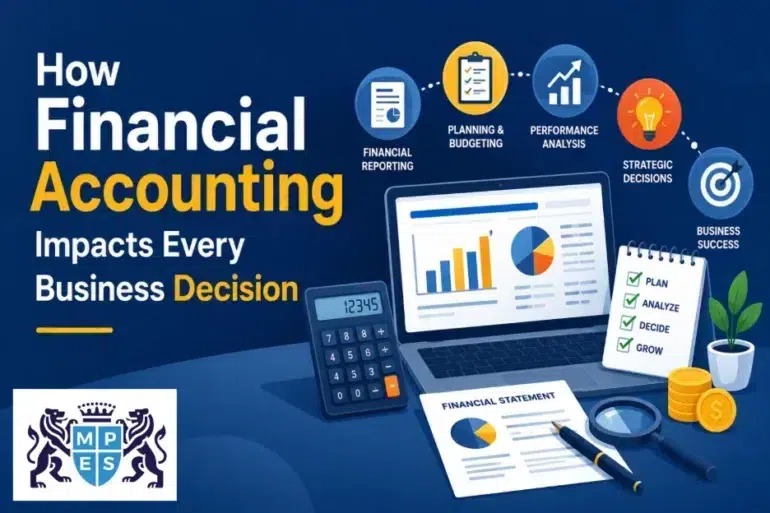
Have you ever wondered why some businesses grow confidently while others struggle with financial confusion? Every successful company depends on proper financial planning and accurate records to make decisions. Professionals studying Financial Accounting (FFA) often learn how businesses use financial information to improve profits.
Understanding Financial Accounting helps organisations control expenses and make informed business choices. From budgeting to investment planning, it supports every important business activity. It gives managers the confidence to make clear decisions with less uncertainty. In this blog, you will explore how Financial Accounting shapes smarter business choices and long-term success.
Ways Financial Accounting Improves Business Decisions
The following ways explain how this accounting supports smarter planning, stronger control, and better business performance:
Financial Reporting Builds Better Transparency
Businesses can better understand their revenue, costs, and profits with the aid of financial reporting. Before making critical decisions, managers assess firm performance using reports.
Additionally, accurate reports increase stakeholder and investor trust. For this reason, this accounting is crucial to the success of businesses.
Budget Planning Supports Smarter Spending
Businesses may effectively manage resources and prevent wasteful spending by using budget planning. It provides managers with a clear financial path for upcoming tasks.
Strong budgets help businesses deal with financial difficulties more skilfully. In order to make better decisions, learners learning Financial Accounting (FFA) frequently investigate budgeting techniques.
Cash Flow Management Improves Stability
Cash flow management monitors the inflow and outflow of funds from a company. Inadequate financial management can cause issues for even successful businesses.
This procedure aids companies in making timely payments to suppliers, employees, and operating expenses. Every day, financial stability is supported by effective cash flow management.
Profit Analysis Helps Business Growth
Businesses can assess their financial success after deducting expenses by using profit analysis. Managers utilise this data to enhance their price, service, and product offerings.
Knowing profits helps businesses grow in the future. This demonstrates the usefulness of this accounting.
Cost Control Increases Operational Efficiency
Businesses can increase productivity and cut waste by controlling costs. Supervisors are able to spot wasteful spending and concentrate on productive endeavours.
This approach promotes long-term corporate stability and increases financial efficiency.
Investment Decisions Become More Accurate
Accounting data is frequently used by businesses prior to making investment decisions. Managers can accurately assess risks and potential possibilities with the use of financial records.
Professionals studying Financial Accounting (FFA) are aware of how financial insights facilitate more intelligent corporate planning and investments.
Tax Planning Supports Better Compliance
Tax planning assists businesses in effectively calculating taxes and avoiding fines. Additionally, it keeps companies financially stable all year long.
Effective tax management lowers financial stress and enhances reputation.
Performance Evaluation Encourages Better Results
Businesses can monitor their operational and financial progress with the use of performance evaluation. To determine strengths and weaknesses, managers compare the company’s objectives with its current performance.
This approach promotes improved departmental business planning and ongoing improvement.
Risk Management Reduces Financial Uncertainty
Businesses can spot hazards before they become significant issues by using financial records. Accounting data is used by managers to prepare for unpredictable market conditions.
Effective financial planning enables companies to act swiftly in challenging circumstances. This demonstrates the importance of this accounting for long-term company management.
Financial Forecasting Improves Future Planning
Businesses can estimate future revenue, costs, and expansion prospects with the aid of financial forecasting. These insights are used by managers to create more effective financial plans.
This approach lowers uncertainty and facilitates long-term decision-making for company expansion.
Credit Management Supports Better Cash Recovery
Credit management assists companies in monitoring client payments and minimising late invoicing. It facilitates steady financial operations and enhances cash collection.
The risk of monetary losses and unpaid debts is also decreased by effective credit management.
Conclusion
Every business decision becomes stronger when supported by accurate financial information. From budgeting to risk management, this accounting helps organisations improve financial control. Businesses that understand financial records can make faster and better decisions during changing market conditions.
Professionals studying Financial Accounting (FFA) often develop practical financial skills that improve career opportunities and business understanding. With support from MPES Learning, professionals can strengthen their accounting knowledge and build practical expertise for smarter business decision-making.