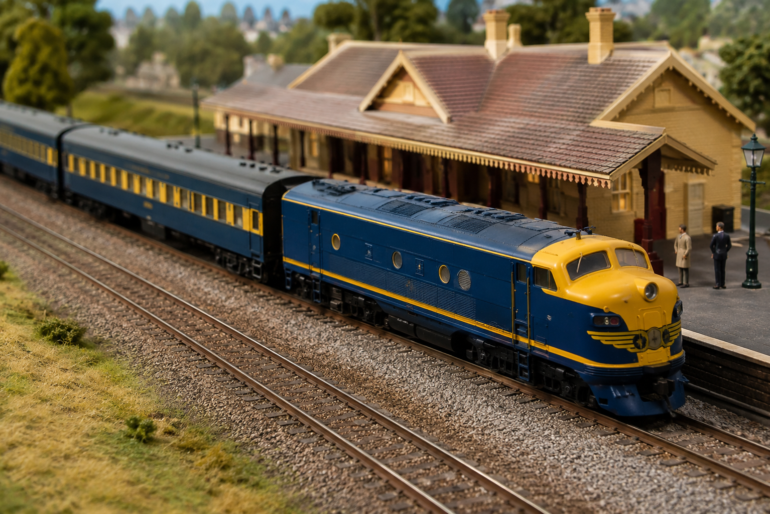
Victorian Railways Models are more than small train replicas sitting on a shelf. For many collectors, they are miniature pieces of Australian transport history, shaped by real locomotives, classic liveries, country stations, freight wagons, passenger cars, and the long railway story of Victoria. Whether someone is building a detailed model railway layout or simply collecting display pieces, these models carry a strong mix of nostalgia, craftsmanship, and historical value.
The appeal is easy to understand. A well-made Victorian Railways locomotive model can remind people of steam-era travel, regional freight lines, old station platforms, or the famous blue and gold designs that many rail fans still recognize today. It is not just about trains. It is about memory, engineering, and the charm of a railway system that shaped communities across Victoria.
For beginners, the world of Victorian Railways Models can feel a little confusing at first. There are scales, gauges, brands, liveries, eras, materials, limited editions, and layout choices to think about. But once you understand the basics, collecting becomes much easier and much more enjoyable.
What Are Victorian Railways Models?
Victorian Railways Models are scale replicas based on the trains, locomotives, rolling stock, stations, and railway equipment used by Victorian Railways in Australia. Victorian Railways operated as the state-owned railway operator in Victoria from 1859 until 1983, later trading as VicRail from 1974.
These models may include steam locomotives, diesel locomotives, passenger carriages, freight wagons, guards vans, station buildings, signal boxes, bridges, and railway accessories. Some are made for active model railway layouts, while others are created mainly for collectors who prefer display cases.
The most popular pieces often reflect real Victorian railway history. Collectors may look for models based on classic locomotive classes, country branch line rolling stock, suburban railway equipment, or famous passenger services. The attraction is not only the shape of the model but also the story behind it.
A model can represent a working locomotive from the steam age, a diesel unit from the mid-century modernization period, or a carriage that once served regional passengers. That historical connection gives Victorian Railways Models a deeper emotional value than ordinary toy trains.
Why Victorian Railways Models Are So Popular
The popularity of Victorian Railways Models comes from a few strong reasons. First, they connect directly to Australian rail heritage. Victoria’s railway network played a major role in linking towns, moving goods, supporting agriculture, and shaping travel across the state.
Second, the designs are visually attractive. Victorian Railways had several memorable liveries, from early steam-era finishes to the later blue and gold scheme. For collectors, a shelf filled with these models can feel like a timeline of transport history.
Third, model railways are hands-on. Many hobbies are passive, but railway modelling gives people something to build, adjust, repair, paint, wire, research, and improve. That makes it rewarding for people who enjoy both history and craftsmanship.
There is also a strong community around model trains. Collectors often share layout photos, trade spare parts, attend railway exhibitions, visit heritage railways, and discuss small details that casual viewers may never notice. A single model can start a conversation about a locomotive class, a route, a town, or a childhood memory.
A Brief Look at Victorian Railways History
To understand why these models matter, it helps to know a little about the real railway system behind them. Victoria’s first railway lines were built in the 1850s by private companies. Over time, financial problems led to government takeover, and Victorian Railways became the main railway operator in the state.
Victorian Railways operated a wide range of services, including passenger trains, freight trains, suburban rail services, and regional lines. It also had branches responsible for rolling stock, way and works, traffic, electrical engineering, and administration.
The railway system was not just about transport. Heritage Victoria notes that railways helped shape economic development, settlement, industry, tourism, and daily life across the state.
This rich background is one reason collectors value Victorian Railways Models. They are not random replicas. They often represent real engines, routes, services, and periods that influenced how people moved, worked, and lived.
Common Types of Victorian Railways Models
Collectors can choose from many different model types. Some people focus on locomotives. Others prefer complete train sets, freight wagons, passenger coaches, or scenic layout pieces.
Locomotive Models
Locomotives are usually the centerpiece of a collection. Steam locomotives attract people who love early railway history, exposed wheels, tenders, smoke boxes, and old mechanical charm.
Diesel locomotives are also popular, especially those connected with the post-war modernization period. The Victorian Railways B class, introduced in the 1950s, is often remembered as an important step in diesel mainline operations.
Electric and suburban models may appeal to collectors who prefer Melbourne rail history or later operating periods. These models often suit layouts based on urban stations, commuter lines, and electrified routes.
Passenger Carriages
Passenger carriages add realism and story to any layout. A locomotive alone looks impressive, but a full passenger consist feels alive. Collectors may choose carriages based on a specific era, route, or livery.
Some collectors prefer country passenger trains. Others like long-distance services with a more polished appearance. The key is matching the carriage style with the locomotive and period.
Freight Wagons
Freight wagons are ideal for layout builders because they create variety. Victorian Railways carried agricultural goods, timber, livestock, minerals, parcels, and general freight. That means a freight collection can include open wagons, vans, tankers, flat wagons, and brake vans.
Freight wagons also allow collectors to build realistic small scenes. A goods yard, siding, loading dock, or country station can look very convincing with the right wagons in place.
Station Buildings and Trackside Details
Not every valuable model has wheels. Station buildings, signal boxes, water towers, platforms, loading sheds, signs, fences, and bridges can completely change the mood of a layout.
These details help turn Victorian Railways Models into a full railway world. A small country platform with a goods shed and a waiting passenger can tell a stronger story than a locomotive sitting alone.
Popular Scales for Victorian Railways Models
Scale is one of the first things a collector should understand. A scale tells you how much smaller the model is compared to the real train.
HO scale is one of the most common model railway scales internationally, often listed as 1:87. O scale is larger, commonly around 1:48, which gives more detail but needs more space.
OO scale is also common in the UK, Australia, and New Zealand, although it has different proportions from HO.
For many collectors, HO scale offers a good balance. It is detailed enough to look realistic but compact enough for home layouts. Larger scales can be beautiful for display, but they require more room and often cost more.
Simple Scale Comparison Table
| Scale | Common Appeal | Best For |
|---|---|---|
| HO Scale | Popular, detailed, space-friendly | Home layouts and broad collections |
| OO Scale | Familiar in Australia and UK-style modelling | Collectors with compatible rolling stock |
| O Scale | Larger and highly detailed | Display pieces and spacious layouts |
| N Scale | Smaller and compact | Large layouts in limited space |
Choosing a scale is not only about size. It also affects track, buildings, vehicles, figures, scenery, and storage. Mixing scales usually makes a layout look unrealistic, so it is better to choose one main scale before buying too many pieces.
What Makes a Victorian Railways Model Collectible?
Not every model has the same value. Some are common, while others become highly desirable because of quality, rarity, condition, or historical interest.
A collectible model usually has one or more of these qualities:
- Accurate design based on a real Victorian Railways locomotive or carriage
- Limited production run
- High-quality materials and detailing
- Original packaging and paperwork
- Strong paint finish and correct livery
- Smooth running performance
- Connection to a famous train, route, or era
- Good condition with no missing parts
Collectors often care deeply about details. A small difference in numbering, paint shade, logo placement, roof color, or wagon lettering can matter. For casual buyers, that may seem excessive. For serious train enthusiasts, it is part of the fun.
Buying Victorian Railways Models: What to Check First
Before buying Victorian Railways Models, it is smart to slow down and check a few things. The prettiest model is not always the best purchase.
Start with condition. Look for broken handrails, missing couplers, cracked plastic, damaged wheels, faded decals, loose parts, and poor repainting. If buying online, ask for clear photos from multiple angles.
Next, check the running quality if it is a powered locomotive. A model may look perfect but run poorly. Listen for grinding sounds, uneven movement, weak pickup, or hesitation on curves.
Also check whether the model matches your chosen scale and track system. This is especially important if you plan to run it on a layout rather than display it.
Packaging matters too. Original boxes can improve collectibility because they protect the model and help confirm its identity. A boxed model is often easier to store, sell, or trade later.
New Models vs Pre-Owned Collectibles
Both new and pre-owned Victorian Railways Models have benefits.
New models usually come with better packaging, cleaner paintwork, modern motors, digital-ready features, and fewer condition worries. They are good for beginners who want reliability.
Pre-owned models can be more interesting for collectors. Some older releases are no longer available, and certain limited editions may only appear on the second-hand market. However, pre-owned buying needs more care.
A second-hand model may have been modified, repaired, repainted, or heavily used. That is not always bad. Some custom work is excellent. But buyers should know exactly what they are getting.
A good rule is simple: buy new for worry-free running, and buy pre-owned when you are looking for rare, discontinued, or historically interesting pieces.
Displaying Victorian Railways Models at Home
A strong collection deserves a good display. Keeping models in boxes is safe, but it does not let you enjoy them every day.
Glass display cabinets are popular because they protect models from dust while keeping them visible. Wall-mounted shelves can also work well, especially for locomotives and short rolling stock sets.
Try to avoid direct sunlight. Over time, sunlight can fade paint, decals, and packaging. Dust is another problem. Fine details like handrails, vents, and buffers can be fragile, so cleaning should be gentle.
For display, group models by era, color scheme, locomotive type, or service style. For example, you could create one shelf for steam, one for diesel, and one for passenger carriages. This makes the collection feel organized rather than crowded.
Building a Layout Around Victorian Railways Models
A layout brings Victorian Railways Models to life. Instead of sitting still, the trains move through stations, sidings, yards, bridges, tunnels, and countryside scenery.
A good layout does not need to be huge. Even a small shelf layout can capture the feel of a Victorian country station. A short platform, goods shed, water tank, signal, dirt road, and a few freight wagons can create a convincing scene.
For a larger layout, think about the story first. Are you modelling a rural branch line? A busy freight yard? A suburban station? A heritage railway scene? The answer will guide your track plan, buildings, rolling stock, and scenery.
Real-World Layout Scenario
Imagine a small rural Victorian station in the late steam or early diesel era. A passenger train waits at the platform. A freight wagon sits near the goods shed. A few people stand beside a timber fence. The track curves into open countryside.
This kind of layout does not need expensive complexity. It needs careful choices. The right locomotive, matching wagons, natural scenery, and a believable station building can make the whole scene feel authentic.
That is the real joy of railway modelling. You are not just placing objects. You are building a moment in time.
How to Care for Model Trains Properly
Proper care keeps a collection looking good and running well. Model trains are small machines, and even display pieces can suffer from dust, humidity, and rough handling.
For powered locomotives, clean the wheels regularly. Dirty wheels can cause poor electrical contact and jerky movement. Track cleaning is just as important because dust and oxidation affect performance.
Store models in dry conditions. Moisture can damage boxes, metal parts, decals, and electrical components. If you live in a humid area, silica gel packets in storage boxes can help reduce moisture.
Handle models by the body or frame, not by fragile details. Tiny handrails, steps, pipes, and mirrors can break easily. When moving a model, use both hands and work over a soft surface.
Common Mistakes New Collectors Make
New collectors often get excited and buy too many random pieces too quickly. That can lead to a collection that feels messy and hard to organize.
One common mistake is mixing incompatible scales. Another is buying locomotives without checking whether they match the existing track or controller system.
Some beginners also ignore era consistency. A steam-era locomotive, a modern diesel, and mismatched carriages can look strange together if the goal is realism. Of course, collectors can buy whatever they enjoy, but layouts usually look better when they follow a clear theme.
Another mistake is focusing only on locomotives. Locomotives are exciting, but wagons, coaches, buildings, signals, and scenery create the full railway atmosphere.
Are Victorian Railways Models Good Investments?
Victorian Railways Models can hold or increase value, especially rare, boxed, limited-edition, or high-quality pieces. However, they should not be treated like guaranteed investments.
The market can change. A model that is rare today may become less valuable if a new improved version is released. Condition also makes a big difference. A damaged or incomplete model may lose value quickly.
The best approach is to collect what you genuinely enjoy. If a model increases in value later, that is a bonus. The real return comes from the pleasure of owning, displaying, researching, and running it.
That said, careful buying helps. Choose models with strong historical appeal, good detail, clean condition, and reliable brand reputation. Keep packaging safe. Avoid unnecessary modifications if collectibility matters to you.
Where Enthusiasts Usually Find These Models
Collectors may find Victorian Railways Models through hobby shops, railway exhibitions, online marketplaces, specialist forums, estate sales, collector groups, and model railway clubs.
Railway exhibitions are especially useful because buyers can see models in person. They can compare details, ask questions, and meet people who understand the hobby.
Online buying gives more choice, but it requires caution. Always check seller photos, descriptions, return rules, and feedback. If a model is expensive, ask specific questions before paying.
Model railway clubs can also be valuable. Members often know which models are accurate, which brands run well, and which pieces are difficult to find. For a beginner, that advice can prevent costly mistakes.
Tips for Choosing Your First Victorian Railways Model
Your first model should match your goal. If you want to build a layout, choose a reliable locomotive in a common scale. If you want a display piece, choose the model that visually connects with you most.
A good beginner choice is usually:
- A popular locomotive class
- A matching set of carriages or wagons
- A common scale such as HO
- A model in clean condition
- A piece with easy spare parts or support
- A design connected to a clear historical era
Do not worry about owning everything at once. A thoughtful collection built slowly often feels better than a large collection bought without direction.
Why Details Matter So Much
Details are what separate a simple toy from a serious model. The shape of the cab, the number placement, the livery, the wagon lettering, the wheel arrangement, and the roof details all contribute to authenticity.
For Victorian Railways Models, details can also show the difference between eras. A locomotive in one livery may represent a different decade from the same locomotive in another finish. That matters when building a historically believable layout.
Small details also create emotional realism. A weathered freight wagon looks like it has worked hard. A clean passenger carriage suggests a cared-for express service. A faded station sign can make a layout feel lived-in.
Best Collecting Themes for Victorian Railways Models
A themed collection is easier to build and more enjoyable to display. Instead of buying random models, choose a direction.
Popular themes include:
- Steam-era Victorian Railways
- Diesel transition period
- Blue and gold livery collection
- Country branch line layout
- Passenger service collection
- Freight yard collection
- Melbourne suburban rail theme
- Heritage railway-inspired display
- Station and infrastructure modelling
Themes also help control spending. When you know your focus, it becomes easier to say no to models that do not fit.
Frequently Asked Questions
Are Victorian Railways Models only for Australian collectors?
No. While they are especially popular with Australian railway fans, collectors from other countries also enjoy them because of their historical design, unique liveries, and connection to a major regional railway system.
What is the best scale for beginners?
HO scale is often a practical starting point because it offers a strong balance of detail, availability, and manageable size. It also works well for both small and medium home layouts.
Should I buy boxed models?
Boxed models are usually better for long-term storage and resale. Original packaging also helps protect fragile details and may increase collector appeal.
Can I run older models on a modern layout?
Sometimes yes, but it depends on the model, motor, wheels, couplers, and control system. Always check compatibility before placing an older locomotive on powered track.
Are limited-edition models worth buying?
They can be, especially if the model is accurate, well-made, and connected to a popular locomotive or era. Still, buy based on personal interest first, not only future value.
Conclusion
Victorian Railways Models offer something special for train enthusiasts. They combine history, craftsmanship, design, and personal memory in a way few collectibles can. A single locomotive can represent decades of transport development, while a complete layout can recreate the feeling of a real Victorian railway scene.
For beginners, the best path is to start simple. Choose a scale, pick a theme, learn the basic history, and buy carefully. For experienced collectors, the joy often comes from hunting rare pieces, improving layouts, and getting the details just right.
These models are not only about collecting trains. They are about preserving miniature stories from Australia’s railway history, one carefully chosen model at a time.