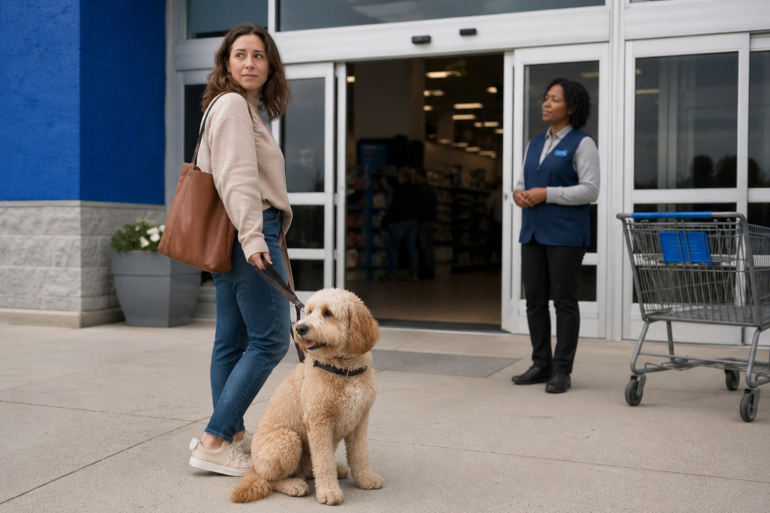
If you are trying to understand Walmart ESA Rules, the short answer is this: Walmart allows service animals as defined by the ADA, but emotional support animals are generally not treated the same way as service animals inside Walmart stores. Walmart’s own public policy says the company welcomes service animals as defined by the Americans with Disabilities Act, but it does not allow pets in its stores.
That can feel confusing, especially because emotional support animals can be extremely important to their owners. Many people rely on them for comfort, anxiety relief, emotional grounding, or daily stability. But under federal public access rules, emotional support is not the same as trained service work.
So, can you bring an emotional support animal inside Walmart?
In most cases, no. A true ADA service animal may enter Walmart. A pet or emotional support animal usually may not.
What Walmart ESA Rules Mean for Shoppers
The phrase Walmart ESA Rules usually comes up when someone has an emotional support dog, cat, or another animal and wants to know whether they can take it inside the store while shopping.
Walmart is not a pet-friendly store in the same way some outdoor shops, farm supply stores, or local boutiques may be. It is a major retail space that sells groceries, pharmacy products, clothing, household items, and personal care goods. Because of food safety, customer safety, and store policy concerns, Walmart limits animal access.
The key point is simple:
Walmart allows service animals.
Walmart does not allow regular pets.
Emotional support animals are usually not considered service animals under the ADA.
That difference matters because public stores in the United States follow ADA rules for service animals. The ADA says service animals are working animals trained to do specific tasks for a person with a disability. Dogs whose only role is comfort or emotional support do not qualify as service animals under ADA rules.
This is where many misunderstandings happen. An ESA letter may help in certain housing situations, but it does not automatically give the animal public access rights in places like Walmart.
Walmart ESA Rules vs Service Animal Rules
To understand Walmart ESA Rules, you have to separate three common terms: pet, emotional support animal, and service animal.
A pet is an animal kept for companionship.
An emotional support animal provides comfort, emotional stability, or calming support.
A service animal is trained to perform specific work or tasks directly related to a person’s disability.
Under ADA guidance, service animals are not required to wear a vest, carry a certificate, or complete a particular professional training program. At the same time, emotional support or comfort animals are not service animals just because they help someone feel better emotionally.
Here is a simple comparison:
| Animal Type | Usually Allowed Inside Walmart? | Why |
|---|---|---|
| Pet dog | No | Walmart does not allow pets in stores |
| Emotional support dog | Usually no | Comfort alone is not ADA service work |
| Service dog | Yes | Protected under ADA public access rules |
| Psychiatric service dog | Yes, if task-trained | Must perform trained disability-related tasks |
| Cat, bird, reptile, or other ESA | Usually no | Not recognized as ADA service animals for store access |
This does not mean emotional support animals are not valuable. It means the law treats them differently from task-trained service animals in public businesses.
What Counts as a Service Animal at Walmart?
A service animal is not defined by how it looks. It is not defined by a vest, badge, online certificate, or special leash. It is defined by training and function.
A service animal must be trained to perform a task for a person with a disability. That task has to be directly connected to the person’s disability.
Examples may include:
Helping a person who is blind navigate a store.
Alerting a person who is deaf to sounds.
Pulling a wheelchair.
Retrieving dropped items.
Alerting someone before a seizure.
Interrupting harmful behavior during a psychiatric episode.
Guiding a person with balance or mobility issues.
A psychiatric service dog can be a real service animal if it is trained to perform specific tasks. This is important because people sometimes confuse psychiatric service dogs with emotional support animals.
For example, a dog trained to interrupt panic attacks, create space during PTSD symptoms, or remind a handler to take medication may qualify as a service animal if the tasks are directly related to the handler’s disability.
But a dog that makes someone feel calmer simply by being present is usually considered an emotional support animal, not a service animal.
That is the heart of Walmart ESA Rules. Emotional support alone usually does not create store access rights.
Are Emotional Support Animals Allowed in Walmart?
In most Walmart stores, emotional support animals are not allowed inside unless the animal also meets the ADA definition of a service animal.
Walmart’s public policy is brief, but clear. It says Walmart welcomes ADA-defined service animals and does not allow pets in stores. Since emotional support animals are not considered service animals under ADA rules when their only function is comfort, they generally fall outside Walmart’s allowed animal policy.
That means an ESA letter, therapist note, online registration, ID card, or vest may not be enough.
Many shoppers assume that if they have paperwork, Walmart must allow the animal inside. That is not how ADA public access rules work. The ADA does not require service animals to have certification, and businesses generally cannot demand documentation for a legitimate service animal. But emotional support documentation does not turn an ESA into a service animal.
So, under Walmart ESA Rules, the question is not, “Do I have an ESA letter?”
The real question is, “Is this animal trained to perform a disability-related task recognized under ADA service animal rules?”
If the answer is no, Walmart can usually deny entry.
Why Walmart Does Not Treat ESAs Like Service Animals
Walmart stores are busy places. People shop with children, older adults, disabled customers, employees, food products, carts, and crowded aisles. A store policy has to balance accessibility with safety and cleanliness.
Service animals have legal protection because they perform trained work for a disabled handler. Emotional support animals may provide real emotional help, but they are not always trained for public behavior, crowd control, store noise, food areas, or unexpected contact with strangers.
That difference is one reason the ADA draws a line between service animals and emotional support animals.
A service dog should be under control. It should not bark repeatedly, jump on people, growl, run loose, block aisles unnecessarily, sniff food displays, or ride in a cart. Even a service animal can be removed from a business if it is out of control and the handler does not take effective action.
Walmart’s job is to allow legitimate service animals while keeping the store safe for everyone. That is not always easy for employees because they cannot simply ask personal medical questions or demand private documents.
What Walmart Employees Can Ask
Under ADA rules, when it is not obvious what service an animal provides, staff may ask two limited questions:
Is the animal required because of a disability?
What work or task has the animal been trained to perform?
They cannot ask about the person’s disability. They cannot require medical papers. They cannot demand a special ID card. They cannot ask the animal to demonstrate the task. ADA guidance makes clear that service animals are not required to be certified, professionally trained, or identified with a vest.
This protects people with disabilities from being forced to share private medical information in public.
But it also means Walmart employees have to rely on the ADA questions and the animal’s behavior.
If someone says, “This is my emotional support animal,” that may not satisfy Walmart’s service animal policy. If someone says, “This dog is trained to alert me before a medical episode,” that is a different situation.
The words matter because the legal category matters.
Common Mistakes People Make About Walmart ESA Rules
A lot of confusion comes from social media posts, online ESA registration websites, and people using different terms loosely. Here are some common mistakes.
Mistake 1: Thinking an ESA Letter Allows Store Access
An ESA letter may be relevant in some housing contexts, but it does not automatically give the animal the right to enter Walmart. Public stores follow service animal rules under the ADA.
Mistake 2: Buying an Online Vest or ID Card
A vest can help identify a working animal, but it does not create legal status by itself. A dog is not a service dog because it wears a vest. A dog is a service dog because it is trained to perform disability-related tasks.
Mistake 3: Calling Every Support Animal a Service Animal
This is risky and unfair to people with legitimate service animals. It can also create conflict with store employees. Emotional support and service work are not the same thing.
Mistake 4: Assuming Small Animals Are Always Allowed
Even a small dog in a purse or cart may be denied entry if it is not a service animal. Walmart’s policy is not based on size. It is based on ADA service animal status.
Mistake 5: Ignoring Animal Behavior
Even if an animal is a legitimate service animal, it must be controlled. Disruptive behavior can lead to removal from the store.
Real-World Scenario: ESA Dog at Walmart
Imagine a shopper named Sarah has anxiety and owns a small emotional support dog. The dog helps her feel calmer at home and during stressful days. Sarah has an ESA letter from a licensed mental health professional.
She walks into Walmart with the dog in a shopping cart. An employee asks whether the dog is a service animal required because of a disability. Sarah says, “No, he is my emotional support dog. I have a letter.”
In this situation, the employee may explain that Walmart allows service animals but does not allow pets or ESAs inside. Sarah may feel frustrated because the dog genuinely helps her, but Walmart’s policy is likely still enforceable.
Now imagine another shopper, David, has a psychiatric service dog trained to interrupt dissociative episodes and guide him to a safe area during symptoms. The dog walks beside him calmly and remains under control.
If an employee asks the two ADA questions, David can explain that the dog is required because of a disability and is trained to perform specific tasks. That animal is much more likely to fall under Walmart’s allowed service animal policy.
The difference is not whether the person has emotional symptoms. The difference is whether the animal is task-trained under ADA service animal standards.
Can Walmart Refuse an Emotional Support Animal?
Yes, Walmart can usually refuse an emotional support animal if the animal does not meet the ADA definition of a service animal.
This is one of the most important parts of Walmart ESA Rules. Emotional support animals are not automatically protected in public stores the way service animals are. Walmart’s policy states that service animals as defined by the ADA are welcome, while pets are not allowed.
An employee or manager may ask the allowed ADA questions. If the animal is described only as an ESA or comfort animal, Walmart may deny entry.
The situation may also depend on state or local laws, but federal ADA rules are the main standard most shoppers and stores refer to in public access situations. Some states have additional rules about service animals, misrepresentation, or public access, so local details can vary.
Still, for the average shopper asking about Walmart ESA Rules, the safest understanding is this: emotional support status alone does not guarantee Walmart access.
What About Psychiatric Service Dogs?
Psychiatric service dogs deserve special attention because people often misunderstand them.
A psychiatric service dog is not the same thing as an emotional support animal. A psychiatric service dog is trained to perform tasks for a person with a psychiatric disability.
Possible tasks may include:
Interrupting self-harming behavior.
Providing pressure therapy during a disability-related episode.
Alerting to panic symptoms.
Guiding the handler away from overwhelming surroundings.
Creating space between the handler and others.
Retrieving medication.
Reminding the handler to take medication.
These tasks are more than general comfort. They are trained responses to disability-related needs.
So, if a shopper has a psychiatric service dog that performs trained tasks, Walmart should treat that animal as a service animal under ADA rules. If the animal only provides comfort by being present, it is more likely considered an ESA.
This distinction is one of the biggest reasons Walmart ESA Rules can feel confusing. Two dogs may both help with anxiety, but only one may qualify as a service animal if it is task-trained.
Can a Walmart Employee Ask for Proof?
Generally, no. Walmart employees should not demand proof, medical records, certification, or an ESA letter for a service animal.
The ADA allows only limited questions when the service is not obvious. The business may ask whether the animal is required because of a disability and what task the animal is trained to perform.
That means a person with a real service dog does not have to show a certificate.
It also means a person with an emotional support animal cannot force access simply by showing ESA paperwork.
This creates a practical challenge. Some people misuse the service animal label. Others with real disabilities are unfairly questioned because employees or customers do not understand the law. A calm, respectful conversation is usually the best way to prevent the situation from escalating.
Are ESAs Allowed in Walmart Shopping Carts?
No animal should be placed in a Walmart shopping cart unless store management specifically allows it for a service-related reason, and even then it can raise hygiene concerns. Food carts are used by many customers, including families buying groceries.
The ADA does not require businesses to allow service animals to sit in shopping carts, chairs, or tables. ADA guidance says businesses are not required to allow a service animal to be seated in chairs or fed at tables in food service settings.
For Walmart shoppers, that means a service dog should normally remain on the floor, under control, and near the handler.
An emotional support animal in a cart is even more likely to create a policy issue because Walmart does not generally allow ESAs or pets inside.
What Happens If You Bring an ESA to Walmart?
If you bring an emotional support animal into Walmart, several things could happen.
An employee may say nothing.
An employee may ask whether the animal is a service animal.
A manager may ask you to remove the animal.
You may be told that Walmart allows only ADA service animals.
If the animal is disruptive, you may be asked to leave.
Some stores may enforce the policy more strictly than others, but that does not mean the rule changes. One location being lenient does not make ESAs officially allowed.
For example, a greeter may not notice a small animal in a carrier. Another store may stop the shopper at the entrance. A third store may respond only if another customer complains. Inconsistent enforcement does not equal permission.
The public policy remains focused on service animals as defined by the ADA.
Why Walmart ESA Rules Matter for Other Shoppers Too
Animal access rules are not only about one shopper and one animal. They affect many people inside the store.
Some customers have allergies.
Some children are afraid of dogs.
Some shoppers use mobility devices and need clear aisles.
Some service dogs may be distracted by untrained pets.
Some employees are responsible for food safety and customer complaints.
A poorly controlled ESA can create problems even when the owner has good intentions. Barking, lunging, sniffing food, riding in carts, or blocking checkout lanes can quickly turn a personal comfort issue into a public safety issue.
At the same time, legitimate service animal handlers often face suspicion because of people misusing ESA or service animal labels. Following the correct rules protects disabled shoppers who rely on trained service dogs every day.
Actionable Tips Before Visiting Walmart with an Animal
If you are trying to apply Walmart ESA Rules in real life, keep the situation simple and respectful.
If your animal is an emotional support animal only, plan to leave it at home or with someone you trust while you shop.
If your animal is a service animal, make sure it is under control before entering the store.
Be ready to answer the two ADA questions calmly if asked.
Do not place the animal in a shopping cart.
Avoid letting the animal sniff shelves, food displays, or other customers.
Leave the store if the animal becomes disruptive or overwhelmed.
Do not rely on online ESA badges, certificates, or vests as proof of store access.
These steps can reduce conflict and help protect access for people who truly need service animals.
Walmart ESA Rules and State Laws
Federal ADA rules are the main standard for service animals in public stores, but state laws may add extra details. Some states have penalties for misrepresenting a pet as a service animal. Others may have broader definitions in certain settings.
However, broader state protections do not always mean every ESA can enter every public store. Housing, air travel, restaurants, grocery stores, schools, and workplaces can all have different rules.
That is why shoppers should not assume that one type of ESA approval works everywhere.
For Walmart, the most reliable public answer is still based on Walmart’s policy and ADA service animal definitions. Walmart allows ADA-defined service animals and does not allow pets. Emotional support animals whose only role is comfort are not ADA service animals.
Frequently Asked Questions About Walmart ESA Rules
Can I bring my emotional support dog into Walmart?
Usually, no. An emotional support dog is not automatically allowed inside Walmart unless it is also a trained service animal under ADA rules.
Does Walmart allow service dogs?
Yes. Walmart says it welcomes service animals as defined by the ADA.
Can Walmart ask what my service dog does?
Yes, when the service is not obvious, staff may ask what work or task the animal has been trained to perform. They may also ask whether the animal is required because of a disability.
Can Walmart ask for my ESA letter?
An ESA letter does not guarantee access to Walmart. For service animals, businesses generally cannot require documentation, certification, or medical records.
Are emotional support cats allowed in Walmart?
Usually, no. Emotional support cats are not ADA service animals for public store access.
Can a psychiatric service dog enter Walmart?
Yes, if the dog is trained to perform specific disability-related tasks and remains under control.
Can Walmart remove a service animal?
Yes, in certain cases. A service animal may be removed if it is out of control and the handler does not control it, or if it is not housebroken.
Conclusion: Walmart ESA Rules Are Clearer Than They Seem
Walmart ESA Rules come down to one main difference: service animals and emotional support animals are not treated the same under ADA public access rules.
Walmart allows service animals as defined by the ADA, but it does not allow pets in stores. Emotional support animals may provide real comfort and emotional help, but comfort alone does not make an animal a service animal. The animal must be trained to perform specific disability-related work or tasks.
For shoppers, the best way to understand Walmart ESA Rules is to focus on function, not labels. A vest, letter, certificate, or online registration does not decide whether an animal can enter Walmart. Training, disability-related task work, and control inside the store matter far more.
This distinction also protects everyone involved: disabled shoppers who rely on trained service animals, employees trying to follow store policy, and customers who expect a safe shopping environment. In the bigger picture of public access, knowing the difference between an ESA and a service animal helps avoid confusion before you reach the store entrance.