Losing a tooth can change more than your smile. It can affect the way you chew, the way you speak, and even how confident you feel in everyday conversations. One option your dentist may discuss is a Cantilever Bridge Dental treatment. It is not the right fit for every case, but in the right situation, it can be a practical and attractive way to replace a missing tooth.
A Cantilever Bridge Dental restoration is a fixed dental bridge supported on only one side of the gap. That is what makes it different from a traditional bridge, which usually uses support from teeth on both sides. Because of that one sided design, this treatment has a very specific role in modern restorative dentistry. It can work well in carefully selected cases, especially when there is only one healthy support tooth next to the missing space and the bite forces are manageable. Clinical reviews and patient resources consistently note that cantilever designs are less strong than traditional bridges, which is why case selection matters so much.
If you are weighing your tooth replacement options, this article will walk you through how a Cantilever Bridge Dental restoration works, who may be a good candidate, the pros and cons, the procedure, aftercare, cost considerations, and how it compares with implants and partial dentures.
What Is a Cantilever Bridge Dental Restoration?
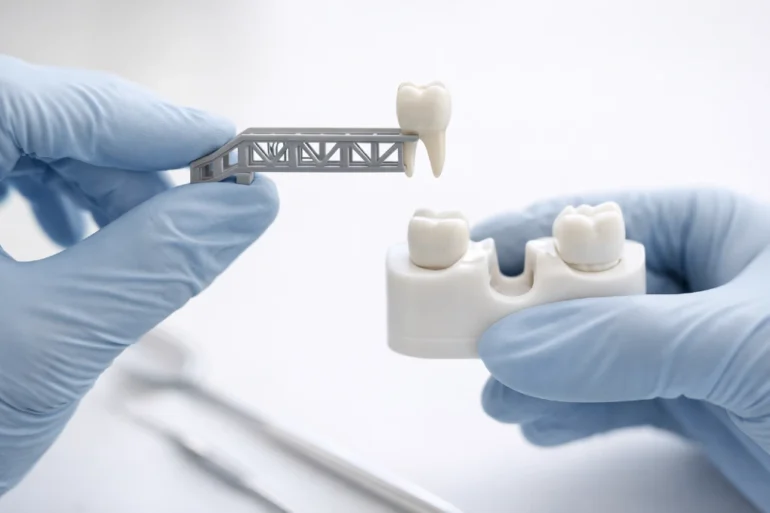
A Cantilever Bridge Dental restoration is a type of fixed partial denture. It uses one neighboring tooth, called the abutment tooth, to support an artificial tooth known as a pontic. In simple terms, the replacement tooth extends into the gap from one side only. Cleveland Clinic describes a cantilever bridge as similar to a traditional bridge, except the bridge is bonded on just one end instead of both.
That one detail changes everything.
Because the pontic is supported by just one side, the supporting tooth absorbs more leverage and pressure during biting and chewing. This is why a Cantilever Bridge Dental option is usually chosen more carefully than a standard bridge. Dentists often consider the size of the missing tooth, the location in the mouth, the health of the support tooth, and the patient’s bite pattern before recommending it. Reviews of fixed partial dentures show higher complication rates with cantilever designs than with conventional bridges over longer follow up periods.
Why Replace a Missing Tooth at All?
Some people delay treatment because a single missing tooth does not seem urgent. The problem is that an open gap can create issues that build slowly over time.
When a tooth is missing, nearby teeth may shift, your bite can change, and chewing may become less efficient. The American Dental Association notes that bridges replace missing teeth by spanning the gap, while MedlinePlus notes that when a tooth is lost, nearby teeth can drift into the space and affect the bite.
Replacing a missing tooth may help with:
- Restoring chewing function
- Improving speech in some cases
- Supporting a balanced bite
- Keeping neighboring teeth from drifting
- Restoring the appearance of the smile
- Making daily eating feel more comfortable
This is why a Cantilever Bridge Dental solution may be worth considering when the clinical situation supports it.
When Is Cantilever Bridge Dental a Good Option?
A Cantilever Bridge Dental approach is not the default choice for every patient. It tends to work best in selective situations rather than broad ones.
Dentists may consider it when:
- There is only one healthy natural tooth next to the empty space
- The supporting tooth is strong enough and well anchored
- The missing tooth is in an area with lighter biting pressure
- The patient wants a fixed solution without implant surgery
- A traditional bridge is not possible because there is no tooth on the other side of the gap
- Budget or medical factors make implants less practical
This matters because the one sided support creates more stress on the abutment tooth. Cleveland Clinic specifically notes that cantilever bridges are not as strong as traditional bridges. Long term evidence also shows that cantilever fixed partial dentures have meaningful complication rates over time, including loss of retention and issues affecting the support tooth.
In real world practice, a Cantilever Bridge Dental restoration is often considered more suitable for carefully selected front tooth replacements than for heavy load bearing back teeth. That pattern appears in clinical commentary and patient education because posterior teeth are exposed to stronger chewing forces.
When It May Not Be the Best Choice
There are situations where a Cantilever Bridge Dental restoration may not be ideal.
It may be a poor fit when:
- The support tooth already has large fillings, decay, or cracks
- You grind or clench your teeth
- The missing tooth is a molar or another high pressure chewing tooth
- Gum disease has weakened the surrounding support
- More than one tooth is missing in that area
- The bite creates excessive sideways force on the bridge
This is not about saying a cantilever bridge never works. It is about recognizing that success depends on smart planning. If the support tooth is compromised, the whole restoration becomes more vulnerable. Cleveland Clinic notes that if the abutment teeth are not strong enough, they can fracture, and poor cleaning can lead to inflammation or cavities around the bridge. Gum disease also weakens the structures that support teeth.
Pros of Cantilever Bridge Dental Treatment
A Cantilever Bridge Dental restoration can offer real advantages for the right patient.
1. It can replace a tooth when only one adjacent tooth is available
This is the main reason the treatment exists. If there is only one healthy neighboring tooth, a traditional bridge may not be possible. A Cantilever Bridge Dental design can solve that problem with a fixed restoration.
2. It is a fixed option
Many patients prefer something that stays in place rather than a removable partial denture. The ADA notes that a fixed bridge cannot be removed by the patient and functions as a permanent restoration.
3. It can be less invasive than implant surgery
Unlike a dental implant, a Cantilever Bridge Dental treatment does not require surgical placement into the jawbone. For some patients, that means a shorter path to tooth replacement, fewer appointments related to surgery, and less concern about bone grafting or healing after implant placement. Mayo Clinic notes that implant surgery is a surgical procedure that replaces tooth roots and may be chosen when there are not enough natural teeth to support bridgework.
4. It can improve appearance and confidence quickly
A properly designed bridge can restore the look of a complete smile, which matters a lot when the missing tooth is visible when talking or smiling. NHS and ADA resources both describe bridges as fixed replacements that can restore appearance and function.
Cons of Cantilever Bridge Dental Treatment
A balanced decision means looking honestly at the drawbacks too.
1. It is less strong than a traditional bridge
This is the biggest limitation. Because the bridge is anchored on one side only, the support tooth takes on more mechanical stress. That increases the chance of loosening, fracture, or long term wear.
2. It may not be ideal for back teeth
Back teeth handle heavier chewing loads. That is why many dentists are more cautious about recommending a Cantilever Bridge Dental restoration in posterior areas.
3. The support tooth usually needs preparation
Like other tooth supported bridges, a Cantilever Bridge Dental restoration often requires the adjacent tooth to be shaped for a crown. That means removing healthy tooth structure, which is one reason some patients prefer implants when appropriate. ADA and Cleveland Clinic sources both describe bridges as being supported by surrounding teeth.
4. It needs careful cleaning and maintenance
Plaque can collect around the bridge and under the pontic if the area is not cleaned well. That raises the risk of decay and gum problems around the supporting tooth.
Cantilever Bridge Dental vs Traditional Bridge vs Implant
Here is a simple side by side look at the main differences.
| Option | Support | Surgery Needed | Main Strength | Main Limitation |
|---|---|---|---|---|
| Cantilever bridge | One adjacent tooth | No | Useful when support exists on one side only | Higher stress on one abutment |
| Traditional bridge | Teeth on both sides | No | More balanced support | Requires two supporting sides |
| Dental implant | Jawbone | Yes | Replaces the root and does not rely on adjacent teeth | Higher cost and longer treatment timeline |
A Cantilever Bridge Dental option can be appealing when a patient wants a fixed solution and has just one possible support tooth. A traditional bridge is usually mechanically more stable because it distributes force across both sides. An implant, meanwhile, does not depend on neighboring teeth and acts as an artificial root placed into bone. Mayo Clinic describes implants as metal posts that replace tooth roots, while the ADA lists bridges and implants among options for replacing missing teeth.
That does not make one option universally better than the others. It makes each option suitable for different clinical realities.
What the Procedure Usually Looks Like
The process for a Cantilever Bridge Dental restoration usually happens over a few appointments, although digital workflows can vary from one practice to another.
Initial consultation
Your dentist examines the gap, checks the support tooth, evaluates the bite, and may take X rays or digital scans. The goal is to confirm whether one abutment tooth can safely handle the load.
Tooth preparation
If the support tooth is healthy enough, it is shaped to fit a crown that will anchor the bridge. This is the part many patients do not realize ahead of time. Even though only one tooth is being used for support, that tooth still needs precise preparation.
Impressions or digital scans
The dentist records the shape of your teeth so the lab can fabricate a custom bridge that fits your bite and smile.
Temporary restoration
In some cases, a temporary crown or temporary bridge is placed while the final restoration is made.
Final placement
Once the bridge is ready, the dentist checks the fit, appearance, and bite, then cements it into place. Small bite adjustments are often made at this stage to reduce excess force on the pontic and support tooth.
That final point matters more than many patients think. With a Cantilever Bridge Dental restoration, careful bite adjustment is part of protecting the long term result.
How Long Does a Cantilever Bridge Dental Bridge Last?
There is no universal number because longevity depends on design, materials, oral hygiene, bite forces, and the health of the support tooth. Still, evidence gives us a useful range.
A Canadian health technology review notes that fixed dental bridges often have an estimated longevity of around 10 years with adequate care. A long term systematic review of cantilever fixed partial dentures reported an estimated survival rate of 81.8% after 10 years, along with a lower complication free success rate.
That means a Cantilever Bridge Dental restoration can last for years, but it is not a set it and forget it treatment. Maintenance, cleanings, and early attention to bite problems can make a major difference.
Materials Used in Cantilever Bridge Dental Restorations
The materials can vary depending on where the tooth is located, the patient’s bite, and cosmetic priorities.
Common bridge materials include:
- Porcelain fused to metal
- All ceramic or porcelain
- Zirconia based restorations
- Metal or alloy based substructures in some cases
The ADA notes that bridges can be made from gold, alloys, porcelain, or a combination of materials. Material choice affects appearance, strength, and cost.
For visible front teeth, esthetics often lead the conversation. For stronger bite areas, durability matters even more.
Aftercare Tips That Actually Matter
A Cantilever Bridge Dental restoration can only perform as well as the support around it. Daily habits make a real difference.
Here is what helps most:
- Brush twice daily with fluoride toothpaste
- Clean under and around the bridge every day
- Use floss threaders, super floss, or interdental tools if your dentist recommends them
- Keep regular dental checkups and cleanings
- Avoid using the bridge to bite very hard foods if your dentist has warned you about force
- Ask about a night guard if you clench or grind
MedlinePlus recommends brushing twice a day with fluoride toothpaste and cleaning between teeth daily as core oral health habits. Cleveland Clinic notes that poor bridge hygiene can lead to inflammation or cavities around the bridge.
This is where many long lasting cases are won or lost. Good dentistry matters, but good maintenance matters too.
Common Questions Patients Ask
Does a Cantilever Bridge Dental bridge look natural?
Yes, it can. Modern dental materials can closely match the shape and shade of surrounding teeth. In visible areas, a well made bridge can blend in very naturally.
Is a Cantilever Bridge Dental bridge painful?
The treatment is usually done with local anesthesia during tooth preparation, so the procedure itself should be manageable. Mild soreness or sensitivity afterward is possible, especially around the prepared tooth, but it is typically temporary.
Can a Cantilever Bridge Dental bridge replace a molar?
It can in some cases, but many dentists are cautious because molars take heavy chewing forces. That is why this design is often considered more selectively in lower stress areas.
Is an implant better than a Cantilever Bridge Dental option?
Not automatically. An implant may preserve adjacent teeth because it does not rely on them for support, but it requires surgery, healing time, and usually higher cost. A Cantilever Bridge Dental restoration may be the better fit when surgery is not ideal, the anatomy is limiting, or only one support tooth makes the bridge design practical.
What can make a Cantilever Bridge Dental bridge fail?
Common issues include decay in the support tooth, gum disease, excess bite force, poor fit, poor hygiene, or fracture of the restoration. Long term reviews also report technical and biological complications over time.
A Realistic Way to Think About This Option
The best way to view a Cantilever Bridge Dental restoration is not as a universal fix, but as a targeted solution. In the right mouth, with the right support tooth and the right bite, it can be a smart and effective treatment. In the wrong situation, it can place too much stress on one tooth and create trouble later.
That is why the dentist’s evaluation matters more than the name of the treatment itself. A bridge that sounds simpler on paper is not always the stronger choice in practice. Long term outcomes depend on biomechanics, support, bite control, and maintenance just as much as they depend on the bridge itself.
If your dentist says you are a good candidate, a Cantilever Bridge Dental restoration may give you a fixed, natural looking replacement without implant surgery. If your case is borderline, it is worth asking how it compares with a traditional bridge, a partial denture, or an implant in terms of stress, lifespan, cost, and future repair needs.
In the end, the best tooth replacement option is the one that fits your anatomy, your bite, your budget, and your long term oral health goals. For some people, that really can be a Cantilever Bridge Dental solution. For others, a traditional or fixed bridge design or an implant may offer a more predictable path.
Conclusion
A Cantilever Bridge Dental restoration can be a useful option for replacing a missing tooth when there is only one suitable support tooth next to the gap. It offers a fixed alternative that can restore appearance and function without implant surgery, but it also comes with higher mechanical demands on the supporting tooth. That is why it tends to work best in carefully selected cases rather than as a one size fits all answer.
The key takeaway is simple. A Cantilever Bridge Dental option can work very well when the support tooth is strong, the bite is favorable, and the design is carefully planned. It needs thoughtful case selection, proper hygiene, and regular dental follow up. When those pieces come together, it can be a reliable and attractive way to replace a missing tooth.