Every woodworker knows the moment: you’re fitting a dovetail joint or inspecting a freshly sanded surface, and you find yourself leaning in, squinting, tilting the piece toward whatever light source happens to be nearby. Poor illumination isn’t just an annoyance—it’s a barrier to precision, a contributor to fatigue, and in many cases, a genuine safety hazard around sharp tools and spinning blades. So what is the best LED work light for woodworking? The answer isn’t a single product recommendation but rather a deeper understanding of what makes lighting effective for this specific craft. It comes down to measurable factors like light output, lumens for workshops, color quality, and how the fixture integrates into your workflow. In this guide, you’ll learn exactly how to evaluate these metrics and apply them to your shop. Whether you’re outfitting a dedicated furniture studio or upgrading a garage workspace, you’ll walk away with a clear, practical framework for choosing work lights that genuinely improve your results at the bench.
Why Proper Lighting is a Non-Negotiable in the Woodshop
The difference between a tight-fitting joint and a sloppy one often comes down to what you can actually see. When you’re cutting dovetails, routing inlays, or checking a surface for sanding scratches, your eyes need crisp, consistent illumination to detect variations measured in fractions of a millimeter. Shadows cast by overhead fluorescents or dim bulbs hide tearout, mask glue squeeze-out, and make layout lines nearly invisible against figured grain. The result isn’t just frustration—it’s wasted material and rework that eats into your shop time.
Poor lighting also takes a physical toll. Squinting under inadequate light triggers eye strain, tension headaches, and accelerated fatigue, all of which degrade your focus. In a space filled with table saws, routers, and chisels, diminished concentration becomes a safety liability. One momentary lapse near a spinning blade can have permanent consequences.
It’s important to distinguish between general shop lighting—the ambient overhead illumination that lets you walk around without tripping—and dedicated task lighting positioned at your workbench or machine station. General lighting fills the room; task lighting reveals the work. They serve complementary but entirely different purposes, and most shops underinvest in the latter.
Finally, consider color accuracy. Selecting complementary wood species for a tabletop, evaluating stain penetration, or judging the sheen of a freshly applied oil finish all demand light that renders colors faithfully. Under poor-quality lighting, cherry can look indistinguishable from mahogany, and a finish defect might not reveal itself until the piece reaches natural daylight. Superior lighting eliminates these costly surprises before they leave the shop.
Decoding Light Output: A Guide to Lumens for Workshops
Lumens measure the total quantity of visible light a source emits—think of it as the volume of brightness hitting your eyes and work surface. This is the number that actually matters when evaluating LED work lights, yet many woodworkers still instinctively reach for wattage as their benchmark. That habit is a holdover from incandescent bulbs, where watts and brightness scaled together predictably. With LEDs, a 20-watt fixture can easily outshine a 60-watt halogen, so wattage tells you about energy consumption, not useful illumination. Train yourself to read the lumen spec first and ignore wattage as a brightness indicator.
How many lumens do you actually need? The answer depends on what you’re doing and how large an area you’re lighting. For general ambient workshop illumination, industry guidelines suggest roughly 50 lumens per square foot, meaning a 200-square-foot shop needs around 10,000 lumens total from ceiling fixtures. But that broad wash of light won’t reveal a hairline tear-out on a routed edge. Task lighting operates on a different scale because it concentrates output onto a compact zone.
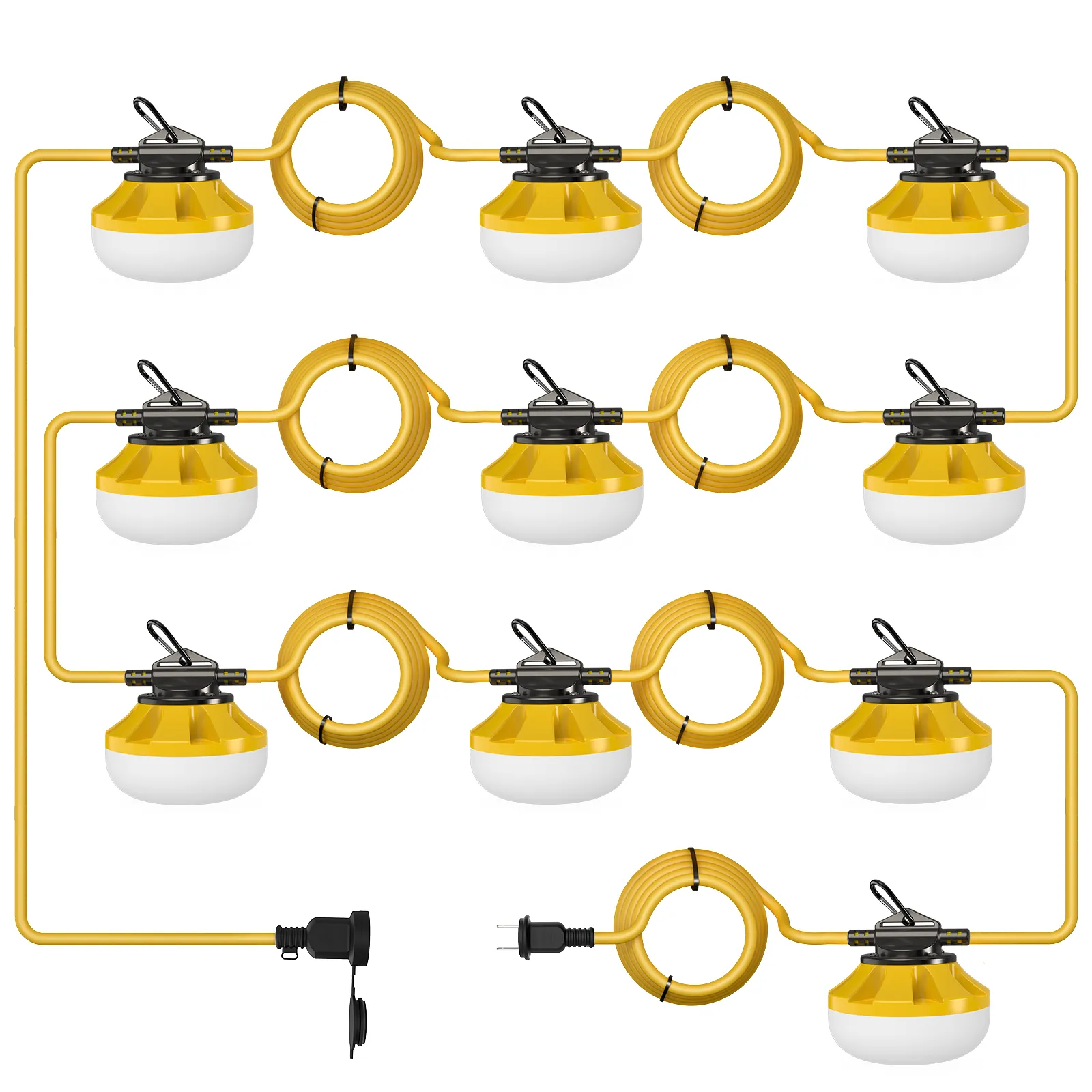
For general bench work like glue-ups, assembly, and layout, a fixture delivering 2,000 to 4,000 lumens positioned directly over your bench provides comfortable, clear visibility. Detailed tasks—hand-cut joinery, carving, fine sanding inspection—benefit from 1,000 to 2,000 or more lumens focused tightly on a small area, where intensity per square inch matters more than raw output. Machinery stations such as a table saw or bandsaw demand 3,000 to 5,000-plus lumens to eliminate shadows around blades, fences, and workpiece edges where your hands operate in close proximity to danger.
One feature that ties all these scenarios together is dimmability. A single high-output LED that dims smoothly lets you flood a station with light during rough milling, then dial back intensity when you’re inspecting a delicate finish coat and harsh glare would wash out surface details. Dimmable fixtures also reduce eye fatigue during long sessions by letting you match light levels to the natural light already entering your shop throughout the day. When comparing lights, prioritize models offering stepless or multi-step dimming rather than simple on-off operation—it’s a small specification that dramatically expands a fixture’s usefulness across your entire range of woodworking tasks.
Beyond Brightness: Essential Features for Woodworking LED Lights
Raw lumen count gets you only partway to great shop lighting. Color temperature, measured in Kelvin (K), determines whether light appears warm and yellowish or cool and bluish. For woodworking, the sweet spot falls between 4000K and 5000K—neutral to cool white. This range minimizes the amber cast that makes layout lines harder to read while avoiding the harsh, clinical blue tint above 6000K that causes eye fatigue during long sessions. Light in this band also reduces perceived shadows on textured surfaces, making grain irregularities and tool marks easier to spot.
Equally important is the Color Rendering Index, or CRI, which rates how faithfully a light source reveals the true colors of objects compared to natural sunlight. A CRI above 85 is acceptable; above 90 is where woodworkers notice a real difference. High-CRI lighting lets you distinguish walnut from wenge at a glance, evaluate how a stain interacts with grain, and catch inconsistencies in a finish coat before the piece leaves your shop. If you regularly work with figured or exotic species, treat CRI 90+ as a hard requirement rather than a luxury.
Beam angle dictates how light spreads from the fixture. A narrow spot beam of 30 degrees or less concentrates intensity on a small zone—ideal for inspecting joinery or carving details. A wide flood beam of 90 to 120 degrees washes an entire bench or machine table evenly, reducing harsh contrasts between lit and unlit areas. Many woodworkers benefit from owning both types and positioning them strategically.
Durability matters in a shop full of sawdust and vibration. Look for fixtures with aluminum or polycarbonate housings, impact-resistant lenses, and sealed construction that resists fine particle infiltration. Effective heat dissipation—usually finned aluminum heat sinks—extends LED lifespan and maintains consistent output over hours of continuous use. Manufacturers like Hyperlite design their lighting fixtures with robust thermal management and durable housings suited to demanding workshop environments. As for power, corded lights deliver uninterrupted output for fixed stations, while cordless models on lithium-ion batteries offer mobility for work inside carcasses, under furniture, or at temporary setups. If you choose cordless, prioritize battery platforms you already own to avoid accumulating incompatible chargers.
Mounting and Flexibility: Getting Light Exactly Where You Need It
A brilliant LED is useless if you can’t aim it precisely where your work demands. Magnetic bases offer instant repositioning on any ferrous surface—drill press columns, bandsaw tables, steel workbench frames—making them perfect for machine stations where lighting needs shift with each operation. Clamp mounts grip bench edges, shelf rails, or overhead supports, keeping the fixture secure without consuming workspace. For maximum reach and adjustability, articulating arms and gooseneck mounts let you sweep light across a broad arc and lock it at any angle, which proves invaluable when you need to rake light across a surface at a low angle to reveal sanding scratches or glue residue.
Overhead solutions deserve consideration for permanent stations. A ceiling-mounted track or rail system positions high-output bar lights directly above your primary bench, eliminating the clutter of stand-mounted fixtures while providing even, shadow-free coverage. Pair that ambient overhead layer with a flexible arm task light clamped at bench level, and you create a two-tier system where general visibility and focused detail illumination coexist without compromise. When evaluating any mounting system, test its stability under vibration—a light that drifts out of position every time you start the planer defeats its own purpose.
Choosing Work Lights: Breaking Down the Best Types for Your Shop
Each light form factor solves a different problem in the woodshop, and understanding where each excels helps you build a layered system rather than relying on a single fixture to do everything poorly.
Bar lights produce a linear wash of illumination that spreads evenly across wide surfaces, making them the natural choice for overhead mounting above workbenches and outfeed tables. Their elongated shape minimizes the concentrated hot spots that create distracting glare on freshly planed surfaces. The tradeoff is limited directional control—once mounted, they illuminate a fixed zone, so they work best as your ambient task layer rather than a precision tool.
Panel lights emit soft, diffused output that wraps gently around contours without casting hard shadows. This quality makes them exceptional for close-up detail work where you need to evaluate surface texture without harsh contrast obscuring subtle defects. They’re particularly useful near finishing stations where specular glare from a point source would mask runs or dry spots in a coat of varnish.
Gooseneck and flexible arm lights deliver ultimate adjustability. You can sweep them low across a board to rake light at a shallow angle—the single best technique for revealing sanding scratches, shallow dents, or uneven glue lines. Their repositioning speed makes them indispensable for hand-tool work where your sight line shifts constantly.
Magnetic base spot and flood lights thrive on machinery. Snap one onto your drill press column or bandsaw frame, reposition it in seconds when the operation changes, and tuck it away when the machine isn’t in use. They’re also ideal for illuminating the interior of a cabinet carcass during assembly.
Finally, headlamps and wearable lights guarantee that illumination follows your gaze. They shine inside deep mortises, underneath assembled furniture during glue-up inspection, and into any confined space where no fixed light can reach. Keep one charged and hanging near your bench—you’ll reach for it more often than you expect.
Your Action Plan: How to Select the Best LED Work Light
With all the technical knowledge in hand, here’s a practical decision framework that moves you from research to purchase with confidence.
Start by auditing your primary workspace. Walk through your shop and identify every station where you perform focused work—your main bench, each machine, your finishing area, and any assembly spots. Note which locations are permanent and which shift depending on the project. Fixed stations justify hardwired or clamped fixtures, while mobile needs call for cordless or magnetic-base options you can grab and reposition in seconds.
Next, prioritize your tasks honestly. A furniture maker spending hours hand-cutting joints needs high-CRI, adjustable-arm task lighting more urgently than a hobbyist who primarily does power-tool cuts and assembly. Identify where you spend the most time and where lighting frustrations cost you the most rework.
Then set your specification benchmarks. Based on the guidelines covered earlier, establish minimums: CRI 90+, color temperature between 4000K and 5000K, lumen output matched to each station’s demands, and non-negotiable features like dimmability or a specific mount type. Write these down so you can filter products objectively rather than being swayed by marketing.
Now choose the form factor. Your audit and task priorities will point clearly toward bar lights for overhead bench coverage, gooseneck arms for detail stations, magnetic spots for machinery, or some combination of all three.
Finally, consider the ecosystem. If you already own cordless tool batteries from a specific platform, seek lights compatible with that system. If you need three or four fixtures, buying within one family simplifies charging and ensures consistent light quality across your shop. Budget-wise, one excellent light at your primary bench delivers more immediate value than five mediocre fixtures scattered around the room. Start where you work most, validate the improvement, then expand systematically. Before clicking “buy,” confirm the fixture meets your written spec benchmarks, fits your chosen mount location physically, and includes a warranty that reflects confidence in build quality.
Better Light, Better Woodworking: Putting It All Together
The best LED work light for woodworking isn’t defined by a single brand name or the highest lumen count on a spec sheet. It’s the fixture—or more accurately, the system of fixtures—that delivers the right quantity and quality of light precisely where your hands and eyes meet the wood. The core principles are straightforward: sufficient light output matched to each station’s demands, high CRI and appropriate color temperature to reveal true colors and surface details, and mounting flexibility that lets you direct illumination exactly where the work requires it.
You now have a concrete framework for choosing work lights based on measurable criteria rather than guesswork. Audit your shop, define your priorities, set your specification benchmarks, and select form factors that address real gaps in your current setup. Approach the decision methodically, starting at the station where better light will yield the most immediate improvement in your results.
Upgrading your workshop lighting is one of the highest-return investments you can make. It won’t wear out like a blade or need replacing like sandpaper—it simply makes every subsequent hour at the bench more productive, more enjoyable, and meaningfully safer. Good light doesn’t just reveal the work; it elevates it.