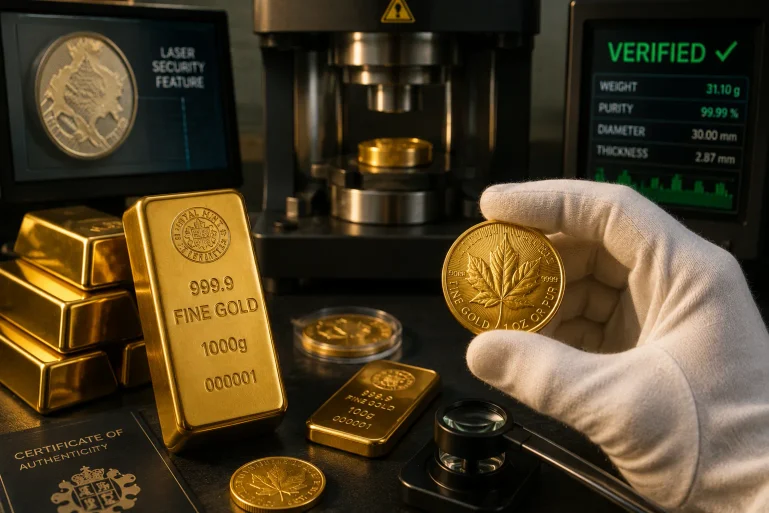
Gold may be ancient, but the products sold to today’s buyers are increasingly sophisticated.
A modern bullion coin can carry laser engraving finer than the naked eye can easily resolve, precisely machined radial lines and patterns built into its edge. A small gold bar may arrive sealed in tamper-evident packaging with an assay card identifying its weight and purity. Behind the familiar shine is a quiet technological contest between the world’s leading mints and those attempting to imitate their products.
For buyers, this has changed what it means to shop for physical gold. Design is no longer only decorative. Packaging is not merely presentation. Even the edge of a coin can contribute to its identity.
The range at Golden Eagle Coins offers a useful view of this modern bullion landscape, bringing together sovereign coins, minted bars and established refinery brands whose reputations are inseparable from trust.
Gold’s Value Creates a Security Problem
Gold has always attracted imitation because it concentrates substantial value in a small object. Counterfeiters have historically plated cheaper metals, altered genuine coins, created casts from original designs or manipulated bars to disguise a different interior.
Modern manufacturing technology makes accurate copies easier in some respects, but it also gives legitimate mints more powerful defences. Fine engraving, controlled dimensions, complex surface textures and database-linked verification are difficult to reproduce together with the correct metal content.
No single feature makes a product impossible to counterfeit. Security works in layers. Weight, dimensions, design detail, edge treatment, packaging, provenance and professional testing all contribute evidence.
This is why the seller matters as much as the product. A recognisable coin bought through an established precious-metals dealer enters the buyer’s hands with a more credible chain of custody than an apparently cheap piece from an anonymous marketplace account.
The Gold Maple Leaf’s Tiny Signature
The Canadian Gold Maple Leaf demonstrates how security can become part of a coin’s visual identity.
Modern examples use precisely engraved radial lines that spread across the coin’s fields. The Royal Canadian Mint also applies a micro-engraved textured maple leaf containing a small numeral corresponding to the coin’s year. The detail is produced with laser technology and designed to be difficult to duplicate accurately.
The Mint’s Bullion DNA programme adds another layer. Authorised dealers can use specialised equipment to capture and compare the coin’s security mark against encrypted information held by the Mint.
To an ordinary owner, the coin remains a clean and recognisable Maple Leaf. The security does not overwhelm the design. That is part of the achievement: advanced authentication features have been integrated into a bullion product without making it look like an identity card.
Golden Eagle Coins carries Canadian Gold Maple Leafs alongside other widely traded sovereign coins, allowing buyers to compare not only premiums and purity but also the different approaches mints take to recognition and security.
Why the Edge of an American Gold Eagle Matters
The edge of a coin is easy to overlook. Historically, reeding helped reveal clipping, where tiny amounts of precious metal were removed from the circumference. In modern bullion, the edge has gained a new anti-counterfeiting role.
The redesigned American Gold Eagle introduced an intentional variation in its reeded edge. This small interruption creates another specific detail for authenticators to examine. It joins the coin’s controlled weight, dimensions, alloy, relief and official design as part of a broader identity.
The U.S. Mint introduced the revised reverse design in 2021, replacing the long-running family-of-eagles image with a close portrait of a bald eagle. Buyers comparing earlier and later Gold Eagles must therefore understand that genuine coins can differ by type as well as year.
Golden Eagle Coins offers American Gold Eagles across dates and sizes, including one-ounce, half-ounce, quarter-ounce and tenth-ounce versions. Product knowledge matters here: a detail that would be correct for one date or type may be wrong for another.
Authentication is not simply spotting something that “looks unusual.” It means knowing what the genuine product from that particular year is supposed to look like.
Bars Have a Different Security Language
Gold bars do not have the issuing authority or legal-tender status of sovereign coins. Their trust rests on the refinery, physical specifications, markings, packaging and documentation.
Minted bars often arrive in sealed assay cards. The packaging may display the refinery, serial number, weight and purity while protecting the bar from handling. Tamper evidence can reveal that a package has been opened or replaced, although intact packaging should never be treated as absolute proof of authenticity on its own.
Golden Eagle Coins carries recognised bar brands such as PAMP Suisse, Perth Mint, Valcambi, Royal Canadian Mint and Sunshine Mint, as well as random-manufacturer options aimed at buyers prioritising lower premiums.
These choices represent different balances. A well-known branded bar in its original assay packaging may be immediately familiar to more buyers. A random-manufacturer bar can provide the same stated gold purity at a lower premium but offers less control over the exact brand or presentation received.
The correct choice depends on whether the buyer values cost efficiency, recognisability, packaging, design or future ease of resale.
Packaging Helps—Until It Is Treated as Proof
Protective packaging serves several useful purposes. It limits scratches and handling, presents product information and may incorporate tamper-evident features. For small minted bars, the assay card can be integral to the retail product.
The danger is assuming that convincing packaging guarantees genuine gold. Boxes, cards, holograms and printed serial numbers can themselves be copied. A buyer should judge the complete transaction: the dealer, manufacturer, product specifications and packaging together.
Opening a sealed bar at home is rarely a sensible first response to uncertainty. It may damage the packaging, reduce buyer confidence on resale and still fail to establish authenticity. If there is a genuine concern, the better route is to contact the dealer and, where necessary, have the product examined using appropriate non-destructive equipment.
Golden Eagle Coins displays product descriptions and images across its gold categories, helping customers understand whether a particular bar is expected to arrive in an assay card or whether a random-manufacturer product may vary.
Knowing what was promised is the starting point for checking what arrived.
Weight and Dimensions Are Necessary, Not Sufficient
Gold products are manufactured to defined specifications. A coin with the wrong weight, diameter or thickness deserves scrutiny. These basic measurements can expose crude imitations.
They cannot provide certainty on their own. Sophisticated counterfeiters may choose substitute metals or constructions intended to approach the correct weight and dimensions. Scales and callipers also need suitable accuracy, and careless measurement can damage a coin or produce misleading conclusions.
Visual checks have similar limitations. Blurred details, incorrect lettering, uneven reeding or poor colour may indicate a problem, but lighting, wear, photography and normal minting variation can confuse an inexperienced owner.
At-home checks are best understood as screening tools. They may reveal a reason to seek professional help, but they should not encourage owners to drill, cut, scratch or chemically test a valuable coin or bar.
Destructive testing answers the authenticity question by damaging the thing being authenticated. For bullion—and especially for collectible gold—that is a remarkably poor bargain.
Professional Testing Looks Beneath the Surface
Precious-metals professionals can draw on several non-destructive testing methods. Depending on the equipment and product, these may analyse electrical conductivity, ultrasonic behaviour, magnetic properties or surface composition using X-ray fluorescence.
Each method has limits. Surface analysis may not reveal the entire interior of a thick bar, while a technique effective for one format may be less useful for another. Strong authentication combines appropriate testing with accurate reference specifications and an understanding of the product’s design.
This is another reason established distribution channels matter. The goal is not to make every owner a laboratory technician. It is to reduce the likelihood of a questionable product entering the transaction and to provide a clear route for resolving concerns.
Buyers should retain invoices, product descriptions and packaging. Those records help establish provenance and can make future resale or professional examination more straightforward.
Recognisability Has Practical Value
Bullion buyers sometimes focus entirely on the lowest premium. Cost matters, but recognisability can also affect the ownership experience.
American Gold Eagles, Canadian Maple Leafs, South African Krugerrands, Austrian Philharmonics and American Gold Buffalos are familiar products with published specifications and established markets. Major gold-bar brands likewise provide known designs and packaging conventions.
That familiarity does not make counterfeiting impossible. Popular products are attractive targets precisely because people recognise them. However, it means dealers and professional buyers are more likely to know what authentic examples should look like and to have suitable reference information.
Golden Eagle Coins’ catalogue centres many of these widely recognised products while also offering historic and specialist gold. A new bullion buyer may prefer a standard modern coin or bar whose value is closely linked to gold content. A collector may accept additional complexity for a scarce date, proof finish or historic issue.
The more unusual the purchase, the more important specialised knowledge becomes.
Historic Gold Requires a Different Kind of Expertise
Modern bullion authentication asks whether a product matches current mint specifications. Historic gold adds questions of age, wear, alteration, cleaning, repair and numismatic grade.
A genuine pre-1933 U.S. gold coin can still be misrepresented. It may have been cleaned, mounted as jewellery, repaired or assigned an overly optimistic condition. Its value may depend on factors that have little to do with the daily gold price.
Golden Eagle Coins carries Liberty, Saint-Gaudens and other pre-1933 U.S. gold in multiple conditions. Buyers entering this category should distinguish bullion-grade historic pieces from coins carrying significant collector premiums.
Third-party certification can assist by providing an independent opinion of authenticity and grade, but buyers should still understand the certification service and verify the holder where appropriate. Even a plastic holder is part of the security chain rather than a magical guarantee.
The lesson is consistent across modern and historic gold: context matters.
A Secure Purchase Begins Before Checkout
Buyers can reduce risk before any money changes hands.
They should confirm the exact product, weight, purity, mint or refinery and expected packaging. They should compare the price with the live gold market and be wary of offers dramatically below normal bullion value. Payment, shipping, insurance, returns and cancellation terms deserve attention.
Golden Eagle Coins has operated since 1974, provides live precious-metal pricing and organises its gold inventory by coin series, country, bar size and product type. That makes it possible to compare options without relying on a generic listing that merely claims to contain gold.
After delivery, the buyer should examine the package promptly, follow any documented procedure for reporting problems and store the gold securely. Purchase records should be kept separately from the metal.
The process may sound less romantic than admiring a newly arrived coin, but good provenance begins with ordinary administrative discipline.
Trust Is Engineered, Layer by Layer
The security of modern gold does not come from one secret mark. It comes from a system.
Mints control dimensions and engraving. Refineries build reputations around purity and consistency. Packaging adds tamper evidence and product information. Dealers provide provenance and a route to address concerns. Professional equipment can test properties the eye cannot see. Owners preserve records and store products responsibly.
Golden Eagle Coins connects those layers by offering gold from recognised sovereign mints and established refiners through a specialist precious-metals marketplace.
The result is a curious marriage of old and new. Gold remains desirable for the same basic reason it has for centuries: people recognise the metal itself as valuable. Yet confidence in a specific modern coin or bar increasingly depends on laser marks, precision engineering, databases, packaging and disciplined distribution.
The shine catches the eye. The hidden technology earns the trust.
Explore gold coins and bullion bars available from Golden Eagle Coins.
This feature is for general informational purposes only and does not constitute investment, financial or authentication advice. Anyone concerned about a product’s authenticity should contact the seller or a qualified precious-metals professional.