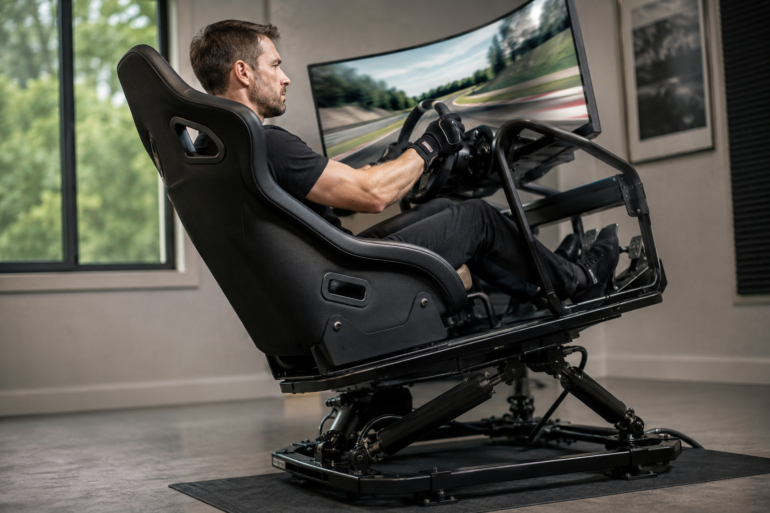
The Sigma Integrale DK2 Motion System is one of those upgrades sim racers start thinking about when a basic wheel, pedals, and cockpit no longer feel immersive enough. You can have a strong direct-drive wheelbase, load-cell pedals, a solid rig, and a beautiful triple-screen setup, but there is still one big thing missing: physical movement.
That is where motion systems come in.
Instead of only feeling force feedback through your steering wheel, a motion platform adds body feedback. You feel bumps, curbs, weight transfer, braking forces, acceleration cues, and track texture in a more physical way. For many serious sim racers, that changes the whole experience.
But the real question is simple: is the Sigma Integrale DK2 Motion System worth the money, space, and setup effort?
Let’s break it down in a realistic way.
What Is the Sigma Integrale DK2 Motion System?
The Sigma Integrale DK2 Motion System is a compact actuator-based motion solution designed for sim racing cockpits. It uses actuators to move your racing rig in response to what is happening inside the simulator.
According to Sigma Integrale, the DK2 system is built to offer strong at-home haptic performance in a smaller and more cost-effective design compared with its higher-end DK2+ and DK6+ systems. The DK2 has 2 inches, or 50mm, of actuator travel, while the DK6+ offers 6 inches, or 150mm, of travel.
That 50mm travel range is important. It does not try to throw you around like an amusement ride. Instead, it focuses on quick, controlled feedback that helps you feel what the car is doing.
For sim racing, that matters more than exaggerated movement.
A good motion system should not distract you. It should add information. When you hit a curb, lock the brakes, ride over uneven road surface, or lose rear grip, the motion system should make that moment easier to feel.
Why Motion Matters in Sim Racing
Sim racing has become much more serious over the last decade. Modern racing simulators are not just casual driving games. They model tire grip, suspension movement, fuel load, braking pressure, track surface, aerodynamics, and weather conditions.
The more realistic the software becomes, the more valuable physical feedback becomes.
A direct-drive wheel tells your hands what the front tires are doing. Load-cell pedals help your feet control braking pressure. But your body still stays still unless you add motion.
That is the gap the Sigma Integrale DK2 Motion System tries to fill.
Motion helps with:
- Feeling curb strikes
- Sensing brake dive
- Detecting traction loss
- Reading surface changes
- Feeling suspension movement
- Improving immersion during long races
- Making rally, GT, endurance, and open-wheel racing feel more alive
It is not only about fun. For some drivers, motion can also help consistency because the body gets more cues from the simulator.
Sigma Integrale DK2 Motion System Design and Build Quality
One of the biggest selling points of the Sigma Integrale DK2 Motion System is its physical construction. Retailer specs describe the system as being made from billet aluminum for better haptic transfer, with a 2-inch solid steel piston designed to handle side loading.
That kind of build matters because motion systems deal with repeated force. A sim racing rig moves hundreds or thousands of times during a session. Every bump, shift, curb, and braking zone creates small movements through the actuators.
A weak design would feel loose over time. A stronger actuator system keeps feedback sharper and more predictable.
The DK2 is also positioned as a lower-profile solution compared with some larger motion platforms. That is useful for home sim racers who want motion but do not want a huge industrial-looking setup in their room.
It is still a serious piece of hardware, though. This is not a casual add-on like a button box or LED strip. It becomes part of the core structure of your simulator.
Key Specs at a Glance
Here is a simple overview based on available product information from Sigma Integrale and specialist sim racing retailers.
| Feature | Sigma Integrale DK2 Motion System |
|---|---|
| Product type | Actuator-based sim racing motion system |
| Travel range | 2 inches / 50mm |
| Main use | Home and advanced sim racing rigs |
| Construction | Billet aluminum body, steel piston |
| Software | License-free software with updates |
| Maintenance | Designed for maintenance-free operation |
| Warranty info | Listed by retailers as 3-year electrical and 1-year mechanical warranty |
| Best for | Serious home sim racers who want physical feedback |
Apex Sim Racing lists the DK2 with license-free software, automatic over-the-air updates, and no lubrication requirement for maintenance-free operation.
That software point is worth noting. Motion hardware is only as good as the software controlling it. If the tuning is poor, even expensive actuators can feel unnatural.
How the DK2 Feels in Real Driving Scenarios
The best way to understand the Sigma Integrale DK2 Motion System is to think about how it behaves in common racing situations.
Braking Into a Corner
When you brake hard into a slow corner, a good motion system gives you a feeling of forward load transfer. You are not actually experiencing real G-force like in a race car, but the movement gives your body a cue that the car is slowing and pitching forward.
This can help your timing. You start to connect braking pressure, wheel input, and car balance more naturally.
Riding Over Curbs
Curbs are where motion systems really show their value. Without motion, you hear the curb, see the camera shake, and feel some vibration through the wheel.
With the DK2, the curb becomes physical.
You feel the rig react under you. That makes curb usage more intuitive, especially in GT racing where taking the right amount of curb can save time without unsettling the car too much.
Losing Rear Grip
When the rear of the car starts to rotate, motion can help make the moment more obvious. The DK2 can give subtle directional cues that support what your steering wheel and visuals are already telling you.
This does not magically make you faster. But it may help you catch slides earlier once you learn how the system communicates.
Rally and Rough Tracks
Rally driving benefits heavily from motion. Gravel, jumps, bumps, dips, and uneven roads feel much more alive with actuator movement.
Sigma describes its higher DK2+ system as being engineered for off-road racing, rally, and F1 simulations, while the DK2 shares the same general family concept with smaller and more cost-effective design goals.
For rally fans, the DK2 can make a home setup feel dramatically more engaging.
Sigma Integrale DK2 Motion System vs DK2+
Many buyers will compare the standard DK2 with the DK2+. The names are close, but the systems are aimed at slightly different needs.
The DK2 is the more accessible option. The DK2+ is the stronger premium 2-inch system.
Sigma Integrale states that DK2+ and DK6+ systems use larger motors with enhanced torque profiles. The company says that translates into more precise bump and curb feedback, quicker directional changes, and a smoother feel.
A retailer listing for the DK2+ notes that the DK2+ is a four-actuator premium 2-inch system designed for realism across rally, off-road, and F1-style simulations.
So who should choose which?
Choose the DK2 if:
- You want motion without going to the highest price tier
- Your rig is not extremely heavy
- You mostly race GT, touring cars, road cars, or mixed sim titles
- You want strong immersion in a home setup
- You prefer compact hardware
Choose the DK2+ if:
- You have a heavier cockpit
- You use a large direct-drive wheelbase
- You want stronger torque response
- You race rally or off-road often
- You want more headroom for future upgrades
For many home sim racers, the regular Sigma Integrale DK2 Motion System is likely the more sensible starting point.
Is the Sigma Integrale DK2 Motion System Good for Beginners?
For complete beginners, probably not.
That does not mean the product is bad. It simply means motion should not be the first upgrade for most people.
A beginner should usually focus on:
- A stable cockpit
- A good wheelbase
- Quality pedals
- Correct seating position
- Reliable display setup
- Basic sim racing technique
Once those pieces are already in place, motion becomes more meaningful.
If your wheel is weak, your pedals are inconsistent, or your rig flexes under braking, the DK2 will not fix those issues. In fact, motion may make weak parts more noticeable.
But if you already have a solid setup, the Sigma Integrale DK2 Motion System can feel like the missing layer of realism.
Setup Requirements and Space Considerations
Before buying any motion system, you need to think about your rig.
The DK2 is designed for sim racing cockpits, not casual desk setups. It needs a strong frame that can handle actuator movement safely and consistently.
You should consider:
- Whether your cockpit is compatible
- Total rig and driver weight
- Floor space
- Cable routing
- Power access
- Noise levels
- Screen placement
- Emergency stop access
- Room ventilation and comfort
A motion setup also changes how your monitors or VR experience feels.
If you use triple screens mounted separately from the rig, that can work well because the screens stay still while your seat and cockpit move. If your monitors are attached directly to the moving rig, you need to think carefully about stability and comfort.
VR users may find motion especially immersive, but it requires careful tuning. Too much motion can create discomfort. Subtle settings usually work better.
Software and Tuning: The Part People Underestimate
Hardware gets the attention, but software tuning decides whether a motion system feels realistic or silly.
A motion system should not exaggerate every event. If the rig jumps too much over every curb, it becomes tiring. If pitch and roll are too strong, you may feel like you are fighting the hardware instead of reading the car.
Sigma Integrale emphasizes the idea of “Motion Integrity” on its DK2+ listing, describing it as a focus on replicating vehicle dynamics without exaggerating pitch and roll.
That same philosophy is important for the DK2 too.
Good tuning should feel:
- Fast but not violent
- Detailed but not noisy
- Physical but not distracting
- Informative but not exaggerated
- Comfortable during long sessions
Most users should start with conservative settings. Then adjust slowly.
A common mistake is turning everything up on day one. That may feel exciting for five minutes, but it usually hurts realism.
Real-World Example: Upgrading From a Static Rig
Imagine a sim racer named Mark. He already has a profile aluminum cockpit, a direct-drive wheel, load-cell pedals, and a 49-inch ultrawide monitor.
His setup is strong, but something still feels flat. When he drives at Spa, he can see Eau Rouge rising. He can hear the curbs. He can feel steering force. But his body is still sitting in a chair.
After adding the Sigma Integrale DK2 Motion System, the car feels more alive. The compression through fast corners becomes physical. Curbs have texture. Heavy braking feels more intense. Rally stages become less like watching the car move and more like sitting inside it.
Does he instantly gain two seconds per lap?
No.
But he feels more connected. Over time, that connection can help him drive with more confidence and consistency.
That is the real value of motion.
Pros and Cons of the Sigma Integrale DK2 Motion System
No product is perfect. The DK2 has clear strengths, but it is not for everyone.
Pros
- Adds physical immersion to sim racing
- Compact compared with larger motion systems
- 50mm travel is enough for detailed haptic feedback
- Strong construction with billet aluminum design
- Works well for serious home racing rigs
- Can improve track feel, curb detail, and braking sensation
- Better value than higher-end motion systems for many users
Cons
- Expensive compared with non-motion upgrades
- Requires a strong compatible cockpit
- May need careful tuning
- Not ideal as a first sim racing purchase
- Space, wiring, and setup planning matter
- Heavier rigs may benefit more from DK2+
- Motion can feel unnatural if settings are too aggressive
The biggest drawback is not really performance. It is cost and readiness. You need the right rig, the right expectations, and enough experience to appreciate what the system adds.
Who Should Buy the Sigma Integrale DK2 Motion System?
The Sigma Integrale DK2 Motion System makes the most sense for sim racers who already take the hobby seriously.
It is a strong fit for:
- Dedicated sim racers
- Home cockpit owners
- GT and endurance racing fans
- Rally and road racing players
- Drivers who already own direct-drive wheels
- Users who want more immersion without a giant platform
- People building a long-term racing simulator
It is not the best fit for:
- Casual arcade racing players
- Desk-mounted wheel users
- People with flexible or weak cockpits
- Beginners still learning basic controls
- Buyers expecting real race car G-forces
- Anyone who dislikes tuning hardware settings
If you race once a month, the DK2 may be too much. If you race several times a week, it becomes much easier to justify.
Does It Make You Faster?
This is the question many sim racers secretly care about.
The honest answer: maybe, but do not buy it only for lap time.
Motion can help you feel the car better. That may improve consistency, especially in braking zones, curb usage, and traction recovery. But raw pace still comes from technique, practice, setup knowledge, and racecraft.
A skilled driver on a static rig will still beat an untrained driver with motion.
Where the Sigma Integrale DK2 Motion System helps most is immersion and feedback. If that deeper connection helps you practice longer, stay more engaged, and read the car better, then speed may follow naturally.
But it is not a shortcut.
Is It Worth It for Sim Racing?
For the right user, yes.
The Sigma Integrale DK2 Motion System is worth considering if your current setup already has the fundamentals covered. If you have a strong cockpit, direct-drive wheel, quality pedals, and a serious interest in racing simulation, the DK2 can add a level of physical realism that standard hardware cannot provide.
It is especially appealing because it focuses on compact, detailed haptic feedback rather than huge dramatic movement. That is the right direction for sim racing. Realism is not about being thrown around. It is about receiving useful cues at the right time.
Still, the value depends on your expectations.
If you want a fun luxury upgrade that makes every race feel more alive, the DK2 makes a strong case. If you are trying to build a budget sim racing setup, your money is better spent first on pedals, cockpit strength, and wheel quality.
Buying Tips Before You Decide
Before purchasing the Sigma Integrale DK2 Motion System, check these points carefully.
First, confirm cockpit compatibility. A motion system needs a rigid frame. Aluminum profile rigs are usually better suited than lightweight folding stands.
Second, check your total weight. Include the cockpit, seat, wheelbase, pedals, accessories, and driver. Weight affects actuator performance and long-term comfort.
Third, think about your display setup. Triple monitors, ultrawide screens, and VR all interact differently with motion.
Fourth, plan your cable management. Moving parts and messy cables are not a good mix.
Fifth, be patient with tuning. The best settings are usually not the strongest settings.
Common Questions About the Sigma Integrale DK2 Motion System
Is the Sigma Integrale DK2 Motion System only for professional racers?
No. It is mainly aimed at serious home sim racers and advanced enthusiasts. You do not need to be a professional driver, but you should already have a capable racing setup.
Does the DK2 work better with VR?
It can be very immersive with VR, but careful tuning is important. Too much motion may feel uncomfortable for some users. Start with gentle settings and increase slowly.
Is 50mm travel enough for sim racing?
Yes, 50mm can be enough when the motion is fast, controlled, and well tuned. For sim racing, sharp haptic detail often matters more than large movement.
Can the DK2 replace a direct-drive wheel?
No. A motion system and a direct-drive wheel do different jobs. The wheel gives steering feedback, while the DK2 adds body movement and chassis feedback.
Is the DK2 better than bass shakers?
It is a bigger and more physical upgrade. Bass shakers add vibration and texture, while actuators move the rig. Some advanced users may even use both, but the DK2 is the more serious investment.
Final Verdict
The Sigma Integrale DK2 Motion System is not a must-have for every racer, but it is a serious upgrade for anyone building a high-quality sim racing cockpit. It brings physical feedback into the experience in a way that wheels, pedals, and screens cannot fully replicate.
Its biggest strength is balance. It offers compact 2-inch motion travel, detailed haptic feedback, and a design aimed at home users who want realism without jumping straight into larger, more expensive systems. Based on official product positioning, the DK2 sits below the stronger DK2+ and DK6+ options, but still targets serious at-home performance.
If your rig is already solid and you want more connection with the car, the Sigma Integrale DK2 Motion System is worth a close look. It will not replace practice, skill, or good driving habits, but it can make each session feel more natural, more physical, and more rewarding.
For readers new to the wider world of sim racing, motion hardware like this shows how far virtual motorsport has come. What used to be a simple wheel-and-pedal hobby has become a serious performance-focused setup, where physical feedback, software tuning, and driving technique all work together.
Conclusion
The Sigma Integrale DK2 Motion System is worth it for sim racers who already have a strong foundation and want a deeper level of immersion. It is not the first upgrade most people should buy, but it can be one of the most exciting upgrades once the basics are already in place.
If you value physical track feel, curb detail, braking feedback, and a more connected cockpit experience, the DK2 delivers a meaningful step forward. For casual players, it may be overkill. For committed sim racers, it can turn a good rig into something that feels much closer to a real driving environment.