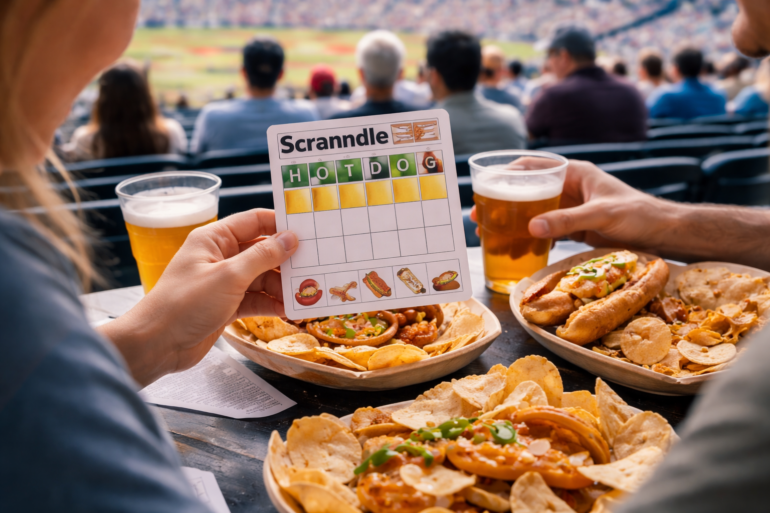
There is something oddly irresistible about Scrandle. You open it thinking you will spend a minute or two judging a couple of stadium meals, and then suddenly you are locked into a streak, second-guessing yourself over chips, pies, burgers, curry trays, and mystery matchday creations from football grounds around the world.
That is the basic appeal of Scrandle. It is quick, funny, weirdly competitive, and rooted in something football fans already love talking about, which is food at the game. The official site describes Scrandle as a daily web game of food comparison, where players look at stadium food and guess which option is considered superior by social ratings. The game has also been described by Playlin as a daily comparison game powered by social media ratings, where your goal is to pick the dish with the higher percentage rating.
In other words, Scrandle is not really about cooking, and it is not exactly about football either. It sits in that sweet spot between internet culture, sports fandom, food obsession, and daily habit gaming. That is a big reason it has caught on so quickly with people who may not even agree on teams, leagues, or cuisines, but can absolutely agree that they have opinions about what looks like top-tier scran.
What is Scrandle?
Scrandle is a browser-based daily game built around one simple question: which stadium meal scored higher with fans? The official description frames it as a food comparison game featuring dishes from around the world, while Playlin summarizes the objective as picking the dish with the higher percentage rating from social media polls.
That simplicity is the whole point. You are shown two food photos, usually with details like price and location, and you choose the one you think people rated more highly. If you are right, you keep going. If you are wrong, your run is in trouble. The rules are easy enough to understand instantly, which is one of the strongest reasons Scrandle feels so sticky after only a few rounds.
The name itself feels like internet shorthand. It sounds playful, slightly chaotic, and memorable in the way daily online games often need to be. Even before you understand the mechanics, Scrandle sounds like something people would send to friends in a group chat with a message that says, “You have to try this.”
Why Scrandle feels different from other daily games
A lot of daily games lean on trivia, words, geography, or logic. Scrandle goes another way. It asks you to judge people’s reactions to food.
That difference matters because food is emotional. You are not only looking at taste. You are reacting to presentation, portion size, value for money, club identity, local food culture, and the bizarre confidence of football fans defending a tray of chips that looks like it was assembled in a parking lot. That creates a kind of instant emotional decision-making that many other puzzle games do not have.
It also helps that football food already has an audience. The wider “footy scran” culture has been growing for years. In 2022, The Guardian wrote that the football food renaissance had been documented by the @FootyScran account, which had attracted more than a third of a million followers as supporters returned to stadiums. The same piece highlighted how matchday food had moved far beyond the old stereotype of bland concession stand fare and into something fans actively discuss, photograph, rate, and debate.
So Scrandle did not invent the obsession. It packaged that obsession into a game.
How Scrandle works
At its core, Scrandle is built on comparisons.
You see two dishes. You study the photos. You check the details. Then you make a call on which one received the stronger rating. The gameplay is built around social approval, not your personal taste. That is what makes Scrandle more interesting than a simple “which one looks better?” contest.
Playlin’s description of the game highlights exactly what players tend to look for:
- Price
- Country or location
- Extras and sides
- Overall presentation
- The likely fan reaction
Those clues matter because Scrandle is really a prediction game. You are trying to think like the crowd.
Here is a quick view of the experience:
| Element | What it does in Scrandle | Why it matters |
|---|---|---|
| Food photos | Shows two matchday meals | Gives you a fast visual impression |
| Price | Displays cost information | Helps you judge value perception |
| Location | Adds stadium or country context | Taps into local food expectations |
| Rating logic | Higher social score wins | Turns taste into crowd psychology |
| Daily format | New challenge each day | Encourages repeat visits |
That is a big part of why Scrandle keeps pulling people back. It rewards instinct, but it also rewards pattern recognition.
Where the ratings come from
One reason Scrandle feels grounded instead of random is that its comparisons are tied to an existing culture of public food judging. The official game description says the winner is determined by social ratings, and third-party summaries of the game consistently link that system to food posts and polling culture built around Footy Scran. Playlin says the higher-rated option is based on social media ratings, and broader write-ups around the game connect it to fan responses to stadium food content.
That gives Scrandle a stronger hook than a made-up scoring system. You are not just choosing between two meals. You are predicting how thousands of football-minded viewers reacted to each one. That makes every round feel like a tiny social experiment.
It also explains why ugly-but-beloved meals can beat photogenic ones. A perfect-looking burger might lose to a slightly chaotic pie and chips combo if fans think the second option feels more authentic, more generous, or simply more “matchday.” That tension is where Scrandle becomes more than a novelty.
Why Scrandle went viral
Viral games usually share a few traits. They are easy to understand, fast to play, simple to share, and fun to argue about. Scrandle checks every one of those boxes.
First, the barrier to entry is almost zero. You do not need to download anything, learn a deep ruleset, or create an account to understand the joke. The official site presents it as a daily web game, which means the experience is built for immediate play.
Second, the subject matter is inherently social. Food judgments invite opinions. Stadium food invites even louder opinions. And football fans rarely need a second invitation to argue about value, standards, authenticity, and whether something is elite or criminal.
Third, Scrandle works brilliantly as spectator content. Streamers, friends, and group chats can all react to the same side-by-side food matchup. Search results and social posts show people posting their reactions and sharing the game experience, which helps explain why the concept spreads so easily across online communities.
There is also a measurable visibility story behind the trend. According to Semrush traffic data updated on April 13, 2026, scrandle.com drew about 1.01 million visits in March 2026, with average visit duration listed at 6 minutes and 49 seconds. Semrush also shows “scrandle” as the site’s leading organic keyword, indicating strong branded search demand. Third-party traffic tools are estimates, not official numbers, but they still suggest that Scrandle has moved well beyond a tiny niche curiosity.
The role of football culture in Scrandle’s success
You could strip football out of Scrandle and still have a decent food comparison game. But it would lose its personality.
Football grounds are full of identity. Food at a stadium is never just food. It reflects place, budget, local taste, club reputation, fan expectations, and the whole ritual of matchday. Some clubs become known for genuinely great food. Others become known for serving things that look unforgettable for the wrong reasons.
That is why Scrandle lands so well. It taps into something football supporters already understand instinctively. A tray of loaded fries from one ground means something different from a pie at another. The image comes with atmosphere attached.
This is also why the rise of better stadium food matters. Reporting from The Guardian and Football Ground Guide points to a broader shift in football catering, with clubs paying more attention to the matchday food experience and fan response around it. Footy Scran has played a major role in spotlighting both the highs and the lows of that culture.
In that sense, Scrandle feels like the game version of an internet movement that was already happening.
What makes Scrandle so addictive
A lot of people describe Scrandle as simple. That is true, but it undersells what the game is doing.
The real hook is uncertainty. Every round asks you to predict taste, but not actual taste. You are predicting public reaction. That means Scrandle plays with visual bias, class expectations, nostalgia, football snobbery, local pride, and internet humor all at once.
These are the main reasons players keep coming back:
- It is fast enough to become a daily habit
- It creates instant debates
- It feels funny without trying too hard
- It rewards intuition and observation
- It is easy to share with other people
The daily reset matters too. Games with one fresh challenge per day often create stronger habits than endless-play formats because they feel like an event rather than a time sink. That model helped define the modern daily game boom, and it is one reason lightweight web games can spread so efficiently. Wordle’s mainstream success is a well-known example of how a simple daily format can scale into a huge routine-based audience.
Scrandle borrows that rhythm and applies it to a much stranger, much funnier niche.
How to get better at Scrandle
Getting better at Scrandle is less about food knowledge and more about reading context.
You are not trying to choose what a chef would approve. You are trying to choose what a large group of football fans thought deserved the higher score. Those are not always the same thing.
A few patterns usually help:
Look beyond appearance
A meal that looks neat and polished is not always the winner. In Scrandle, generous portions and satisfying comfort-food energy can beat cleaner-looking dishes.
Pay attention to value
If one option seems far more generous for the price, that can shape how fans score it. Matchday food is often judged through the lens of value as much as flavor.
Respect local identity
Some dishes feel deeply tied to a place, a club, or a football culture. That emotional connection can matter a lot in fan ratings.
Notice the extras
Sauce, sides, toppings, portion size, and presentation all influence how people react. Tiny details can swing the result.
Think like the crowd, not like a critic
This is probably the biggest lesson in Scrandle. The winning dish is often the one that feels more satisfying, more iconic, or more amusingly over-the-top.
Scrandle and the internet’s love of low-stakes competition
Part of the charm of Scrandle is that nothing truly important is on the line. It is competitive without being stressful.
That matters in a crowded online environment where many games feel either too shallow or too demanding. Scrandle gives players a few seconds of judgment, a quick hit of validation or failure, and then another chance to prove they understand the crowd better than they probably do.
It is also built for low-stakes bragging rights. Streaks, reactions, and controversial decisions make the game naturally shareable. A single absurd matchup can fuel a whole conversation. That is a powerful mechanic because it turns play into content.
And unlike many trend-based games, Scrandle has a subject with real staying power. Football is not going anywhere. Food culture is not going anywhere. Online argument definitely is not going anywhere.
Is Scrandle just a trend?
It is obviously part of a trend, but it would be unfair to call Scrandle disposable.
The game works because it sits on top of an existing community and an existing obsession. It is not forcing a meme into existence. It is formalizing behavior people were already doing on social platforms, which is rating stadium food, mocking bad meals, praising great ones, and arguing over what deserves respect.
That gives Scrandle a stronger foundation than a random viral game with no cultural base underneath it.
Whether it stays huge for years is harder to predict. Most internet games cool down from their peak. But the combination of daily repeat play, football fandom, food discourse, and social shareability gives Scrandle better long-term odds than many one-season online sensations. The available traffic estimates from Semrush suggest it has already built serious awareness, at least for now.
Why Scrandle matters more than it looks
On the surface, Scrandle is just people picking between two plates of food.
But under that surface, it says a lot about how internet culture works now. People love niche rituals. They love games that can be understood instantly. They love formats that create social conversation without requiring a major time commitment. And they love seeing everyday things, like stadium meals, turned into objects of ranking, identity, and debate.
That is why Scrandle feels bigger than its premise. It is funny, yes. It is silly, yes. But it is also a great example of how a very specific internet subculture can become a daily habit for a much wider audience.
Conclusion
Scrandle works because it turns football food culture into a daily game that feels immediate, social, and strangely personal. It is easy to play, easy to share, and surprisingly hard to stop thinking about once you start caring whether a tray of chips from one stadium should really beat a loaded burger from another.
More than anything, Scrandle succeeds because it understands the internet. It knows people like fast decisions, public opinion, weird specificity, and arguments that are more fun than serious. That is why Scrandle has become part of the broader rhythm of online play, and why it feels right at home inside modern association football culture.
FAQs
Is Scrandle free to play?
Yes. The official site presents Scrandle as a web-based daily game, and third-party listings also describe it as a free browser experience.
Do you need to know football to enjoy Scrandle?
Not really. Knowing football culture helps, especially around stadium food expectations, but Scrandle is simple enough for anyone who enjoys food, internet games, or crowd-based guessing.
Is Scrandle based on personal taste?
No. Scrandle is built around predicting which food scored higher with the crowd, not which one you personally would order.
Why do some ugly meals win in Scrandle?
Because fan ratings are shaped by more than looks. Portion size, price, authenticity, nostalgia, and club culture can all influence how people react to a dish.
Is Scrandle still popular?
All public popularity estimates should be treated carefully, but third-party traffic data from Semrush shows strong visit volume and branded search interest for scrandle.com in March 2026, which suggests the game has meaningful current visibility.