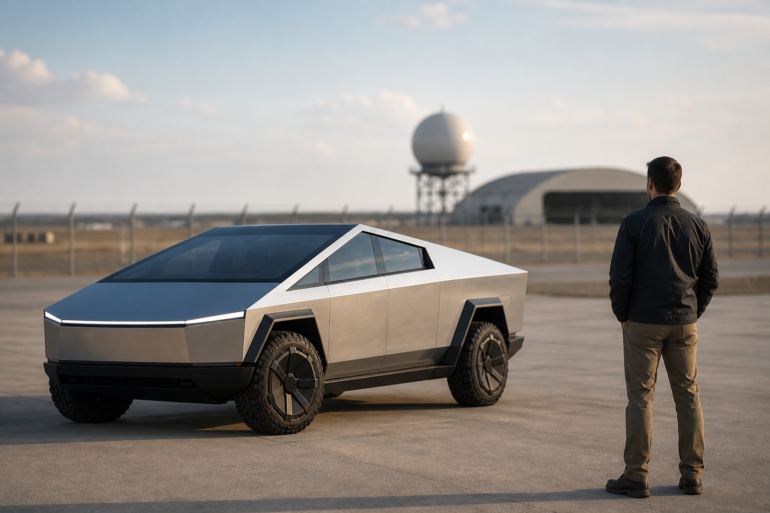
The phrase Pentagon Big Tech Tesla Cybertruck sounds strange at first. It feels like three different stories forced into one headline: the U.S. military, Silicon Valley, and a sharp-edged electric pickup truck that already looks like it came from a science-fiction movie.
But that is exactly why people are searching for it.
Defense technology is no longer just about tanks, fighter jets, missiles, or military bases. It now involves cloud computing, artificial intelligence, satellite networks, autonomous systems, cybersecurity, electric vehicles, and private tech companies that move faster than traditional government contractors.
The Pentagon is paying close attention to Big Tech. Big Tech is moving deeper into defense. Tesla’s Cybertruck, meanwhile, has become a symbol of how civilian technology can suddenly become part of military conversations, even when the original product was not built as a weapon.
Why Pentagon Big Tech Tesla Cybertruck Is Getting Attention
The interest around Pentagon Big Tech Tesla Cybertruck comes from a bigger shift in defense planning. Modern warfare is becoming more digital, more automated, and more dependent on commercial technology.
The Pentagon has recently expanded its work with major AI and cloud companies. In May 2026, Reuters reported that the Pentagon reached agreements with several leading AI companies to deploy advanced capabilities on Defense Department classified networks, including firms such as Google, Microsoft, Amazon Web Services, Nvidia, OpenAI, SpaceX, and Reflection.
That matters because the military is not just buying hardware anymore. It is buying speed, data, computing power, and decision-making tools.
At the same time, the Tesla Cybertruck entered defense-related headlines after reports said the U.S. Air Force wanted to acquire Cybertrucks for precision weapons testing at White Sands Missile Range. The reported purpose was not to turn Cybertrucks into military vehicles, but to use them as targets during testing because of their unusual durability and design.
So the real story is not that Tesla has suddenly replaced armored vehicles. The real story is that the line between consumer technology and military technology is getting thinner.
The Bigger Picture Behind Defense Tech
Defense tech is trending because the world has changed.
For decades, military strength was mostly measured by aircraft carriers, fighter jets, submarines, and missile systems. Those things still matter, of course. But today, digital infrastructure can be just as important.
A military that can process battlefield data faster has an advantage. A country that can defend its networks better is harder to weaken. A force that can use drones, satellites, sensors, and AI together can spot threats earlier and respond more quickly.
That is why Big Tech has become so attractive to the Pentagon.
Companies that build AI systems, cloud platforms, chips, satellites, and cybersecurity tools already operate at massive scale. They have engineers, infrastructure, and research pipelines that governments want access to.
This is not only about weapons. It is also about:
- Secure cloud storage
- Cyber defense
- Battlefield communication
- Drone detection
- Satellite internet
- Logistics planning
- AI-assisted intelligence analysis
- Faster command decisions
In simple terms, the future military is not just mechanical. It is digital.
Big Tech’s Growing Role in the Pentagon
The Pentagon has worked with private companies for a long time. Boeing, Lockheed Martin, Northrop Grumman, Raytheon, and General Dynamics have been familiar names in defense for decades.
What feels different now is the type of company entering the defense conversation.
Google, Microsoft, Amazon, Nvidia, OpenAI, SpaceX, and other tech firms are not traditional defense contractors in the old sense. They are known for search engines, cloud platforms, chips, AI models, productivity software, rockets, and consumer-facing technology.
Yet their tools are now deeply relevant to military operations.
Microsoft and Amazon already have strong cloud relationships with government agencies. Nvidia’s chips power many AI workloads. SpaceX provides satellite launch and communication capabilities. AI companies are developing tools that can summarize information, detect patterns, and assist with planning.
A 2026 report from Breaking Defense noted that the Pentagon had cleared major tech firms to deploy AI on classified networks, showing how aggressively the department is trying to bring commercial AI into secure military environments.
This is why the Pentagon Big Tech Tesla Cybertruck topic feels so timely. It is not about one product or one contract. It reflects a much larger defense technology trend.
Where Tesla Cybertruck Fits Into the Conversation
The Cybertruck is not a standard military vehicle. It was designed as a consumer electric pickup with a stainless-steel body, futuristic styling, and a strong public identity tied to Tesla and Elon Musk.
Still, it became part of defense talk because of its unusual build.
Business Insider reported that the U.S. military contracting documents described Cybertrucks as vehicles that may not receive the normal extent of damage expected during major impact, which is one reason they were considered for target testing.
That point is important.
The Air Force interest was not about buying Cybertrucks as official battlefield trucks. It was about understanding how certain modern civilian vehicles might behave if they appeared in a conflict zone. In today’s world, almost any durable commercial vehicle can show up in unexpected places.
That includes pickup trucks, drones, satellite devices, electric vehicles, and off-road machines.
The Cybertruck is visually dramatic, but the real defense question is practical: how should military planners prepare for consumer technologies that are tough, fast, connected, or difficult to disable?
Pentagon Big Tech Tesla Cybertruck and the New Military Mindset
The phrase Pentagon Big Tech Tesla Cybertruck captures a new military mindset. The Pentagon is no longer waiting for every important tool to come from a defense-only factory.
Instead, it is watching the commercial market.
A drone sold to civilians can be modified for surveillance. A satellite internet terminal can help communication in war zones. A cloud platform can support classified workloads. An AI model can help sort thousands of reports faster than a human team.
An electric pickup may become relevant not because it was designed for war, but because its shape, materials, and resilience make it worth studying.
That is a major shift.
The battlefield is becoming more improvised and more technology-driven. The war in Ukraine has shown how low-cost drones, commercial software, satellite communications, and rapid battlefield adaptation can change military planning. Defense organizations now understand that commercial technology can shape real conflicts quickly.
Why Defense Tech Is Trending Now
Defense tech is trending because money, fear, innovation, and competition are all moving in the same direction.
Governments want faster tools. Tech companies want large contracts. Investors see defense startups as serious opportunities. Military planners want systems that can adapt to drones, cyberattacks, AI threats, and electronic warfare.
There is also a geopolitical reason.
The United States is competing with China and other powers in AI, chips, space systems, cyber capabilities, and autonomous technology. That competition pushes the Pentagon to work more closely with companies that already lead in these areas.
The Guardian reported that the Pentagon’s AI agreements are part of a broader effort to support classified military initiatives and strengthen decision-making across warfare domains.
That phrase, decision-making, is key.
Modern defense is not only about who has the biggest weapon. It is about who can understand the situation fastest, move data securely, protect systems from hacking, and make the right call before the other side does.
The Role of AI in Modern Defense
Artificial intelligence is one of the biggest reasons Big Tech is moving closer to the Pentagon.
AI can help process satellite imagery, detect cyber threats, summarize intelligence reports, support logistics, identify patterns, and improve mission planning. It can also raise serious ethical questions, especially when connected to surveillance or weapons systems.
Reuters reported that Google signed a classified AI agreement with the Pentagon, with the deal reportedly involving sensitive applications such as mission planning and targeting support while also including limits around domestic mass surveillance and autonomous weapons without human oversight.
That shows both sides of the debate.
On one side, AI can help the military move faster and reduce information overload. On the other side, people worry about accountability, mistakes, privacy, and the risk of humans relying too heavily on machine recommendations.
That tension is not going away. In fact, it will probably become one of the central debates in defense technology.
How Cybertruck Became a Symbol
The Cybertruck is not the biggest defense story by itself. But it is a powerful symbol.
Why?
Because it looks like a vehicle designed for a post-apocalyptic movie. It is electric. It is made with a distinctive stainless-steel exterior. It is heavily associated with Big Tech culture, internet attention, and Tesla’s bold product style.
When a vehicle like that appears in a military testing conversation, people notice.
The Pentagon Big Tech Tesla Cybertruck keyword works because it brings together three public fascinations:
- The Pentagon and national security
- Big Tech and its growing influence
- Tesla Cybertruck and futuristic vehicle design
That combination naturally attracts curiosity. Readers want to know whether this is hype, a real military shift, or just another viral tech headline.
The honest answer is: it is a bit of all three.
What This Means for Ordinary Readers
For everyday readers, the story matters because defense technology often starts in one place and spreads into another.
GPS began as a military system and became part of daily life. The internet had military research roots before becoming the backbone of modern society. Drones moved from military use into photography, farming, delivery experiments, and consumer markets.
Now the flow often works both ways.
Consumer technology can influence defense. Defense needs can shape commercial innovation. Big Tech products can become national security tools. Vehicles, AI systems, cloud platforms, chips, and satellites can all cross the line between civilian and military use.
That is why people should not dismiss this topic as just another strange headline.
It points to a future where the devices, platforms, and vehicles we see in daily life may also matter in security planning.
Benefits of Big Tech Working With Defense
There are real advantages when the Pentagon works with technology companies.
First, Big Tech moves quickly. Traditional defense procurement can be slow, expensive, and loaded with paperwork. Commercial tech companies are used to building, testing, updating, and scaling products at high speed.
Second, these companies already handle enormous amounts of data. That experience can help with cloud security, analytics, and AI systems.
Third, defense agencies need access to top engineering talent. Many of the world’s best AI, chip, cybersecurity, and cloud specialists work in or around major tech firms.
Fourth, competition among vendors can reduce dependence on a single contractor. Reuters noted that the Pentagon’s expanded AI partnerships also appear designed to avoid overreliance on one provider.
That is a practical move. If one system fails, becomes too expensive, or creates ethical concerns, the military needs alternatives.
Risks and Concerns Around Defense Tech
Of course, there are serious concerns too.
When Big Tech enters defense, people ask hard questions. Should companies known for consumer products help build military systems? Who controls how AI tools are used? Can private companies say no to certain government requests? What happens when profit, national security, and ethics collide?
There is also the issue of public trust.
Many people already worry about data privacy, surveillance, algorithmic bias, and corporate power. When those same companies work on military systems, the concern grows.
Another risk is overdependence. If the Pentagon relies too heavily on commercial platforms, it may become vulnerable to vendor lock-in, cyber weaknesses, pricing pressure, or supply chain problems.
There is also the human factor. AI can assist decision-making, but it should not replace human judgment in life-and-death situations. Technology can be powerful, but it can also fail, misread context, or produce false confidence.
That is why oversight matters.
Is Tesla Really Becoming a Defense Company?
This is where the topic needs careful wording.
Tesla is not usually described as a traditional defense company. The Cybertruck case reported in 2025 was about target testing, not a confirmed move to make Tesla trucks standard military vehicles.
However, Elon Musk’s broader business world does touch defense and government contracts through companies such as SpaceX. SpaceX has major relevance in satellite launches, communications, and national security space operations.
So when people connect Tesla, Cybertruck, Pentagon, and Big Tech, they are often mixing multiple threads:
- Tesla’s Cybertruck as a durable electric pickup
- SpaceX’s defense and government role
- Big Tech’s AI and cloud defense contracts
- The Pentagon’s interest in commercial innovation
The connection is not always direct, but the public conversation blends them because they all sit inside the same larger trend: private technology companies are shaping modern security.
A Real-World Scenario: Why the Pentagon Studies Civilian Tech
Imagine a future conflict zone where an adversary uses modified consumer vehicles, commercial drones, satellite internet, and AI-assisted planning tools.
None of those tools need to be built originally for war.
A pickup truck could carry equipment. A drone could scout roads. A satellite connection could keep units online. AI software could help analyze open-source maps. A rugged electric vehicle could be used in unexpected ways.
In that kind of environment, the Pentagon cannot only study traditional military equipment. It must also understand commercial products that might appear on the battlefield.
That is where the Cybertruck story becomes more understandable.
The military does not need to love the vehicle. It simply needs to know how it behaves under certain conditions.
Why Investors Are Watching Defense Tech
Defense tech has become attractive to investors because it combines government demand with fast-moving innovation.
Startups are now building drone systems, AI tools, cyber platforms, battlefield software, autonomous vehicles, satellite services, and sensor networks. Some investors who once avoided defense now see it as a major growth area.
The reason is simple: governments spend heavily on security, and the demand is not fading.
But defense tech is not like ordinary consumer software. It carries higher responsibility. A bad shopping app may annoy users. A bad defense system can create serious consequences.
That is why companies entering this space need strong testing, compliance, transparency, and ethical boundaries.
What Readers Should Watch Next
The Pentagon Big Tech Tesla Cybertruck story is still developing, but there are a few areas worth watching.
First, watch how AI contracts evolve. The Pentagon will likely continue testing different AI vendors to find secure and useful tools for classified environments.
Second, watch electric and autonomous vehicle experiments. Even if the Cybertruck itself never becomes a military platform, EV technology may influence future defense mobility.
Third, watch the public debate. Employees, lawmakers, privacy advocates, and defense officials will continue arguing over where the limits should be.
Fourth, watch how commercial technologies appear in real conflicts. The more civilian tools are adapted for military use, the more governments will study them before they become problems.
Common Questions About Pentagon Big Tech Tesla Cybertruck
Is the Pentagon buying Tesla Cybertrucks for war?
Reports in 2025 said the U.S. Air Force was looking to acquire two Cybertrucks for precision weapons testing, mainly as targets. That is different from buying them as official combat vehicles.
Why is Big Tech working with the Pentagon?
Big Tech companies offer cloud platforms, AI models, chips, cybersecurity systems, satellite services, and data tools. These are now central to modern defense planning.
Does the Cybertruck have military value?
The Cybertruck may interest defense observers because of its unusual design, durable body, electric platform, and public visibility. But that does not mean it is automatically suitable for battlefield use.
Is defense tech only about weapons?
No. Defense tech includes communications, logistics, cybersecurity, AI analysis, cloud infrastructure, satellites, drones, sensors, and vehicle testing.
Why is this topic trending?
It combines three highly searched areas: Pentagon technology spending, Big Tech defense partnerships, and Tesla Cybertruck curiosity.
The Ethical Side of Defense Innovation
The hardest part of defense tech is not always the engineering. Sometimes it is the moral question behind the engineering.
A powerful AI tool can help analysts sort urgent information. It can also raise concerns about surveillance and targeting. A cloud system can improve secure communication. It can also create dependence on private vendors. A futuristic electric vehicle can inspire new mobility ideas. It can also become part of weapons testing.
This is why defense innovation needs more than speed. It needs rules, accountability, and public debate.
There is nothing wrong with technology helping protect people. But there is a real problem if technology moves faster than responsibility.
Final Thoughts
The phrase Pentagon Big Tech Tesla Cybertruck may sound unusual, but it points to one of the most important technology stories of our time.
The Pentagon wants faster innovation. Big Tech has the tools. Tesla’s Cybertruck has become a symbol of how commercial products can enter defense conversations in unexpected ways.
This does not mean every consumer device will become military equipment. It means the boundary between civilian technology and defense planning is becoming harder to ignore.
Defense tech is trending because modern security now depends on software, chips, AI, cloud systems, electric mobility, satellites, and cyber resilience. The next major shift may not come from a traditional weapons factory. It may come from a company best known for apps, vehicles, cloud servers, or an electric vehicle that looks too strange to ignore.
In the end, Pentagon Big Tech Tesla Cybertruck is not just a keyword. It is a snapshot of a new era where technology, national security, and public curiosity are moving in the same direction.