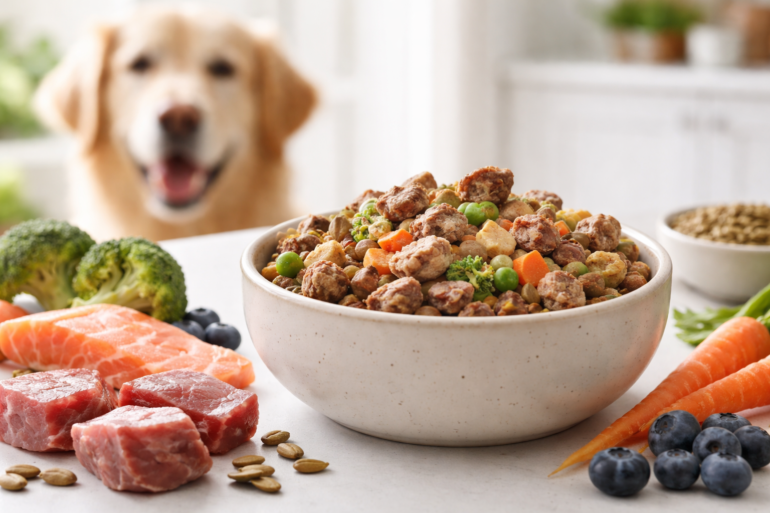
If you are looking at Dr. Marty’s Dog Food because you want something that feels more premium, more natural, and a little closer to whole-food nutrition than standard kibble, you are not alone. A lot of health-conscious pet owners are paying closer attention to ingredient lists, processing methods, and whether a formula is truly complete for everyday feeding. That is exactly where Dr. Marty’s Dog Food enters the conversation.
This review takes a practical look at what the food is, what stands out about its ingredients, where it fits in a dog’s diet, and what pet owners should think about before switching. Rather than treating it like a miracle product or dismissing it as hype, it makes more sense to judge it by the things that actually matter: nutritional adequacy, ingredient quality, feeding practicality, and how well it matches your own dog’s needs. According to Dr. Marty’s official product information, Nature’s Blend is marketed as a premium freeze-dried raw dog food made with meat, fish, vegetables, fruit, and seeds, without artificial preservatives, additives, fillers, or synthetic ingredients. AAFCO and FDA guidance also make it clear that one of the most important things pet owners should verify on any food is whether it is complete and balanced for the dog’s life stage.
For many buyers, the real appeal is simple. You want food that looks less like heavily processed pellets and more like real ingredients. That does not automatically make one formula perfect for every dog, but it does explain why freeze-dried products like this keep getting attention among owners who care deeply about canine nutrition. The American Kennel Club notes that freeze-dried and other alternative dry foods appeal to owners who want shelf-stable convenience with whole-food style ingredients, though they can also be more expensive and sometimes need rehydration.
What Is Dr. Marty’s Dog Food?
At the center of the brand’s dog food lineup is Nature’s Blend, a freeze-dried raw formula. Freeze-drying removes moisture while aiming to preserve much of the original ingredient structure and nutrient profile. AKC describes freeze-dried dog food as an alternative to kibble that uses moisture removal rather than conventional kibble-style cooking, and notes that these products are often nutrient-dense and shelf-stable.
Dr. Marty’s official product page presents the formula as a meat-first recipe with premium meats, fish, vegetables, fruit, and seeds. The product listing also states that the food contains no artificial preservatives, fillers, or synthetic ingredients and gives a calculated calorie content of 4,990 kcal/kg and 256 kcal per cup.
That positioning matters because it places the food in a premium niche rather than the everyday budget category. This is not trying to compete with bargain kibble. It is trying to attract owners who want a more ingredient-conscious product and are willing to pay more for that style of feeding.
Why Health-Conscious Pet Owners Notice It
Health-conscious buyers usually do not shop for dog food the way casual buyers do. They are not just asking whether the dog will eat it. They are asking whether the ingredient list makes sense, whether the food has enough animal protein, whether it contains fillers, and whether the formula is appropriate for long-term daily feeding.
That is the lane where Dr. Marty’s Dog Food performs best in terms of brand appeal. The focus on freeze-dried raw ingredients, meat-forward formulation, and low-interest in traditional filler-heavy positioning matches what many modern pet owners are already looking for. Dr. Marty’s own educational content emphasizes that the first ingredients in Nature’s Blend are premium cuts of turkey, beef, salmon, duck, and organ meat.
There is also a psychological side to this. Pet owners often connect visible, recognizable ingredients with quality. While that is not the only thing that matters, it is understandable. A food that appears closer to meat and produce tends to feel more reassuring than one built around vague marketing language.
Ingredient Profile and Nutritional Philosophy
One of the biggest talking points around Dr. Marty’s Dog Food is its ingredient profile. The product pages emphasize premium meats, fish, organ meat, vegetables, fruit, and seeds. That type of formulation aligns with a high-protein, whole-food-centered feeding philosophy rather than a grain-heavy or filler-heavy one.
Here is the bigger nutritional context. Dogs need a balance of protein, fat, vitamins, minerals, and other nutrients, not just a nice-sounding ingredient list. AAFCO explains that “complete” means the food contains all required nutrients, while “balanced” means those nutrients are present in the correct ratios for the intended life stage. The FDA likewise tells pet owners to look for the nutritional adequacy statement when deciding whether a food can meet a pet’s nutritional needs.
That distinction is important because premium ingredients alone do not tell the whole story. A recipe can sound impressive and still need to be checked against label standards and life-stage suitability. For pet owners comparing foods seriously, that label detail matters just as much as the front-of-bag marketing.
What stands out in the formula
- Meat and fish are central to the product’s positioning.
- Organ meats are presented as part of the nutritional profile.
- Vegetables, fruit, and seeds are included to round out the recipe.
- The food is marketed as free from artificial preservatives, additives, and fillers.
For owners who want a less processed feel, those points are attractive. For owners who prioritize regulatory clarity and long-term feeding suitability, the adequacy statement remains the thing to confirm before making the food a staple.
Freeze-Dried Raw: Benefit, Buzz, and Reality
Freeze-dried raw food sits in an interesting middle ground. It is not fresh refrigerated food, and it is not standard kibble. It is designed to keep many of the appealing qualities of raw-style feeding while being easier to store and serve.
AKC notes several pros of alternative dry foods such as freeze-dried formulas. These foods can be lightweight, travel-friendly, free of artificial preservatives, and nutrient-dense enough that dogs may eat smaller portions than they would with conventional kibble. AKC also points out the downsides: they can be expensive, can crumble easily, and may need rehydration depending on the product and the dog.
That description fits the real-world experience many owners have with this category. The food can feel premium and practical at the same time, but it is rarely the cheapest or simplest feeding option. If you are used to scooping kibble and moving on, this style of food may feel more intentional and sometimes more demanding.
Is Dr. Marty’s Dog Food Actually Good for Dogs?
This is the question most people are really asking, and the honest answer is that it depends on the dog, the life stage, and how the food is used.
For a healthy adult dog with no special medical condition, a premium freeze-dried formula can be a reasonable option if it is complete and balanced for that dog’s life stage and fed according to directions. AAFCO specifically advises pet owners to choose food labeled for species, life stage, and condition, and to follow feeding directions because even a good food can become nutritionally mismatched when overfed or underfed.
For dogs with very sensitive digestion, food allergies, pancreatitis, kidney concerns, or highly specific veterinary dietary needs, the question becomes more individualized. Premium does not always mean ideal for every medical situation. A dog with a therapeutic diet requirement may need precision that goes beyond the appeal of a natural ingredient list.
This is why a strong review of Dr. Marty’s Dog Food should not claim the formula is universally superior. What it can say fairly is that the food is clearly aimed at owners who want a premium, meat-centered, freeze-dried option and who are comfortable paying for that format.
A Practical Look at Pros and Cons
A review becomes more useful when you step away from slogans and ask what day-to-day ownership feels like.
| Area | What Works Well | What May Be Less Ideal |
|---|---|---|
| Ingredients | Meat-forward positioning with fruit, vegetables, and seeds | Premium ingredients do not replace the need to verify label adequacy |
| Processing style | Freeze-dried format appeals to owners avoiding traditional kibble processing | Some dogs may do better with rehydration |
| Convenience | Shelf-stable and easier than frozen raw food | Can crumble and may be less tidy than kibble |
| Cost | Feels premium and specialized | Usually more expensive than standard dry food |
| Owner appeal | Strong fit for health-conscious pet owners | May not suit households needing a budget-friendly staple |
For many buyers, the biggest drawback is not the concept of the food. It is the cost. Freeze-dried products usually ask owners to spend significantly more than they would on ordinary kibble, and that changes the long-term value equation.
How It Compares With Traditional Kibble
Traditional kibble wins on price, convenience, and simplicity. It is easy to store, easy to portion, and widely available. AKC notes that many standard dry foods are designed to be complete and balanced and remain the most economical way to feed many dogs.
Where Dr. Marty’s Dog Food tries to stand apart is in processing style and ingredient image. It speaks to owners who believe less conventional processing and more visible whole-food ingredients are worth paying for. That does not automatically make kibble “bad,” but it does explain why some pet owners are willing to switch categories entirely.
A better way to frame the comparison is this: kibble is the mainstream convenience option, while freeze-dried formulas like this target owners who want a more premium feeding experience and are comfortable with the tradeoffs.
Safety and Raw-Style Concerns
Any honest discussion of freeze-dried raw style feeding has to include safety context. AVMA states that it discourages feeding cats and dogs animal-source protein that has not been subjected to a process to eliminate pathogens because of illness risk to pets and humans. FDA also reminds pet food makers that raw ingredients can pose safety risks if not handled properly.
That does not mean every freeze-dried product is unsafe. It means pet owners should avoid assuming that “raw-inspired” automatically means risk-free. Handling, manufacturing controls, storage, and following label directions all matter.
For households with young children, elderly family members, or immunocompromised individuals, that safety conversation becomes even more important. A premium food should still be evaluated with basic food safety common sense.
What Kind of Dog May Benefit Most
Dr. Marty’s Dog Food is likely to appeal most to owners in a few specific situations.
Dogs that are picky about ordinary kibble sometimes respond well to richer-smelling, meat-forward formulas. Active adult dogs may also do well on nutrient-dense foods when portions are managed correctly. Owners who travel often may appreciate that freeze-dried food offers more convenience than frozen raw diets while still fitting a premium feeding philosophy. AKC specifically notes the travel convenience of alternative dry foods and the fact that these foods are often nutrient-dense.
On the other hand, giant-breed households, multi-dog homes, and owners on tight monthly budgets may find the format harder to sustain. A food can be excellent in theory and still not be practical for your real life.
What to Check Before You Buy
If you are seriously considering the product, there are a few smart things to verify before making it a regular part of your dog’s routine.
- Check the nutritional adequacy statement and life-stage suitability on the package. AAFCO and FDA both point pet owners toward this as a core decision-making factor.
- Review feeding directions and watch your dog’s body condition after switching. AAFCO notes that directions are guidelines and may need adjustment depending on the animal.
- Consider whether your dog does better with dry texture or with added moisture. AKC notes that some alternative dry foods may be rehydrated and that moisture can aid digestion.
- Think about sustainability. The best food is not only the one that looks good on paper. It is the one you can feed consistently and correctly.
Common Questions Pet Owners Ask
Is Dr. Marty’s Dog Food complete and balanced?
That is something to verify directly on the packaging through the nutritional adequacy statement. FDA and AAFCO both emphasize that this statement is the key indicator for whether a food is suitable as a complete diet for a given life stage.
Is freeze-dried dog food better than kibble?
Not automatically. Freeze-dried food may offer a different ingredient profile and processing style, but “better” depends on the dog, the formula, the household budget, and whether the food is complete and balanced. AKC notes both benefits and limitations of these alternative dry foods.
Can Dr. Marty’s Dog Food help picky eaters?
It may, especially if the dog prefers stronger meat aromas and textures that feel different from standard kibble. That said, individual response varies, and a picky dog can still reject a premium formula.
Is it worth the price?
For owners who strongly value ingredient-conscious feeding and freeze-dried convenience, it may feel worth it. For owners focused mainly on affordability and straightforward daily feeding, the value may be harder to justify.
Final Verdict
Dr. Marty’s Dog Food makes the strongest impression when viewed as a premium niche product for health-conscious pet owners, not as a one-size-fits-all solution. Its appeal comes from the freeze-dried raw format, meat-forward positioning, and the brand’s emphasis on ingredients that feel closer to whole-food nutrition than conventional kibble. Those are real advantages for the right buyer.
The more balanced takeaway is that good dog food decisions should always go beyond marketing. Ingredient quality matters. Processing style matters. But life-stage suitability, feeding directions, safety, and nutritional adequacy matter just as much. AAFCO and FDA guidance make that clear, and those standards remain useful whether you are buying budget kibble or a premium freeze-dried formula.
For the owner who wants a more upscale feeding option and is comfortable paying for it, Dr. Marty’s Dog Food can be an appealing choice. For the owner who values affordability above all else, it may feel more aspirational than practical. The smartest view is not to ask whether it is trendy. It is to ask whether it fits your dog, your budget, and your standards for pet nutrition.