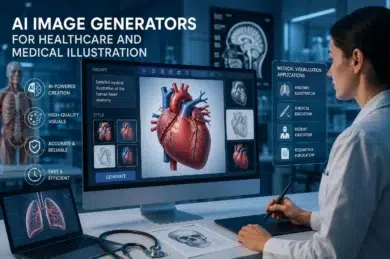
AI image generation sits at an interesting intersection in healthcare: the potential to significantly reduce the cost of medical illustration, the absolute requirement for accuracy in clinical content, and the emerging applications in patient communication and medical education.
Legitimate applications of AI image generation in healthcare
Patient education materials
Explaining medical procedures, anatomy, conditions, and treatment options visually improves patient comprehension and reduces anxiety. AI can generate illustrative images for patient handouts, website content, and digital health tools at a fraction of the cost of commissioned medical illustration. Key requirement: all patient-facing medical imagery must be reviewed by clinically qualified professionals for accuracy before use.
Healthcare marketing and communications
Hospital websites, health system marketing, and wellness brand content all require significant volumes of imagery showing healthcare settings, patients, and professionals. AI generation produces diverse, stigma-sensitive, and contextually appropriate imagery at scale.
Clinical research visualization
Generating conceptual illustrations for research papers, grant applications, and scientific presentations where the visual communicates a concept rather than providing clinical data.
For anyone still deciding on tooling, the the AI image generator used across healthcare continues to evolve rapidly — it is worth reviewing the current options before committing to a subscription.
Critical limitations for clinical use
- Not for diagnostic use: AI-generated images are not diagnostic tools and must never be used in clinical decision-making contexts.
- Accuracy requirements: AI generators do not have medical knowledge; they generate plausible-looking images based on training patterns, not clinical accuracy.
- Privacy compliance: Generating images of real patients or clinical scenarios involving identifiable individuals raises HIPAA compliance issues.
Best tools for healthcare imagery
| Use case | Recommended tool | Key consideration |
| Patient education illustrations | Midjourney v7 or FLUX 2 Pro | Expert clinical review required |
| Diverse patient stock imagery | FLUX 2 Pro, Imagen 4 | Representation and dignity |
| Healthcare professional imagery | FLUX 2 Pro, Adobe Firefly | Commercial licensing |
| Wellness and lifestyle content | Midjourney, Adobe Firefly | Standard quality requirements |
FAQs
Can AI replace medical illustrators?
For generic healthcare setting imagery, AI is increasingly capable. For anatomically precise medical illustration, trained medical illustrators remain essential.
Is AI-generated healthcare imagery compliant with stock photography platform policies?
Check current platform policies before submitting AI-generated healthcare imagery, as policies are evolving.
What are the ethical considerations around generating images of patients?
Never generate images of real, identifiable patients without explicit consent. Images depicting sensitive conditions require particular care to avoid stigmatization.