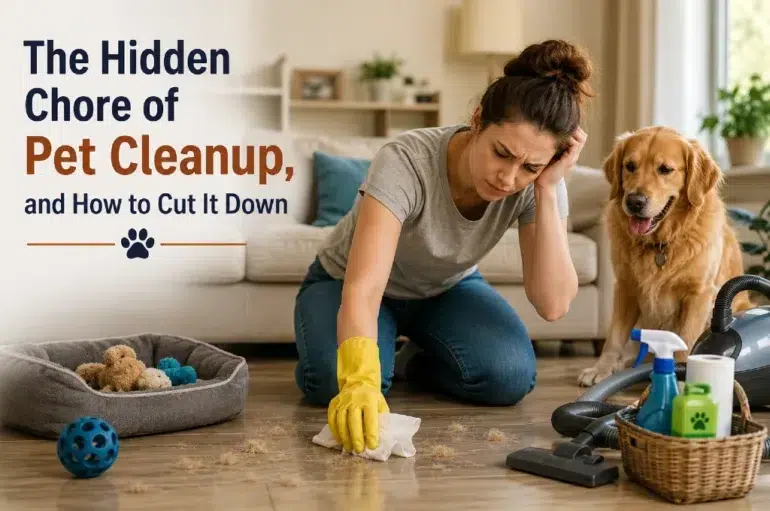
The visible job of cleaning up after a pet is the vacuuming. The hidden job is everything around it. Emptying a packed bin, pulling hair off a tangled brush, doing the whole thing again two days later. For a home with a shedding cat or dog, that hidden work often adds up to more time than the cleaning itself. Reducing it is mostly a matter of design and a few sensible habits.
Key Takeaways
- The real time cost of pet cleanup is the maintenance around the vacuum, not the cleaning pass.
- Pet homes fill a dustbin far faster than average, so emptying becomes the bottleneck.
- A self-emptying base and a tangle-resistant brush remove the two chores people skip most.
- Sealing dust during disposal keeps dander from going straight back into the air.
Why Cleaning Up After Pets Takes Longer Than It Should
The time goes into maintenance, not the cleaning pass itself. Fur is bulky and constant, so the machine fills, clogs, and tangles far more often than it would in a pet-free home.
The dustbin is the real bottleneck
Most cleaning sessions in a pet home stop early, not because the floor is clean but because the bin is full. A standard robot or stick vacuum holds a modest volume, and fur packs out that space quickly. Emptying mid-clean is the step people quietly start skipping, and skipped maintenance is the usual reason a machine seems to lose suction over the months.
Designing the Chore Out of the Routine
Two features remove most of the manual work. One handles disposal, the other handles tangling, and together they cover the chores that otherwise get neglected.
Let the bin empty itself
A self emptying robot vacuum addresses the bottleneck directly. After each run it returns to a base that draws the collected hair into a larger sealed bag, leaving the small onboard bin clear for the next pass. Instead of emptying every day or two, you handle disposal every few weeks. For a pet household, that one feature turns the most-skipped chore into something you barely think about.
Stop fighting tangled brushes
The second time sink is hair wound around the brush roll. A robot vacuum for pet hair is built with anti-tangle brush geometry, often a rubberized or comb-style roller, so long fur feeds through to the bin instead of spooling around the axle. That keeps suction steady and removes the weekly ritual of cutting hair off the brush with scissors.
Don’t Let Disposal Undo the Work
Emptying a bin can release dander straight back into the air. The American Lung Association notes that pet dander is microscopic and easily airborne, and Mayo Clinic adds that it stays aloft with the slightest air movement. Tipping a full bin into the trash can sends a cloud of that material back into the room. A bagged, sealed base keeps it contained. If you empty by hand, do it into a bag you can close, ideally near an open window or outdoors.
A Few Habits That Stretch the Gains
Maintenance shrinks further with small routines that keep the machine working at full strength.
- Run a cleaning pass daily so no single run overloads the bin.
- Brush your pet outdoors to cut the volume of fur entering the system.
- Tap out or rinse filters on a set schedule so airflow stays strong.
The Point Is Less Work, Not More Cleaning
A pet-friendly home does not have to feel like a second job. Most of the effort people spend cleaning up after animals is maintenance, the emptying and untangling and re-cleaning. Remove those steps with a base that empties itself, a brush that refuses to tangle, and disposal that keeps dander contained, and the routine quietly takes care of itself. The floors stay clear, and the weekend stays yours.
References
American Lung Association. (2023). Pet dander. https://www.lung.org/clean-air/indoor-air/indoor-air-pollutants/pet-dander
Mayo Clinic. (2025). Pet allergy: Symptoms and causes. https://www.mayoclinic.org/diseases-conditions/pet-allergy/symptoms-causes/syc-20352192