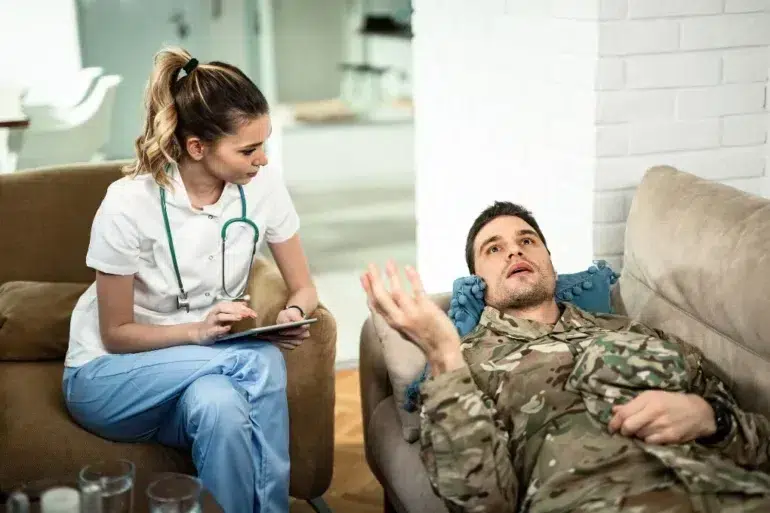
From “Soldier On” to Evidence-Based Care
For much of military history, the psychological toll of combat was treated as something to be endured silently. Terms like “shell shock” and “battle fatigue” acknowledged that something happened to soldiers exposed to sustained violence — but the prevailing response was often to minimize it, push through it, or simply not speak of it. The culture of the military, which prizes stoicism and unit cohesion, reinforced these norms in ways that persisted long after service ended.
The past few decades have brought a fundamental shift. Driven by research into PTSD, trauma neuroscience, and treatment outcomes, the clinical field now offers veterans a significantly different picture — one in which trauma is understood as a brain and body response, not a personal failing, and in which effective treatments exist for conditions that were once considered untreatable.
Approaches like EMDR for veterans, cognitive processing therapy, and prolonged exposure have strong research support for treating combat-related PTSD, and programs that offer these therapies are changing outcomes for people who might otherwise have spent years without real relief.
What We Now Know About How Trauma Works in the Brain
The science of trauma has advanced considerably in the last thirty years. We now understand that traumatic experiences are processed and stored differently from ordinary memories. Rather than being filed away as past events, traumatic memories can remain encoded with their original emotional and sensory intensity — as if part of the brain has not fully registered that the danger has passed.
This is why veterans with PTSD do not simply “remember” difficult experiences. The memories can intrude — in nightmares, flashbacks, or as intense physical and emotional reactions to triggers that may seem unrelated on the surface. The nervous system remains primed for threat even in environments that are objectively safe.
This understanding has reshaped how treatment is designed. Approaches that work with the specific way trauma is stored — rather than simply asking people to talk about their experiences — have emerged as the most effective tools available.
The Therapies That Changed the Field
Three trauma-focused therapies have the strongest evidence base for treating PTSD, including in veteran populations: Cognitive Processing Therapy (CPT), Prolonged Exposure (PE), and Eye Movement Desensitization and Reprocessing (EMDR).
CPT focuses on the way traumatic experiences shape beliefs — about safety, trust, power, self-esteem, and intimacy. Therapists work with patients to identify and challenge distorted thoughts that developed in the aftermath of trauma and are keeping them stuck.
PE works through gradual, structured exposure to trauma memories and reminders, under the guidance of a trained therapist. Over time, the nervous system learns that the memories themselves are not dangerous and begins to process them with less intensity.
EMDR uses bilateral stimulation — typically guided eye movements — while the person focuses on a traumatic memory. The mechanism is not fully understood, but the outcomes are well-documented: EMDR significantly reduces PTSD symptoms in many patients who have not responded to other approaches.
According to the National Institute of Mental Health, all three of these approaches are recommended as first-line treatments for PTSD, and they are increasingly available through both VA and private treatment programs serving veterans.
Why Veterans Often Respond Differently to Traditional Therapy
Standard talk therapy — the kind where a person discusses their feelings and experiences with a therapist over an extended period — can be valuable, but it has limitations for veterans with significant combat trauma. The reasons are both clinical and cultural.
Clinically, some veterans have trauma that is more effectively addressed through structured, trauma-specific approaches than through open-ended conversation. The directive, skills-focused nature of CPT and PE can also feel more compatible with a military mindset than approaches that are less structured or more emotionally exploratory.
Culturally, many veterans are wary of appearing weak, emotionally expressive, or dependent — and the perceived demands of traditional therapy can create resistance that prevents engagement. Therapists who work with veteran populations are trained to navigate this, often using the language of skill-building and resilience rather than vulnerability and processing.
Group therapy is also particularly valuable in veteran populations, for reasons that have less to do with clinical technique and more to do with the power of shared experience. Veterans who have struggled in one-on-one settings often engage more readily in groups where others understand — without explanation — what service looked and felt like.
The Role of Peer Support Alongside Clinical Care
Clinical therapy is only part of what supports veteran recovery. Peer support — connection with other veterans who have walked a similar road — plays a role that no therapist, however skilled, can fully replicate. It provides a sense of being understood by someone who has been there, and evidence that a way forward is genuinely possible.
Veteran peer specialists — people with their own lived experience of military service and recovery who are trained to support others — are increasingly integrated into formal treatment programs. Their presence changes the experience of treatment for many veterans who might otherwise remain guarded or disengaged.
Recovery Built on Connection
The evolution of trauma care for veterans is ongoing. The field has moved from dismissal to recognition, from silence to structured evidence-based treatment — but the work is not finished. Access remains uneven, stigma has not disappeared, and many veterans still struggle to find or accept the help that is available.
What has changed is the foundation. The science is solid, the tools are proven, and the culture — slowly, imperfectly, but genuinely — is shifting. Veterans who are ready to engage with treatment today have access to care that would have been unrecognizable a generation ago. That is worth building on.