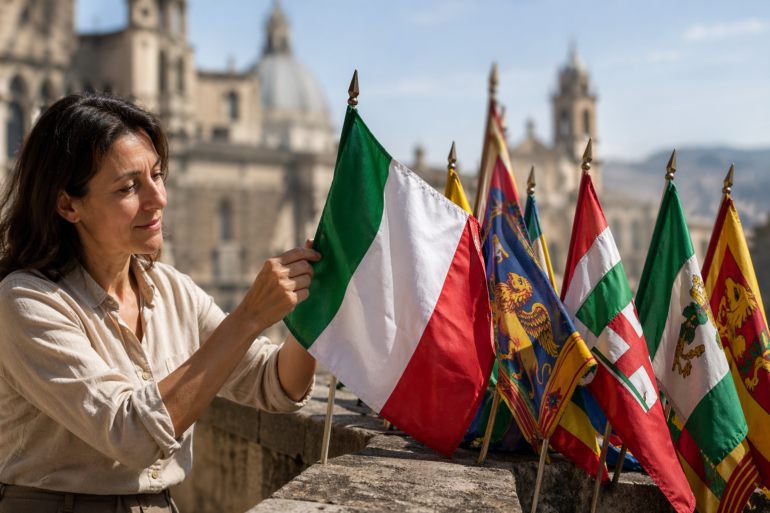
Flags From Italy tell a bigger story than many people expect. At first glance, most readers think only of the national tricolor, but the visual identity of Italy goes much deeper than one green, white, and red banner. Flags From Italy reflect political history, regional pride, medieval traditions, island identity, and the way local communities have carried symbols across centuries. The result is a rich and layered flag culture that feels unmistakably Italian.
If you have ever looked at Flags From Italy and wondered why some feel simple while others look highly ornate, that difference comes from how Italy developed as a country. Italy became a unified state in the nineteenth century, but its regions, republics, duchies, kingdoms, and maritime powers had already built strong identities long before national unification. That is why Flags From Italy often combine official state symbolism with local memory, religion, heraldry, and civic tradition.
In practical terms, Flags From Italy can be grouped into three broad levels. There is the national flag, which represents the Italian Republic. There are regional flags, which reflect the identity of Italy’s twenty regions. Then there are city, provincial, historical, and ceremonial banners that still appear during festivals, public processions, and official events. Understanding those layers makes Flags From Italy far more interesting than a simple collection of colors and shapes.
What Are Flags From Italy?
Flags From Italy are the national, regional, and local flags associated with the Italian Republic and its historic territories. Some are modern official emblems created by regional law. Others are older symbols that survived because people continued to identify with them long after political borders changed. In other words, Flags From Italy are both legal symbols and cultural memory in fabric form.
That is one reason this topic attracts travelers, history readers, students, designers, and genealogy enthusiasts. When you study Flags From Italy, you are not only looking at flag design. You are also reading clues about faith, trade, war, autonomy, geography, and local heritage.
The National Flag Among Flags From Italy
The best known of all Flags From Italy is the national tricolor, known as il Tricolore. Article 12 of the Italian Constitution defines the flag of the Republic as green, white, and red in three vertical bands of equal size. That official wording matters because it fixes both the order and the structure of the design.
The modern flag looks simple, but its history is long. Britannica traces the origins of the green, white, and red tricolor to the late eighteenth century, during the political upheavals connected to the Napoleonic era and the republican experiments in northern Italy. The tricolor later became a unifying symbol during the Risorgimento, the movement that led toward Italian unification.
Today, when people think of Flags From Italy, this is the image they usually picture first:
- Green on the hoist side
- White in the center
- Red on the fly side
- Three vertical bands of equal size
That structure is elegant because it is easy to recognize, easy to reproduce, and loaded with national meaning. It also leaves room for interpretation, which is part of why the Italian tricolor has remained emotionally powerful.
What Do the Colors Mean?
One of the most common questions about Flags From Italy is what the colors actually mean. The honest answer is that there is no single official interpretation fixed in the Constitution. Over time, several explanations have circulated, and each reflects a different way Italians have understood the flag.
Popular interpretations often describe:
- Green as the country’s plains and hills, or hope
- White as the snow of the Alps, or faith
- Red as the blood shed for independence, or charity
These meanings are widely repeated because they connect the flag to both landscape and national feeling. Even when a meaning is symbolic rather than legally defined, it still matters because symbols work through shared recognition. That is especially true with Flags From Italy, where emotional association often travels alongside official status.
Why Regional Identity Matters in Flags From Italy
To understand Flags From Italy fully, you need to understand Italy itself. Britannica notes that Italy is divided into twenty regions, and five of them have special autonomous status. That administrative structure helps explain why regional symbolism remains so visible. Italy may be one nation, but it is also a mosaic of territories with distinct histories, dialects, and traditions.
The five autonomous regions are:
- Sicily
- Sardinia
- Trentino Alto Adige/South Tyrol
- Aosta Valley
- Friuli Venezia Giulia
Because those regions hold particularly strong historical identities, Flags From Italy often become most visually striking at the regional level. Some regional flags are straightforward civic emblems. Others are bold, symbolic, and deeply tied to local history.
How Regional Flags From Italy Usually Look
Regional Flags From Italy are often more detailed than the national flag. Rather than relying on three plain color bands, many regional designs use coats of arms, crosses, historic emblems, saints’ symbols, or heraldic animals. That makes sense because regional flags tend to preserve medieval and early modern traditions that the national tricolor intentionally simplified.
A few recurring design traits show up again and again in Flags From Italy:
| Design feature | What it often represents |
|---|---|
| Crosses | Christian heritage, crusading memory, civic identity |
| Lions | Venice, Saint Mark, strength, prestige |
| Human heads or faces | Historic emblems, contested memory, island identity |
| Heraldic shields | Noble, civic, or regional authority |
| Red, white, gold, and blue | Older heraldic traditions rather than modern nationalism |
That visual variety is one reason Flags From Italy appeal to both casual readers and serious vexillology enthusiasts.
Sardinia and One of the Most Recognizable Flags From Italy
Among regional Flags From Italy, Sardinia stands out immediately. The Sardinian flag, often called the Four Moors, features a red cross on a white field with four Moor heads, one in each quarter. The current regional version was adopted in modern law after earlier forms had circulated for centuries.
This design is memorable because it does not look like a typical modern administrative flag. It feels historic, layered, and slightly mysterious. The symbol is linked to the island’s long and complex history, including Aragonese and later political traditions. That alone makes Sardinia an excellent example of how Flags From Italy preserve older identities rather than replacing them with generic modern branding.
For travelers, the Sardinian flag is also a reminder that island identity in Italy can be especially strong. In places like Sardinia, the regional symbol is not just decorative. It often carries emotional and cultural weight in everyday life, festivals, public buildings, and local merchandise.
Veneto and the Legacy of Saint Mark
Another striking example among Flags From Italy is the flag of Veneto. The regional flag draws from the symbolism of the historic Republic of Venice and prominently features the Lion of Saint Mark. The design is more elaborate than a standard national flag, and that is exactly the point. Veneto’s emblem speaks to Venice’s centuries as a maritime power, commercial hub, and independent political force.
The lion is not a random decorative choice. It signals a deep connection to Venetian identity, memory, and prestige. This is where Flags From Italy become especially revealing. A regional flag does not just identify territory. It can carry the story of a former republic, its patron saint, and the legacy of its power.
Sicily and Symbolic Depth
Sicily is another place where Flags From Italy take on a powerful local character. Although the Sicily result set here is less official than the national and Sardinian sources, the Sicilian emblem is widely associated with the Trinacria or triskelion, a symbol tied to the island’s triangular geography and long classical heritage. That emblem remains one of the most recognizable local symbols in Italy.
Even when readers begin with the national flag, they often stay interested because regional symbols like Sicily’s show how much visual storytelling can fit into a single design. With Flags From Italy, a flag is rarely just a marker. It is usually a compact historical narrative.
Why So Many Flags From Italy Feel Historical
Many people assume national flags are the main event and regional flags are secondary. Italy often flips that expectation. The national flag is extremely important, of course, but many regional and local banners feel visually older and historically denser. That is partly because the Italian tricolor was designed to unify. Regional flags, by contrast, often preserve distinctions.
Before unification, the Italian peninsula was divided among different states, including republics, duchies, kingdoms, papal territory, and foreign-influenced domains. Those political realities left a strong visual legacy. So when you browse Flags From Italy today, you are often looking at symbols that predate the modern republic by a very long time.
Flags From Italy in Festivals, Tourism, and Public Life
Flags From Italy are not confined to museums or textbooks. You can see them in daily life, especially during holidays, sports events, city celebrations, religious processions, and historical reenactments. The national tricolor appears on public buildings and during official state ceremonies. Regional flags appear during local events where civic pride matters just as much as national identity.
For travelers, this creates a richer experience on the ground. You may arrive expecting one national symbol and leave noticing dozens of local ones. That is particularly true in historic centers, port cities, and island regions where symbolic traditions remain highly visible.
In tourism, Flags From Italy serve practical and emotional purposes:
- They help visitors identify place-based heritage
- They create a sense of continuity between past and present
- They turn regional history into something instantly visible
- They reinforce local pride during public celebrations
That visual layer helps explain why Italy often feels regionally distinct even within a unified national culture.
How to Read Flags From Italy More Intelligently
If you want to make sense of Flags From Italy without getting overwhelmed, it helps to ask a few simple questions every time you see one.
1. Is it national, regional, or local?
This is the first filter. A plain vertical tricolor is national. A more ornate design with a crest, lion, or historic symbol is often regional or local.
2. Does the design look modern or heraldic?
Modern flags usually use fewer elements. Heraldic flags often borrow from coats of arms, medieval emblems, religious signs, or old civic iconography.
3. Is the symbol tied to geography, religion, or political history?
Many Flags From Italy are easiest to understand once you identify the source of meaning. Some refer to islands or landscapes. Others reflect saints, republics, or former ruling powers.
4. Is the flag still active in public culture?
A symbol that appears in official offices, festivals, and regional branding is not merely historical. It is still alive in local identity.
Common Misunderstandings About Flags From Italy
A lot of online discussions flatten the topic too much. Here are a few quick corrections that help.
Myth: Italy only really has one meaningful flag.
Reality: The national tricolor is central, but regional flags remain culturally significant across the country.
Myth: All regional flags are modern marketing tools.
Reality: Many regional symbols draw on older political, religious, or heraldic traditions.
Myth: The colors of the national flag have one official meaning.
Reality: The Constitution defines the design, but not one exclusive official symbolic interpretation.
Why Flags From Italy Matter Beyond Design
Flags From Italy matter because they show how identity works in a country built from both unity and difference. The national flag tells the story of the republic and the idea of Italy as one nation. Regional flags remind you that local memory did not disappear when the state unified. Both levels matter, and both continue to shape how Italians represent themselves publicly.
That balance is one of the most interesting things about Italy. National belonging is strong, but so is regional belonging. You can see that in language, cuisine, architecture, festivals, and, of course, in Flags From Italy.
Final Thoughts on Flags From Italy
Flags From Italy are worth paying attention to because they turn history into something visible at a glance. The national tricolor captures the idea of a united republic. Regional flags bring forward older stories, island identities, civic traditions, and symbols that still matter in public life. When you look closely, Flags From Italy reveal a country that never lost its local character even as it built a shared national one.
That is what makes the subject so rewarding. You start with a flag, then end up learning about unification, autonomy, maritime republics, medieval heraldry, and local pride. For anyone who wants to understand the country more deeply, studying Flags From Italy is a smart place to begin. And if you want broader background on the country’s territorial structure, the history of Italian regions adds useful context for why so many local symbols still matter.
In the end, Flags From Italy are not just banners. They are visual keys to how Italy remembers itself.
FAQs About Flags From Italy
What is the main national flag of Italy?
The main national flag is the Italian tricolor, defined in Article 12 of the Constitution as green, white, and red in three vertical bands of equal size.
How many regions in Italy have their own identity within the state?
Italy has twenty regions, and five of them have special autonomous status, which helps explain the visibility of regional symbols and flags.
Why are some Flags From Italy more detailed than others?
Many regional flags preserve heraldic and historical traditions, while the national flag uses a simpler modern design rooted in unity and republican symbolism.
Which regional flags are especially well known?
Sardinia’s Four Moors and Veneto’s Lion of Saint Mark are among the most recognizable examples.