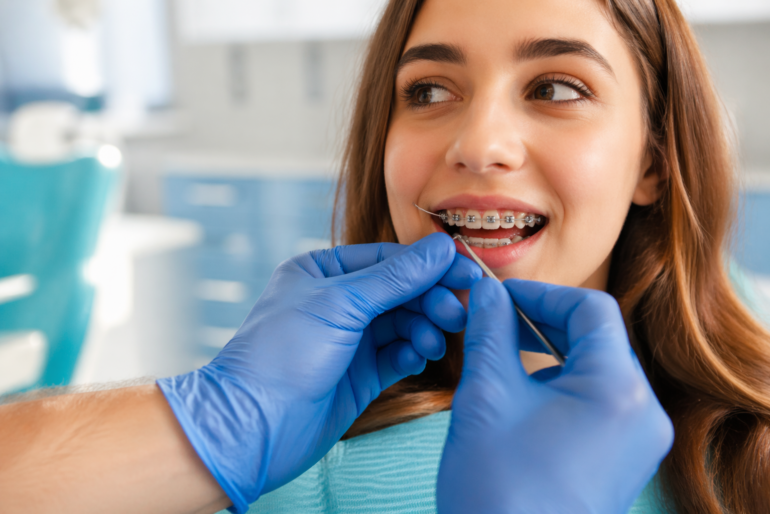
If your orthodontist has told you that you need Power Chain Braces, you are probably wondering what exactly they do, why they suddenly appear in the middle of treatment, and whether they mean your teeth are finally going to move faster. The simple answer is yes, sometimes they can help certain stages of treatment move more efficiently because they connect multiple brackets and apply extra force across a wider section of teeth. But they are not a magic shortcut. They are a tool your orthodontist uses when your case needs more coordinated movement, especially for closing spaces and improving alignment.
Power Chain Braces are small connected elastic rings that stretch from bracket to bracket instead of using a single elastic on each tooth. According to the American Association of Orthodontists, power chains are interconnected elastic ligatures used during specific parts of treatment to apply additional forces to move teeth. That is why they often show up after your braces have already done some early straightening. They are usually brought in when the orthodontist wants more control over how a group of teeth shifts together.
What makes Power Chain Braces feel different from regular braces is not just the look. It is the job they are doing. Standard elastic ties mainly hold the archwire into the bracket slot, while power chains can also help pull teeth together and maintain more unified pressure across several teeth at once. That is why many patients notice more tightness or soreness right after a power chain is placed or changed.
What Are Power Chain Braces?
Power Chain Braces are continuous elastic modules made of connected loops. Instead of one tiny band around each bracket, the chain links several brackets together. Orthodontists use them when they want to close gaps, improve spacing, help rotate teeth, or coordinate tooth movement over a section of the dental arch. They are commonly used after some initial leveling and alignment has already happened.
You can think of them as a more active version of the usual colored elastics that many people associate with braces. They may look simple, but clinically they matter because they deliver force differently. Research on orthodontic elastomeric chains shows that these materials exert force that changes over time, with significant force decay occurring early after placement, which is one reason orthodontists monitor them and replace them at adjustment visits.
That is also why your appointments matter. If a power chain stretches out too much or breaks, it may not keep doing its job the way your orthodontist intended. Broken or damaged braces parts can affect treatment timing and outcomes, which is why the AAO advises contacting your orthodontist if something comes loose or breaks.
How Power Chain Braces Move Teeth Faster
This is the question most people really care about. Do Power Chain Braces actually speed things up?
In many cases, they can help a certain phase of treatment move more efficiently, especially when the goal is to close spaces or bring teeth into closer contact. They do this by applying extra force across multiple teeth rather than treating each tooth more independently. Orthodontic tooth movement happens because controlled force changes the tissues around the tooth, including the periodontal ligament and surrounding bone. Bone is resorbed on one side and rebuilt on the other, allowing the tooth to shift gradually.
So when people say Power Chain Braces move teeth faster, what they usually mean is this: they can make certain movements more direct and more coordinated. If there is a gap after a tooth extraction, if spaces remain after early alignment, or if the orthodontist wants a row of teeth to work together, a power chain may help that stage progress more efficiently than individual ties alone. But faster does not always mean your entire treatment time will suddenly be cut in half. The biology of tooth movement still matters, and every mouth responds at a different pace.
That distinction matters because orthodontics is not just about moving teeth quickly. It is about moving them safely and predictably. Evidence suggests that force magnitude and force pattern influence comfort, tissue response, and potential side effects. In other words, the goal is efficient movement with healthy bone and roots, not simply the strongest possible pull.
Why Orthodontists Use Power Chain Braces
Orthodontists usually choose Power Chain Braces for specific reasons, not just because they are the next step for everyone.
The most common reason is space closure. If you have gaps between teeth, whether natural spacing or space created during treatment, power chains can help bring those teeth together. They may also be used to improve the way teeth contact each other, help correct minor rotations, or coordinate sections of the arch more effectively. The AAO specifically notes that power chains are used to apply extra force when needed during braces treatment.
A common real world example is a patient who had crowding, got braces, and then had a premolar extraction as part of the plan. After the early stage of leveling the teeth, the orthodontist may place Power Chain Braces to help close the remaining spaces in a controlled way. Another example is someone whose teeth are mostly straight already, but small gaps remain. A power chain can help finish the case more neatly.
Do Power Chain Braces Hurt?
They can make your mouth feel sore, tight, or tender, especially for the first few days after placement or adjustment. That is normal for many patients because braces work by putting pressure on teeth. The AAO notes that braces discomfort is usually mild and temporary, even though it can feel more noticeable right after an adjustment.
The soreness often peaks in the first day or two and then starts to ease. Soft foods, cold water, and whatever pain relief your dental professional says is appropriate can help. Orthodontic wax may also help if a bracket or chain area rubs against the inside of your mouth. If the discomfort becomes severe, a chain snaps, or something feels obviously wrong, it is a good idea to contact your orthodontist rather than waiting for your next scheduled visit.
How Long Do You Wear Power Chain Braces?
There is no single timeline for Power Chain Braces because treatment depends on your bite, spacing, age, bone response, and the goal of that phase of care. Some people wear them for only a short part of treatment, while others may have them replaced and adjusted over several visits. Because elastomeric chains lose force over time, regular follow up is important to keep the movement active and controlled.
This is why you should not compare your timeline with a friend’s braces timeline. Two people can both have Power Chain Braces and still have very different treatment lengths. One may only need small gap closure, while the other may need broader bite correction and anchorage control.
What to Expect After Getting Power Chain Braces
When Power Chain Braces are first added, you may notice three things right away. First, your braces look different because the elastic chain creates a connected appearance across several teeth. Second, your mouth may feel tighter than usual. Third, food may get trapped a little more easily, which means brushing and flossing become even more important.
You may also notice that spaces begin to look smaller over time. That is often the visible sign that the chain is doing its job. But remember that tooth movement is gradual. Healthy orthodontic movement depends on biologic remodeling, not overnight force.
Eating With Power Chain Braces
Food choices matter a lot when you are wearing Power Chain Braces. The AAO advises avoiding hard and sticky foods because they can damage braces. Foods that are difficult to chew can also make soreness feel worse right after an adjustment. Water is the best drink choice, and sugary or acidic drinks should be limited because braces create more places for plaque and food to collect.
A simple approach works best:
- Choose softer foods for a day or two after adjustments
- Avoid sticky candy, popcorn, hard nuts, and ice
- Cut tougher foods into smaller bites
- Drink water often to help rinse the mouth
- Be extra careful with foods that can pull on brackets or wires
How to Clean Power Chain Braces Properly
Cleaning is one of the most important parts of living with Power Chain Braces. Because the chain covers more area around the brackets, it can be easier for plaque and food debris to stay trapped. The American Dental Association recommends brushing twice a day and flossing once a day, and water flossers may be especially helpful for people with braces.
A good cleaning routine usually includes brushing carefully around the brackets and gumline, cleaning between teeth every day, and attending regular dental cleanings during orthodontic treatment. The AAO also advises following your orthodontist’s brushing and flossing instructions and keeping up with dental visits at least every six months, or more often if recommended.
If you do not clean well, you are not just risking bad breath. You may also increase the risk of cavities, gum inflammation, and white spot lesions around brackets. That is one reason orthodontists talk so much about oral hygiene during braces treatment.
Are Power Chain Braces Better Than Regular Braces?
This question comes up a lot, but it is not really the right comparison. Power Chain Braces are not a separate treatment from braces. They are an add on used with braces during certain phases. Regular braces do the overall mechanical work of guiding teeth, while the power chain is one of several tools your orthodontist may use when extra coordinated force is needed.
So the better question is whether Power Chain Braces are better for a specific job. For closing spaces and bringing teeth together more efficiently, they often are very useful. For other steps, your orthodontist may use different mechanics such as springs, individual ligatures, or other force systems depending on the case. Systematic reviews comparing force delivery systems in orthodontic space closure show that multiple methods exist, and the best choice depends on treatment mechanics and anchorage considerations.
Common Questions About Power Chain Braces
Do Power Chain Braces always mean treatment is almost over?
Not always. Sometimes they are used in the later finishing stages, but they can also be used earlier when space closure becomes necessary. It depends on your treatment plan.
Can Power Chain Braces be colored?
Yes. In many orthodontic offices, power chains come in different colors or clear options, although color availability varies by practice and brand. This is more of a cosmetic choice than a treatment difference.
What happens if my power chain breaks?
Call your orthodontist. A broken chain may stop delivering the intended force, and the AAO advises not ignoring broken braces components because they can affect treatment progress.
Can Power Chain Braces close all gaps?
They can help close many orthodontic spaces, but not every gap problem has the same cause. Some spaces are related to tooth size, jaw relationships, or bite patterns, so your orthodontist decides whether a power chain alone is the right tool.
The Bottom Line on Power Chain Braces
Power Chain Braces are one of the most effective tools orthodontists use when they want to close spaces, coordinate several teeth, and add more directed force to a braces system. They can make a phase of treatment move more efficiently, which is why many people feel like things suddenly start happening faster once the chain goes on. But the real story is not about speed alone. It is about controlled, biologically sound tooth movement that protects your long term result.
If you have recently gotten Power Chain Braces, the best thing you can do is stay consistent. Keep your appointments, follow food guidelines, clean carefully, and call your orthodontist if anything breaks. That combination matters just as much as the chain itself. In the final stretch of treatment, details make a big difference, and understanding the science behind orthodontic treatment can make the whole process feel much less confusing.
In short, Power Chain Braces help your orthodontist guide teeth in a more coordinated way when spacing and alignment need extra help. They may not be a miracle fix, but they are a smart and highly practical part of modern braces treatment when used at the right time. If your orthodontist has recommended them, it usually means your treatment has entered a very active and purposeful stage.