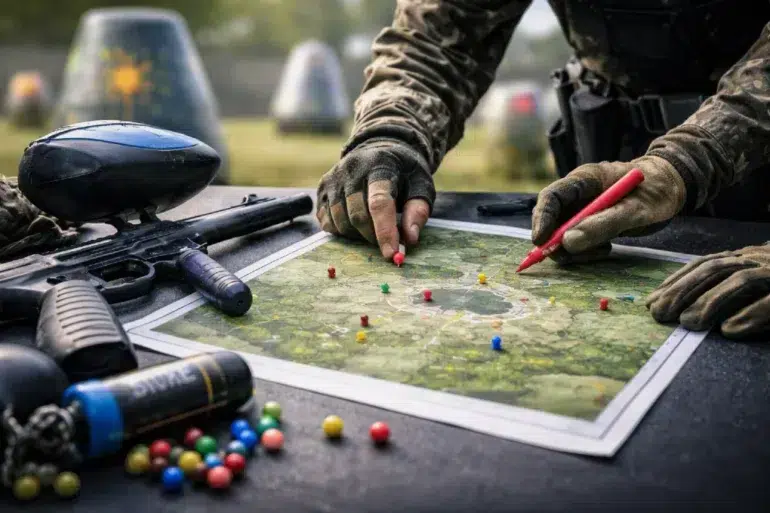
If you have ever walked onto a field and felt like the other team was always one step ahead, you are not alone. Winning in Appa Paintball is not just about shooting straighter or running faster. It is about reading the field, working angles, communicating clearly, and choosing the right moment to attack or slow the game down.
The good news is that tactics are learnable. You do not need to be the “best player” to become the most effective player. You need a repeatable plan, a few smart habits, and a team that moves with purpose. Below are 15 practical tactics you can start using right away, whether you play speedball, woodsball, or scenario games.
Before the tactics: what actually wins games in Appa Paintball?
Most matches are decided by three things:
- Positioning: who owns the best angles and lanes first
- Information: who knows where bodies are and where gaps are opening
- Tempo: who controls the pace, forcing mistakes instead of chasing highlights
Paintball also rewards safe play. Industry safety standards for paintball game sites exist for a reason, and fields often enforce rules around equipment, chronographing, and safe operation practices. Staying within field rules is not “soft”, it keeps you in the game and protects everyone.
Now let’s get into the tactics.
1) Win the first 30 seconds with a simple opening plan
Most teams step onto the field and “figure it out” after the first few exchanges. That is already too late.
A strong opening should answer two questions:
- Who takes your best forward positions fast?
- Who stays alive to feed information and cover lanes?
Quick setup (works for most formats):
- 1 player runs to a forward bunker or strong piece of cover
- 1 player takes a back angle that can protect the runner
- 1 player floats mid, ready to support either side
- Everyone calls what they see within the first 10 seconds
A clean, repeatable opening helps your team settle, even when the match gets chaotic.
2) Control lanes, not just targets
A lane is a shooting line that blocks movement. Smart teams do not wait for someone to appear. They deny space so opponents cannot move safely.
Lane control tips:
- Pick lanes that cut off the easiest routes to key positions
- Shoot short, controlled bursts instead of “spraying the whole time”
- Change lanes when you notice the enemy adapting
The goal is not to get a quick elimination. The goal is to freeze movement, then punish the next mistake.
3) Use “pairs” so nobody fights alone
One of the fastest ways to lose bodies is sending single players to take space without support. Instead, move in pairs.
Pair system basics:
- Player A moves while Player B covers
- Then Player B moves while Player A covers
- Both players share what they see, constantly
This creates safer pushes, better trades, and fewer “I got shot from nowhere” moments.
4) Communicate like it matters (because it does)
Good communication turns five players into one unit. Poor communication turns a team into five solo missions.
If you want one habit that pays off immediately in Appa Paintball, make it this: talk early, talk clearly, and talk in useful chunks.
What to call out:
- Enemy positions (left 50, back right, snake corner, tree line)
- Enemy movement (pushing left, rotating back, crossing mid)
- Your status (reloading, hit, moving, covering)
Paintball strategy resources consistently emphasize communication and coordination as core advantages, especially under pressure.
5) Play angles instead of playing “straight”
If you and an opponent are shooting directly at each other from equal cover, you are basically flipping a coin.
Angles win games.
Angle play looks like this:
- You move one bunker wider so you can see their side
- You shoot them while they can only see your front edge
- You force them to either retreat or take a bad fight
Even a small angle shift can turn an impossible shot into a simple one.
6) Do not “peek twice” from the same spot
Paintball is a pattern game. If you peek the same window twice, someone is already waiting for your mask.
Simple rule:
- If you shoot from a spot, relocate by at least one step or switch sides before peeking again
This one habit reduces easy headshots and keeps opponents guessing.
7) Use suppressive fire to move, not to look busy
Suppressive fire is not random noise. It is controlled pressure that creates a safe moment for movement.
When suppressive fire is worth it:
- When your teammate needs to cross an open lane
- When you want to stop an opponent from posting a key angle
- When you are setting up a flank
Shoot with intention. Then move or let someone else move.
8) Time your pushes when the enemy is weakest
The best time to push is rarely “right now”. It is when the other team is distracted or compromised.
Look for these signals:
- They are reloading (you see a marker drop or hear frantic shaking)
- They stop shooting a lane they were holding
- They rotate players and leave a gap
- You get a quick elimination and their line hesitates
Pushing at the right time often feels unfair. That is the point.
9) Flank with purpose, not with hope
A flank is not “running wide and praying.” A good flank is planned, covered, and timed.
Flank checklist:
- Someone covers the lane you must cross
- You know your next piece of cover before you move
- You have a clear job after you arrive (shoot their back line, cut rotations, collapse an objective)
If you cannot answer the “after I arrive” question, it is not a flank. It is a gamble.
10) Use crossfire to trap instead of chase
Crossfire happens when two teammates hold angles that overlap, making it hard for opponents to move without exposing themselves.
How to build a crossfire:
- One player posts a strong front lane
- Another player shifts wide to see the enemy’s side escape route
- You squeeze the space until someone breaks and gets tagged
Crossfire wins without hero plays. It forces predictable movement.
11) Treat bunkering as a tool, not your whole personality
Bunkering (closing distance to eliminate a player from their cover) can be effective, but it also causes unnecessary penalties, trades, and risky collisions if done poorly.
If you bunker in Appa Paintball, do it with discipline:
- Only go when your teammate can cover you
- Know the opponent’s marker position before you commit
- Commit hard, do not stop halfway in the open
- Accept that trading is sometimes still a win if it breaks a key position
For a general overview of bunkering concepts and common mistakes, you can compare how different fields and guides describe safe, effective approaches.
12) Reload and manage paint like a pro
Nothing kills momentum like hearing “I’m out!” during a push.
Paint management is tactical.
Practical habits:
- Top off pods during calm moments, not during a crisis
- Reload behind cover with your marker still pointed downrange
- If you know you are about to fight, reload early so you are not caught mid-action
A lot of “bad luck” in paintball is really just bad timing on reloads.
13) Control the midline to control the match
In many layouts, the middle positions decide everything. Mid players see rotations, deny lanes, and support both sides.
If your team can own mid safely, you get:
- Faster information
- More angles
- Cleaner pushes
- Better defense against flanks
Your mid player does not have to be the best shooter. They have to be the best decision-maker.
14) Switch tempo: speed up to punish, slow down to suffocate
Teams that only play fast get baited into traps. Teams that only play slow get walked into.
Winning teams can shift tempo.
Speed up when:
- You score a quick elimination
- You see a clear gap
- The other team is rotating badly
Slow down when:
- You are up on bodies and just need to protect lanes
- The enemy wants you to chase them into a kill box
- You are defending an objective and time is on your side
Tempo control makes opponents feel like they are always reacting.
15) Review after every game (the fastest “skill upgrade”)
This is the tactic most people skip, and it is why they plateau.
After each round, take 60 seconds and answer:
- Where did we lose the first key position?
- Which lane surprised us?
- When did communication break down?
- What single adjustment would have changed the round?
If you play multiple games in a session, small improvements stack fast.
A quick tactics table you can screenshot and use
| Tactic | Best time to use it | Common mistake |
|---|---|---|
| Opening plan | Start of every round | Everyone running forward at once |
| Lane control | When enemy relies on one route | Shooting without purpose |
| Pair movement | Any time you push | Sending one player alone |
| Strong comms | Always, especially under pressure | Too much talking, not enough useful info |
| Angle play | When fights feel “even” | Staying square and trading shots |
| Do not peek twice | When you are posted up | Repeating the same window |
| Suppressive fire | To move teammates | Burning paint for no movement |
| Timed pushes | After disruptions | Pushing into a set defense |
| Planned flanks | When lanes are covered | Flanking without a job |
| Crossfire traps | To squeeze space | Both players holding the same angle |
| Disciplined bunkers | When opponent is isolated | Charging without coverage |
| Paint management | Between fights | Reloading in the open |
| Mid control | Most layouts | Ignoring mid and getting pinched |
| Tempo switching | When the game swings | Playing one speed only |
| Post-game review | After every round | Blaming gear or luck |
Common questions players ask about Appa Paintball strategies
How do I stop getting picked off early?
Start with two fixes: do not peek twice from the same spot, and stop moving without cover. Have one teammate post a lane while you relocate. Early eliminations usually come from predictable peeks and rushed crossings.
What is the best tactic for beginners to focus on?
Pair movement plus clear callouts. If you move with coverage and communicate positions, you instantly become harder to beat even if your shooting is average.
Is aggressive play always better?
Not always. Aggression wins when it is timed and supported. Random aggression feeds the other team easy eliminations. Learn to speed up after you create advantage, not before.
How important is safety gear and field rules in performance?
Very important. A fogged mask, loose strap, or unsafe marker settings will ruin your day faster than any opponent. Paintball game site safety standards exist to reduce risk and keep games consistent.
Are paintball injuries common?
Severe injuries are not the norm, but they can happen, especially without proper eye protection or if safety rules are ignored. Research using national emergency department surveillance data has documented paintball-related injuries and emphasizes the importance of safety practices and protective equipment.
A real-world scenario: turning a messy round into a clean win
Imagine your team loses the first duel on the left. Most teams panic, rotate randomly, and get pinched.
A smarter response looks like this:
- Back player immediately posts the lane that prevents the enemy from sprinting deeper
- Mid player calls the new enemy position and slows tempo
- Right-side pair takes a wide angle and builds crossfire into the enemy’s new left control point
- Once you get one elimination, you push together and collapse space
Notice what changed: you stopped reacting emotionally and started reacting tactically.
That is how Appa Paintball rounds swing.
Conclusion: win more games by playing smarter, not louder
If you want to improve quickly in Appa Paintball, stop hunting the perfect highlight and start stacking small advantages. Win the opening with a plan. Control lanes. Move in pairs. Use angles. Communicate like a teammate, not a commentator. Then review what happened so the next round is cleaner.
Paintball looks chaotic, but the teams that win consistently usually do the basics at a higher level. And once you do that, the fancy stuff becomes easier, safer, and way more effective.
In the last few minutes before your next session, pick just three tactics from this list and commit to them. Your game will feel different almost immediately, and your teammates will notice.
One extra edge most players ignore is mental control. If you stay calm, you see options faster, you communicate better, and you do not chase bad fights. That is sports psychology in action, even if you never call it that. Here is a quick read on sports psychology if you want the basics.