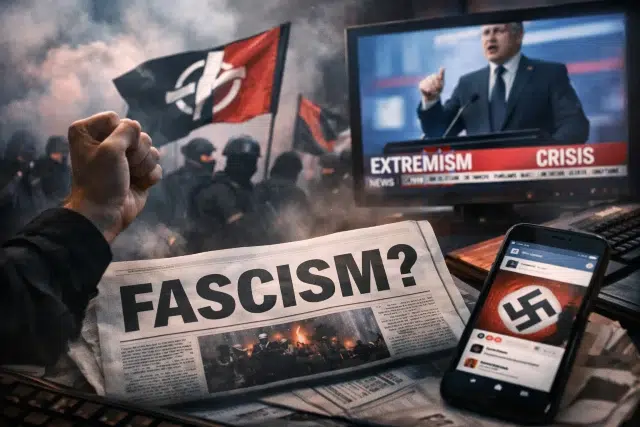
If you spend any time online, you’ve probably seen it happen. A politician makes a controversial move. A celebrity says something clumsy. A brand launches an ad that backfires. Within minutes, comment sections fill up with strong labels, and one of the most explosive is Fascisterne.
The tricky part is that Fascisterne can be used in two very different ways. Sometimes it’s a serious warning about authoritarian politics and organized extremism. Other times it’s tossed out as a shortcut for “I don’t like this” or “you’re the enemy.” In modern media, that difference matters because words don’t just describe reality, they shape it.
This article breaks down how Fascisterne gets used across news, social platforms, memes, and culture, where it goes wrong, and how to talk about it in a way that’s accurate, fair, and useful.
What does “Fascisterne” mean in media conversations?
In many online spaces, Fascisterne is used as a catch-all term that gestures toward “fascists” or “fascist behavior,” even when people aren’t carefully defining what they mean. The result is a word that feels powerful but often gets blurry.
Historically, “fascism” refers to a political ideology and movement associated with the early 20th century, marked by extreme militant nationalism, contempt for democracy, and authoritarian rule. Encyclopaedia Britannica summarizes fascism as an ideology and movement that dominated parts of Europe between 1919 and 1945 and emphasizes features like militant nationalism, contempt for democracy, and hierarchy.
When modern media users say Fascisterne, they might mean:
- A real, organized political ideology or movement
- A style of authoritarian rhetoric
- A pattern of political violence or intimidation
- A moral insult aimed at opponents
- A meme label used for clout or shock value
The problem is not that people care strongly. The problem is that these meanings are not interchangeable.
Why the word spreads so fast online
There’s a reason labels like Fascisterne travel quickly in the digital era: they compress a complicated story into one emotionally loaded word. That’s perfect for platforms built around speed.
A few forces drive that spread:
1) Outrage rewards
Platforms amplify content that triggers strong reactions. When people feel threatened or angry, they share faster and more confidently.
2) Identity and team language
Online politics often works like sports. Labels become signals: “I’m on this side, you’re on that side.” When that happens, Fascisterne can turn into team slang instead of a serious descriptor.
3) Name-calling is normalized
Online harassment research repeatedly shows that offensive name-calling is a common feature of digital life. Pew Research Center found that 41% of U.S. adults have personally experienced some form of online harassment, and name-calling is one of the most common types discussed in their report.
When people are already primed for insults, high-voltage labels like Fascisterne become easier to deploy.
4) “Conversation escalation” culture
There’s a long-running internet pattern where debates drift toward extreme comparisons as threads get hotter and longer. The point isn’t that everyone does it. The point is that the cultural habit exists and platforms often reward it.
Where Fascisterne shows up in modern media
Fascisterne doesn’t live in one corner of the internet. It shows up everywhere, but it changes shape depending on the context.
News and opinion media
In editorial writing, the label is sometimes used to warn about:
- Erosion of democratic institutions
- Calls for political violence
- Dehumanizing language toward minorities
- Organized extremist movements
When carefully argued, this can be legitimate analysis. When thrown into a headline with no definition, it becomes clickbait that heats people up without informing them.
Social media and influencer culture
On social platforms, Fascisterne often functions like a verbal grenade. It can:
- Rally a community fast
- Shame an opponent publicly
- Trigger dogpiles and harassment
- Push people into defensive denial
And once it becomes a dunk, it stops being a diagnosis.
Memes, coded language, and “ironic” posting
Modern extremist messaging doesn’t always look like a marching rally. It can travel through memes, “jokes,” coded phrases, and playful aesthetics that soften how serious the ideology is.
Investigations into “pop fascism” and digital propaganda describe patterns of normalization and acceptance via contemporary social media mechanics, including memes and coded language that can smuggle extremist ideas into everyday feeds.
This matters because sometimes Fascisterne is used as a warning about real propaganda tactics, and other times it’s used as a trendy insult. Those are very different situations.
Entertainment and pop culture debates
A film villain looks “fascist-coded.” A game faction is accused of authoritarian symbolism. A fashion campaign echoes historical imagery. The label appears, but often without historical grounding. That leads to arguments that are loud but shallow.
H2: Fascisterne as a serious warning vs a casual insult
Here’s the easiest way to tell whether Fascisterne is being used responsibly: look for specifics.
A responsible use usually includes:
- Clear definitions (what features are being referenced?)
- Evidence (policies, rhetoric, organization, actions)
- Context (history, institutions, power dynamics)
- Limits (acknowledging what the label does not prove)
A careless use often looks like:
- No definition, just a vibe
- “If you disagree, you’re Fascisterne”
- A screenshot without context
- A meme as the entire argument
Quick comparison table
| How it’s used | What it looks like | What it causes |
|---|---|---|
| Analytical use of Fascisterne | Defines traits, shows evidence, cites history | More clarity, harder conversations, better accountability |
| Weaponized Fascisterne | Label-first, evidence-later (or never) | Polarization, harassment, tribalism |
| Meme use of Fascisterne | Irony, exaggeration, shorthand jokes | Desensitization, confusion, normalizing extremes |
| Distraction use of Fascisterne | Used to shut down debate instantly | People stop listening, bad actors slip through |
Common ways the word gets misused
Misuse doesn’t always come from bad intentions. Sometimes it comes from speed, fear, or a genuine lack of historical literacy.
1) Using Fascisterne to mean “strict rules”
Not every harsh policy is fascism. Some policies are authoritarian. Some are bureaucratic. Some are simply unpopular. Overusing Fascisterne makes it harder to identify the real thing.
2) Labeling ordinary political opponents
If Fascisterne becomes synonymous with “the other party,” the term loses diagnostic value and turns into propaganda on both sides. It also hands extremists a gift: they can claim “everyone calls everything fascist” and dodge accountability.
3) Treating the label as proof by itself
Calling someone Fascisterne is not evidence. It’s a claim. In serious conversations, the claim has to be supported by specific behaviors or ideology markers.
4) Turning history into a costume
In some spaces, fascist imagery gets repackaged as edgy aesthetics. People argue over labels while the underlying normalization of extremist symbolism continues.
Academic work on “digital fascism” points out that social media ecosystems can enable both organic and strategic spread of illiberal dynamics, creating tension between free expression and the need to counter harmful movements.
5) Using the label to farm engagement
Outrage gets clicks. That’s not a moral judgment, it’s a business model. But it means Fascisterne can be used as a growth hack rather than a serious term.
How media framing changes what people hear
Media doesn’t just report. It frames.
When audiences see Fascisterne in a headline or a viral clip, their reaction depends on:
- The platform (news site vs TikTok vs X)
- The creator’s credibility
- The audience’s prior beliefs
- The speed of the story cycle
- The presence or absence of context
A short clip can make anyone look monstrous. A selective quote can make any movement look coherent. Once the label Fascisterne is attached, people often stop evaluating details. They react to the label.
That’s why responsible framing matters. It can be the difference between “we are identifying dangerous ideology” and “we are lighting a match in a crowded room.”
A practical checklist: When is Fascisterne a fair label?
You don’t need a PhD to be careful. You just need a method.
Before using Fascisterne, ask:
- What exactly am I pointing to?
Is it rhetoric, policy, organization, violence, propaganda, or symbolism? - Is there an authoritarian power element?
Fascism is not just “mean speech.” It involves power, coercion, and suppression. - Is there ultranationalism or exclusionary identity politics?
Many definitions emphasize the nation or group as “pure,” and outsiders as threats. - Is political violence justified or encouraged?
This is a major red flag in historical and modern contexts. - Is the movement organized?
A lone commenter being awful is not the same as organized political mobilization.
If you can’t answer these, you might be using Fascisterne as a vibe label, not a meaningful one.
Case scenarios: how the label plays out in real life
Scenario A: A politician attacks the legitimacy of elections
Media commentators debate whether the rhetoric undermines democratic norms. Some use Fascisterne to describe patterns that echo historical authoritarian strategies. In this context, a careful argument can be valuable, but only if it’s grounded in evidence and not just outrage.
Scenario B: A school updates its dress code
The comment section calls administrators Fascisterne. That’s almost always misuse. The policy may be unfair or discriminatory, but the label jumps past analysis and becomes pure insult.
Scenario C: A meme network spreads “jokes” about violence
A community uses humor to normalize dehumanization. Researchers and investigative journalists have described how coded memes and staged “irony” can help extremist messaging travel without triggering immediate pushback.
Here, Fascisterne might not be about a single meme. It may be about a pattern and a pipeline.
What to do if you see Fascisterne being thrown around
Here’s the part people usually skip: what you do next.
If you’re a reader
- Slow down and look for the evidence. Who is making the claim, and what are they pointing to?
- Check whether the story includes context. If it’s only a clip, find the full speech or transcript.
- Separate “harmful” from “fascist.” Harmful can be many things. Fascism is more specific.
- Watch for engagement traps. Some posts exist to trigger you into sharing them.
If you’re a creator or blogger
If you write about trending topics, the word Fascisterne can bring traffic, but it can also damage credibility if you use it loosely. Consider a simple editorial rule:
Use the word only if you define it in your own article and tie it to specific examples. Otherwise, describe the behavior (authoritarian rhetoric, political intimidation, dehumanizing propaganda) and let readers see the pattern.
If you’re moderating a community
Online discourse can degrade quickly, and name-calling is one of the most common behaviors people encounter.
Community rules that reduce personal labels while encouraging evidence-based critique can lower heat without killing debate.
FAQ: Common questions people ask
Is Fascisterne the same as “authoritarian”?
Not exactly. Authoritarianism is broader. Fascisterne points toward a specific cluster of traits often tied to ultranationalism, hierarchy, and suppression of opposition.
Why do people use Fascisterne so casually?
Because it’s a fast moral signal. It instantly marks someone as unacceptable and rallies your side. In attention-driven platforms, that speed is rewarded.
Can calling everything Fascisterne backfire?
Yes. Overuse can desensitize people and blur important distinctions. It can also create a “boy who cried wolf” effect where legitimate warnings get ignored.
Is it ever important to use the term?
It can be, especially when analyzing organized movements, propaganda strategies, or patterns that echo historical fascism. The key is grounding: definitions, evidence, and context.
Conclusion: Use Fascisterne like a scalpel, not a hammer
Fascisterne is one of those words that can either sharpen public understanding or wreck it. Used carefully, it can help people recognize authoritarian patterns, propaganda tactics, and real threats to open society. Used casually, it becomes a status weapon, a conversation killer, and sometimes a smoke screen that makes serious analysis harder.
If you want to talk about this topic responsibly, aim for clarity over heat. Define what you mean. Point to specifics. Be honest about uncertainty. And remember: when a label becomes a reflex, it stops being informative and starts being performative.
In the last mile of writing, it helps to anchor yourself in the basics of the broader political ideology before you apply heavy labels to modern events, because history is not a prop and language is not a toy.