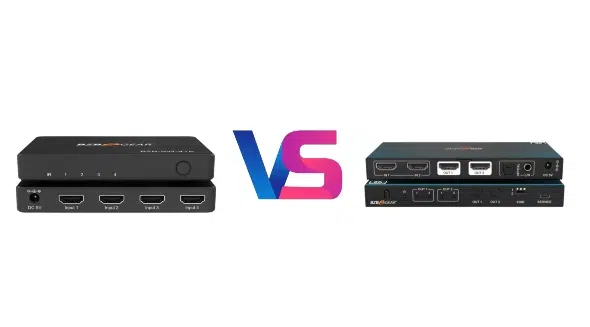
It’s not uncommon for most modern AV setups to integrate and rely on smart connectivity solutions to help them manage multiple sources and displays. The two most common of these tools are going to be the HDMI switcher and the HDMI matrix switcher. While both of these allow for simplified AV routing, they do differ in their flexibility, scalability and practical application. Understanding both of these devices will help you to design a cleaner and more efficient AV system.
What Is an HDMI Switcher?
Typically when talking about an HDMI switcher, it’s referring to a device that allows for several HDMI sources to be able to connect to a single display. From Blu-ray players all the way to laptops or gaming consoles these devices remove the need to constantly plug and unplug things or fiddle with remotes, all you have to do is press a button and you can swap between the sources!
HDMI switchers are ideal for:
- Home theaters with multiple devices connected to one TV.
- Small offices or classrooms that rely on a single projector or monitor.
- Conference rooms where presenters alternate between laptops.
For example, this hdmi switcher from BZBGEAR supports 4K resolution, HDR, and boasts HDMI 2.0 compatibility, which helps to ensure seamless transitions between sources without sacrificing image quality. It’s a compact, cost-effective solution for everyday multimedia setups.
What Are HDMI Matrix Switchers?
An HDMI matrix switcher is very similar, except it ups the ante by allowing for multiple displays to be added into the mix. This means that you can have several sources and independently route them to whatever display you want them to go to. Or in other words, you could have a signal from your Blu-ray player being sent to a living room while the laptop is being sent to an office room all at the same time and then swap as you see fit.
These systems are perfect for:
- Corporate environments and boardrooms that manage multiple screens.
- Digital signage networks needing flexible content routing.
- Control centers and live event venues requiring simultaneous video feeds.
BZBGEAR’s hdmi matrix switchers deliver high-bandwidth 4K UHD support, HDCP compliance, and advanced control options for scalable, professional AV systems.
Choosing Between an HDMI Switcher and a Matrix Switcher
When trying to figure out which one makes more sense, consider:
- Number of sources and displays — Switchers handle multiple inputs to one output, while matrix systems handle both multiple inputs and outputs.
- Application scale — Use switchers for small spaces; use matrix switchers for complex, multi-room environments.
- Budget and growth — Switchers are affordable; matrix systems are investments in long-term scalability.
Both technologies simplify AV management, reduce clutter, and deliver smooth, high-quality video performance.