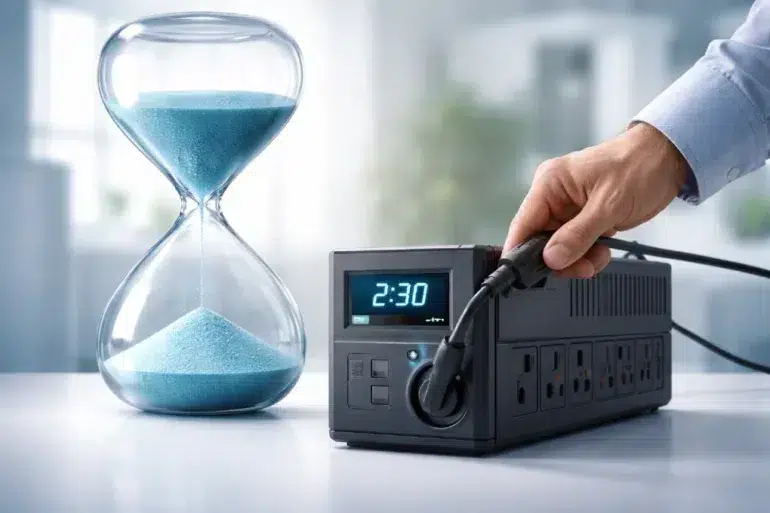
If you have ever watched the lights flicker and immediately wondered whether your PC, router, or office setup would stay alive, you are already thinking about Uninterruptible Power Supply Hours. That phrase sounds simple, but the answer is not. A UPS does not give every device the same backup time, and it certainly does not deliver a fixed number of hours just because the label shows a certain VA rating. In real use, runtime depends on load, battery size, efficiency, battery age, temperature, and the kind of UPS you are using. Manufacturer runtime charts and calculators make this clear, and most standard desktop UPS units are built for short bridge time rather than all day operation.
That is why buyers often get confused. They assume a 1500VA unit will run a desktop for hours, then discover it may only provide enough time to save work, shut down cleanly, or keep a modem and router online during a brief outage. For many people, that is exactly the point. A UPS is designed to protect electronics, prevent sudden shutdowns, and buy you a short but valuable window of time. Emergency preparedness sources also stress planning around how long battery backup actually lasts, especially when power interruptions affect communications or essential equipment.
So how long can a UPS really run your devices? Let’s break it down in plain English.
What Uninterruptible Power Supply Hours really means
When people search for Uninterruptible Power Supply Hours, they usually want one of three answers:
- How long a UPS can keep a device running during a power outage
- How to estimate runtime before buying a UPS
- Why actual backup time is often shorter than expected
In technical terms, UPS runtime is the amount of time the unit can continue supplying power from its battery after utility power fails. It is usually expressed in minutes, though people often say “hours” in searches because they are trying to compare how long different devices can stay on. In practice, many consumer and office UPS models are designed to provide around 5 to 15 minutes at meaningful load, which is enough for safe shutdown or short continuity, not long duration backup.
That short runtime is not a flaw. It is the intended design for most small UPS systems.
Why UPS runtime changes from one setup to another
The biggest reason UPS runtime varies is simple: devices do not all draw the same amount of power.
A Wi Fi router might use only 8 to 20 watts. A desktop PC and monitor could pull 200 to 400 watts under normal use. A gaming PC under load may draw much more. The same UPS that keeps a router running for a long stretch may only support a powerful computer for a short window. Schneider Electric notes that runtime calculations depend on the load attached to the UPS and the battery capacity available. Eaton’s runtime tools show the same pattern across its product ranges: as load rises, runtime drops.
The main factors are:
- Load in watts
Higher watt draw means shorter runtime. - Battery capacity
More battery capacity generally means longer runtime. - UPS efficiency
Some energy is lost in conversion, so not every stored watt hour reaches the device. - Battery condition
Older batteries hold less charge and discharge less effectively. - Ambient temperature
Heat shortens battery life and can reduce dependable runtime over time. - UPS topology
Standby, line interactive, and online UPS systems behave differently and are used for different needs.
A simple way to estimate UPS backup time
A rough estimate can help before you consult a manufacturer runtime chart.
A simplified approach looks like this:
Runtime in hours = usable battery watt hours ÷ device load in watts
For example, if a UPS has roughly 216Wh of battery capacity and about 80 percent usable efficiency, the usable energy is around 173Wh. If your connected equipment draws 100 watts, runtime may be around 1.7 hours in a simplified estimate. But real world discharge curves, inverter losses, battery age, and load spikes reduce precision, which is why manufacturer calculators remain more reliable than generic math. Eaton explicitly notes that actual runtime can vary, and some of its battery runtime pages state that real results may differ by about plus or minus 15 percent depending on equipment, temperature, battery age, and configuration.
Here is a practical rule of thumb:
| Device Type | Typical Power Draw | Likely UPS Runtime Trend |
|---|---|---|
| Modem or router | 8 to 20W | Often much longer runtime |
| Laptop charger | 45 to 90W | Moderate runtime |
| Desktop PC | 150 to 300W | Shorter runtime |
| Gaming PC | 300W and above | Much shorter runtime |
| CCTV or small network gear | 20 to 80W | Moderate to long runtime |
| Server or workstation | 400W and above | Usually short unless using larger UPS systems |
This table is directional, not absolute. The exact answer always comes back to your specific UPS model and your real load.
Why VA rating does not tell the whole story
A lot of shoppers look only at VA, such as 650VA, 1000VA, or 1500VA. That is useful, but it is not enough.
VA refers to apparent power, while your devices consume real power in watts. A UPS rated at 1500VA may not deliver 1500 watts. In fact, many models have a lower watt rating, and the runtime chart is based on the actual watt load, not just the VA label. Wikipedia’s overview of UPS systems also notes that units are given VA ratings across a wide range, while real runtime still depends on battery storage and discharge behavior.
So when comparing UPS models, check:
- VA rating
- Watt rating
- Battery chemistry
- Runtime chart at your expected load
- Whether external battery modules are supported
This is where many buyers make the wrong purchase. They buy for peak capacity, not runtime.
Typical Uninterruptible Power Supply Hours by device type
Let’s make this more practical.
Router and modem
For internet equipment, a UPS can feel surprisingly capable because the power draw is low. A basic router and modem combo may use less than 30 watts total. In that case, many decent UPS units can keep your connection alive far longer than they could support a desktop tower. This is one of the best use cases for a UPS in the home.
Desktop computer and monitor
A home or office desktop setup usually lands somewhere in the mid range for power draw. If you connect a tower, one monitor, and perhaps a few accessories, runtime is commonly short to moderate. That may be enough to save documents, finish a call, and power down safely. It is not usually enough for long uninterrupted work unless the system load is quite low or the UPS battery bank is larger.
Gaming PC
Gaming systems are where expectations often crash into reality. Powerful GPUs, high refresh monitors, RGB accessories, and external drives all add to the load. A UPS that seems large on paper can deliver only a brief runtime under gaming conditions. If the goal is to keep gaming during an outage, most standard consumer UPS units are the wrong tool. If the goal is safe shutdown and hardware protection, they work very well.
NAS, servers, and office gear
Small business users often rely on UPS systems to prevent data corruption, maintain connectivity, and give servers enough time for automated shutdown. Runtime here is planned, not guessed. Eaton’s load and runtime tools are built around this idea: size the UPS to your actual load and desired endurance, not to marketing assumptions.
Why runtime drops faster than most people expect
One of the most important things to understand about Uninterruptible Power Supply Hours is that runtime does not usually scale in a neat straight line.
If you cut load in half, runtime may increase dramatically, but not always in a perfectly proportional way. Battery discharge behavior is more complicated than that. UPS documentation and battery references note that battery type, discharge rate, and inverter efficiency all matter. Lead acid batteries, which are still common in UPS systems, do not behave like a perfect fuel tank. Faster discharge can reduce effective available capacity.
This is why two people with the same UPS can report very different experiences:
- One uses it for a router and gets a long window
- Another powers a desktop and gets only several minutes
- A third thinks the battery is defective, but the real issue is a much higher load than expected
Battery age matters more than most users realize
A UPS can look healthy and still provide disappointing runtime because the battery has aged.
Schneider Electric states that VRLA UPS batteries typically last about 3 to 5 years in optimal conditions, while lithium ion options can last about 8 to 10 years in good operating conditions. It also warns that elevated temperatures, repeated discharges, and poor environmental conditions shorten battery life. APC documentation similarly notes that higher ambient temperatures can dramatically reduce expected service life.
That means your UPS may still turn on, pass self tests, and offer surge protection, yet no longer deliver the backup duration it once did.
Signs of aging battery performance include:
- Runtime drops sharply compared with earlier months or years
- The UPS beeps and shuts off sooner than expected
- Recharge time seems longer
- Battery replacement warnings appear
- The unit struggles under loads it once handled easily
If your UPS is several years old, weak runtime is often a battery issue before it is a UPS electronics issue.
Temperature can quietly ruin UPS performance
Heat is one of the biggest enemies of UPS batteries.
APC notes that a battery expected to last 4 years at 25°C may last only about 2 years at 33°C. Riello also states that VRLA batteries are typically rated around 20 to 25°C, and a sustained 10°C rise above recommended temperature can cut service life roughly in half. Even when the short term runtime seems acceptable, long term exposure to heat shortens the battery’s ability to hold reliable charge.
That is why placement matters. Do not tuck a UPS into a sealed cabinet, next to a heater, or behind a device that dumps hot air directly into it.
Standby vs line interactive vs online UPS
UPS type affects both protection quality and buying decisions.
According to Wikipedia’s summary of common UPS topologies, the main categories are standby, line interactive, and online. Standby models are common for simple home use. Line interactive units add better voltage regulation and are widely used for workstations and small offices. Online UPS systems use continuous double conversion and are typically chosen for sensitive or mission critical loads.
Here is the practical difference for most buyers:
- Standby UPS
Good for basic home electronics and short backup needs. - Line interactive UPS
Better for desktops, network gear, and moderate protection needs. - Online UPS
Best for critical systems where clean and continuous power matters most.
A more advanced UPS may improve power quality and reliability, but it does not automatically mean dramatically longer runtime. Battery capacity still does the heavy lifting there.
Real world scenarios that make runtime planning easier
Scenario 1: Work from home setup
You have a fiber modem, Wi Fi router, laptop charger, and one monitor. Total draw might be modest. In this case, a UPS can keep your internet alive and let you continue working or at least finish a call. This is one of the most cost effective uses of backup power.
Scenario 2: Desktop editing or office workstation
Your desktop, display, and external drive create a heavier load. Here the UPS should be sized around safe save and shutdown time, not around continuing a full work session through a long outage.
Scenario 3: Gaming rig
You lose power in the middle of a session. The UPS keeps the system alive long enough to exit safely and avoid abrupt power loss. That is a win. Expecting hours of play from a standard tower UPS is usually unrealistic.
Scenario 4: Small business network closet
A router, switch, modem, and firewall often draw relatively low power compared with full computers. That means a UPS can deliver solid continuity for communications equipment while giving servers time to shut down properly.
How to increase UPS runtime safely
If longer Uninterruptible Power Supply Hours is your goal, there are realistic ways to improve it.
1. Reduce the connected load
This is usually the fastest fix.
Disconnect non essential items such as:
- Printers
- Speakers
- Desk lamps
- Extra monitors
- Chargers that do not need backup
The lower the load, the longer the runtime.
2. Choose the UPS by runtime, not just by VA
Use the manufacturer’s runtime chart or calculator. Eaton specifically offers load and runtime tools for matching your desired endurance to real equipment load.
3. Replace old batteries on schedule
If you are still using the original battery after several years, runtime may no longer reflect the unit’s original capability.
4. Keep the UPS cool and ventilated
Battery life suffers in high heat, and poor battery life eventually means poor runtime.
5. Consider external battery modules or larger systems
Some business and enterprise UPS models support extended runtime through extra battery cabinets or modules. Eaton’s runtime graphs clearly show how added battery modules can stretch available backup time.
Common mistakes people make when estimating UPS hours
A lot of confusion around Uninterruptible Power Supply Hours comes from the same avoidable mistakes:
- Buying based on VA only
- Ignoring watt draw of connected devices
- Assuming old batteries perform like new
- Overloading the battery backed outlets
- Forgetting that gaming and rendering loads spike power use
- Ignoring room temperature
- Expecting a UPS to behave like a whole home battery system
A UPS is excellent at continuity, protection, and controlled shutdown. It is not a substitute for a generator or a large scale home battery unless you are buying a much bigger system built for that purpose. Preparedness agencies also frame backup planning around identifying essential loads and deciding how long you actually need them powered.
FAQs about Uninterruptible Power Supply Hours
How many hours does a UPS usually last?
For many home and office UPS units, actual backup time under load is often measured in minutes rather than full hours. Low power devices such as routers may run much longer, while desktops and gaming PCs usually get far less time.
Can a UPS run a computer for 2 hours?
It can, but only if the computer load is low enough and the UPS battery capacity is large enough. For most typical consumer UPS units protecting a desktop, 2 hours is not the norm. For light loads or larger battery systems, it becomes much more realistic.
Does a bigger UPS always mean longer runtime?
Usually yes, but not automatically. A bigger UPS can support more load, yet runtime depends on the actual battery capacity and the load connected. Always check runtime charts, not just size labels.
Do UPS batteries wear out even if I rarely use them?
Yes. UPS batteries age over time even without frequent outages. Service life is affected by heat, charging conditions, and chemistry.
Is it okay to plug a printer into a UPS?
Usually not a great idea for battery backed outlets, especially laser printers, because they can draw high power and reduce available runtime for more important devices.
Final thoughts
Understanding Uninterruptible Power Supply Hours comes down to one simple truth: runtime is never just about the UPS label. It is about the relationship between battery capacity and the real load you place on it. A small load can stretch runtime nicely. A large load can drain even a respectable UPS surprisingly fast. Once you factor in battery age, temperature, and UPS type, the picture becomes much more realistic and much more useful.
If you want dependable backup power, size your UPS around what you actually need to keep running and for how long. Protect the essentials first. Keep the unit cool. Replace batteries before they become unreliable. And when you compare models, trust manufacturer runtime charts more than assumptions. For readers who want a broader technical overview of UPS design and common topologies, this backup power reference is a helpful starting point.