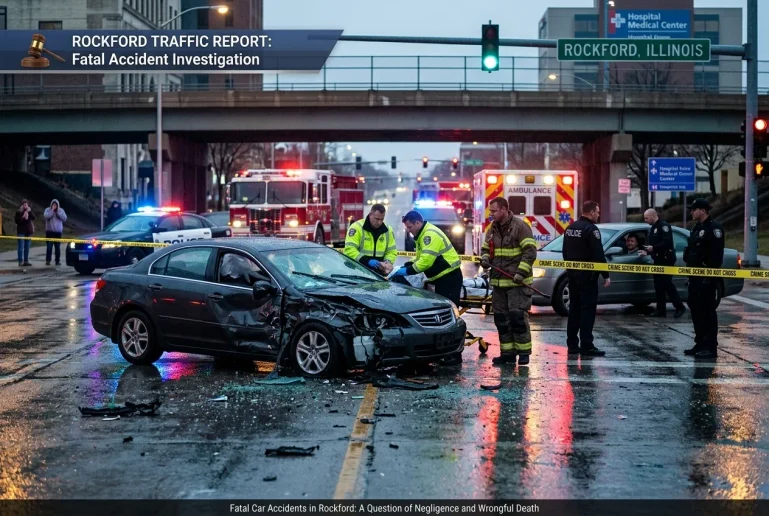
Everything changes after a fatal crash. One phone call, one knock at the door, and your family is left trying to understand how an ordinary drive turned into a permanent loss. You may be dealing with grief, funeral costs, insurance calls, and a hundred questions that no one should have to answer in the first days after losing someone. For legal guidance and support, visit https://tuitelaw.com/rockford-wrongful-death-attorney/.
When a loved one dies in a crash, the legal issue usually comes down to this. Was it a tragic accident with no legal fault, or did someone act carelessly enough that the death became a wrongful death under Illinois law? That line matters because it affects whether your family can pursue compensation for what was taken from you, including financial support, medical bills, and the loss of your loved one’s presence in your life.
Negligence turns a fatal car crash into a wrongful death when another driver or party caused the loss
A fatal collision becomes a wrongful death claim when someone’s negligent act caused the death. Negligence means a person failed to use reasonable care. In everyday terms, they did something they should not have done, or failed to do something they should have done, and that failure led to the crash.
In fatal car accidents in Rockford, negligence often shows up in familiar ways. A driver was texting and drifted across the center line. A truck driver was exhausted and missed a red light. A driver was speeding through a wet intersection and could not stop in time. A bar overserved someone who then got behind the wheel. A vehicle had defective brakes. A road hazard was left unmarked. Each situation raises a different legal question, but the core idea stays the same. If carelessness caused the death, the surviving family may have grounds for a claim.
That does not mean every deadly crash is automatically a wrongful death case. Some collisions happen because of sudden medical emergencies, unforeseeable mechanical failures, or conditions no one could control. The facts matter, and they matter early, before records disappear and memories shift.
Evidence decides whether a wrongful death claim can move forward
Families often assume the police report will tell the whole story. Sometimes it helps a great deal. Sometimes it is only a starting point. A report may identify speeding, distraction, intoxication, lane violations, or witness statements, but it may not capture the full chain of events. Phone records, black box data, traffic camera footage, toxicology results, maintenance logs, and crash reconstruction can all become part of the picture.
You may already sense something was off. Maybe the other driver admitted they looked down for a second. Maybe your loved one had the right of way and was struck head on. Maybe the insurance company started asking questions that felt designed to minimize what happened. That instinct matters. Fatal crash cases often turn on details that seem small at first and become decisive later.
Public crash data also shows why these cases deserve close review. The National Highway Traffic Safety Administration’s Fatality Analysis Reporting System tracks deadly crashes across the country, and Illinois also publishes state crash and safety data. Those numbers cannot explain your loss, but they do confirm a hard truth. Many deadly crashes are preventable, and preventable is often another word for negligent.
The cost of a fatal crash reaches far beyond the accident scene
After a death, families are pushed into practical problems before they have had time to grieve. Income stops. Bills do not. If your loved one supported children, paid the mortgage, carried health insurance, or handled care for an aging parent, the loss reaches into every part of daily life.
Illinois wrongful death claims can involve compensation for financial losses and the human loss that cannot be measured neatly on paper. That can include funeral expenses, medical costs before death, lost income, lost benefits, loss of companionship, and grief suffered by surviving family members. In some cases, a related survival action may also seek damages your loved one could have pursued had they lived, such as pain and suffering before death.
This is why wrongful death after a car accident is not just about proving someone made a mistake. It is about showing what that mistake cost your family, now and in the years ahead.
Common signs that a fatal accident may involve negligence
| Situation | What it may suggest | Why it matters |
|---|---|---|
| Driver was speeding or racing | Failure to operate the vehicle safely | Supports a claim that the crash was preventable |
| Phone use or distracted driving | Driver took attention off the road | Can show a breach of reasonable care |
| Drunk or drug impaired driving | Severe negligent conduct | May strengthen liability and damages evidence |
| Commercial vehicle involved | Employer, maintenance, or training failures | More than one party may be responsible |
| Defective vehicle part | Possible product liability claim | The manufacturer or service provider may share fault |
| Dangerous road design or missing warnings | Unsafe roadway conditions | A public or private entity may be involved |
A fatal auto accident wrongful death case can involve one careless driver, several parties, or a mix of driver error and defective equipment. That is one reason families often feel overwhelmed. The case is not only about what happened in a few seconds. It is also about who had a duty to prevent it.
Three steps can protect your family and your claim right away
Get and preserve every record you can. Ask for the crash report, medical records, photographs, witness names, and any communication from insurers. Save voicemails, texts, and letters. If your loved one’s vehicle is available, do not authorize repairs, disposal, or release until it has been reviewed if needed.
Limit contact with the insurance company. Insurers move quickly after fatal crashes, and their goals are not the same as yours. A recorded statement given too soon can lock you into details before you know the full facts. Basic information is one thing. Detailed interviews before you have guidance can create problems later.
Speak with a personal injury lawyer as early as possible. Fatal crash investigations are time sensitive. Video gets erased. Vehicles are destroyed. Electronic data is lost. A lawyer handling wrongful death and personal injury lawyer claims can identify liable parties, preserve evidence, and calculate damages that are easy to undervalue in the first weeks after a loss.
Clarity matters when your family is trying to move forward
You do not need to figure out the legal answer on the same day you are planning a funeral. You do deserve to know whether someone else’s carelessness caused this death, and whether the law gives your family a path forward. When negligence caused the crash, a wrongful death claim can provide accountability and financial support at a time when both matter deeply.
If you are facing questions after a fatal crash, reach out to a personal injury lawyer and get clear answers about your rights, the evidence, and the next steps.