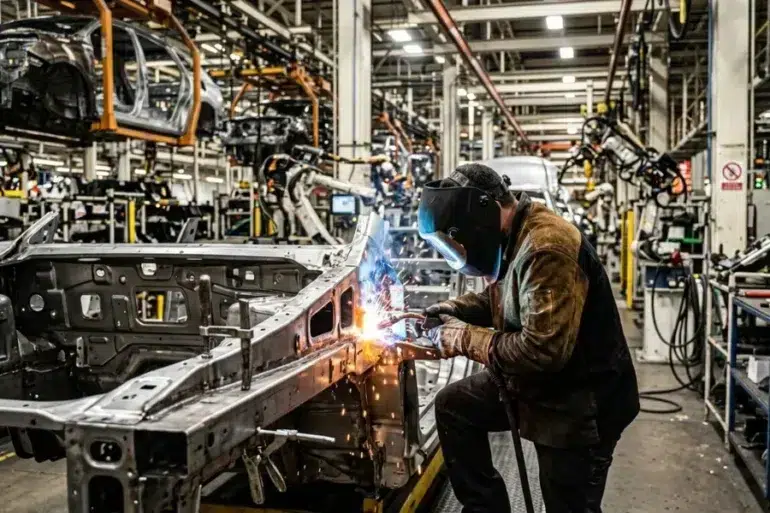
What’s the article talking about? Discover the five most common welding problems in automotive manufacturing, their causes, impacts, and practical solutions to improve weld quality, reduce rework, and enhance production efficiency.
To be really honest, the automotive industry is built on precision, speed, and consistency. Each welded component, be it chassis assemblies, suspension parts, or any other, must meet strict standards while keeping production lines running without interruption. However, even highly automated manufacturing facilities face challenges, including reduced throughput, increased costs, and impacts on product quality; these issues often stem from inefficient workholding systems, inflexible fixtures, and lengthy setup procedures.
That’s why you need to switch to Fixto’s automotive welding solutions that actually go beyond robotics and automation. The right set of fixtures plays a critical role in improving productivity, reducing downtime, and achieving repeatable weld quality.
But, for now, let’s take a look back at five of the most common welding fixture problems in automotive manufacturing and Fixto’s practical ways to solve them.
Weld Spatter or Expulsion
What is meant by weld spatter?
Weld spatter, or weld expulsion, is a phenomenon in which molten metal is forcibly expelled from the weld zone during welding. It is one of the most common defects in resistance spot welding. So, if there is an excessive welding current, incorrect electrode force, poor part fit-up, or contaminated sheet metal, one might experience weld spatter.
Why is weld spatter a problem?
While weld spatter is seen as a cosmetic issue, its impact extends further. A normal spatter is negotiable, but excessive spatter can damage electrode tips and reduce tool life, leave invisible surface defects that require additional finishing, and increase cleaning and grinding operations before painting. It can also create unnecessary downtime due to equipment maintenance. With time, such small things can lower production efficiency and increase operating costs.
How to prevent weld spatter?
Manufacturers can reduce weld spatter by optimizing welding current and electrode force and maintaining clean welding surfaces free from oil, rust, and coatings. Make sure that components fit up properly before the process and perform regular electrode maintenance and replacement.
Thermal Distortion and Panel Warping
What is meant by distortion or warping?
During the welding procedure, localized heat causes sheet metal to expand. As the material cools, there is an uneven contraction that leads to warping or distortion. This is really common in thin automotive materials such as advanced high-strength steel (AHSS) and aluminium.
Why is it a problem?
No matter what is said, even a minor twist can affect the dimensional accuracy of vehicle components. The consequences include poor panel alignment, additional manual straightening and rework, difficulty in maintaining BIW tolerances, and really slower production cycles. Furthermore, as vehicle designs become lighter and more complex, controlling warping has become extremely important.
How to prevent distortion?
To minimize thermal distortion, it is advised to use optimized robotic weld sequencing and controlled heat input and welding cycle times. Apply precision clamping to stabilize components during cooling while distributing welds strategically to reduce heat concentration. A rigid workholding system also helps prevent component movement throughout the welding process.
Porosity
What do you mean by porosity?
Porosity is another phenomenon that occurs when gas becomes trapped inside the molten weld pool during solidification. It creates microscopic holes or cavities within the weld. A few common causes, such as contaminated materials, inadequate shielding gas coverage, excessive welding speed, or moisture on the workpiece, lead to porosity.
Is porosity a problem?
Of course, although porosity is often invisible from the surface, it reduces weld quality by lowering the pieces’ structural strength, reducing their fatigue resistance, and increasing the likelihood of inspection failures. For automotive components, even small internal defects can have serious long-term consequences.
How to prevent porosity?
Reducing porosity begins with process control. Means from cleaning the sheet metal before welding and removing oil, rust, paint, and moisture from joining surfaces, to verifying proper shielding gas flow where applicable and following the recommended welding parameters for each material grade. All it needs is consistent preparation, which results in stronger and more reliable welds.
Cold Welds or False Welds
What are cold welds?
A cold weld, also known as a false weld, occurs when the base metals fail to combine properly. While the joint may appear complete from the outside, an insufficient weld nugget forms beneath the surface. This issue is really common when one joins multiple sheets or dissimilar materials that are used in modern automotive manufacturing.
Why is cold weld a problem?
Cold welds are among the most dangerous welding defects as they are often difficult to detect through visual inspection. They can impact your workpiece easily. One can see differences like weak structural joints, reduced load-bearing capacity, unexpected component failure under vibration or impact, and increased safety risks during vehicle operation.
How to prevent a cold weld?
Manufacturers can reduce false welds by optimizing current, pressure, and welding time, validating weld nugget size through quality testing, using adaptive welding controls to monitor every weld cycle, and maintaining consistent clamping pressure throughout the process. Reliable process monitoring is essential for ensuring every weld meets automotive quality standards.
Fixture Misalignment and Positioning Errors
Why are fixture errors?
Even with perfectly adjusted welding equipment, inaccurate fixtures can lead to inconsistent part positioning. Worn locating pins, poor fixture design, or inadequate clamping allow components to shift during welding. As production increases, these small positioning errors quickly translate into significant quality problems.
Why is it a problem?
Fixture-related issues can result in dimensional inaccuracies, poor weld results, and increased scrap and rework. It also takes longer production cycles to complete the process, while having difficulty maintaining repeatable quality across multiple shifts. Moreover, in many cases, manufacturers only focus on adjusting welding parameters when the root cause is actually inconsistent work input.
How to solve fixture misalignments?
Improving fixture accuracy is one of the most effective ways to improve welding quality. One must consider designing fixtures using GD&T principles, performing regular calibration and preventive maintenance, replacing worn locating elements promptly, and using precision-driven modular welding tables that provide repeatable positioning and faster fixture reconfiguration.
How to Choose the Right Automotive Welding Solution Provider
It isn’t about investing in advanced welding equipment, but evaluating the systems that support every welding operation. When selecting automotive welding solutions, look for workholding systems that offer high positional accuracy, rigid construction for demanding production environments, flexible fixture configurations, quick setup and changeover capabilities, and long-term durability with minimal maintenance.
Lastly, working with an experienced modular welding table manufacturer like Fixto will make sure that your fixturing system evolves alongside changing vehicle designs and production demands. And honestly, a precision modular welding table is the one that will create a stable foundation for every weld by ensuring repeatable positioning throughout the process.
Conclusion
Weld spatter, thermal distortion, and fixture misalignment are some of the most common welding challenges in automotive manufacturing. Leaving them unaddressed will only increase your rework, reduce productivity, and compromise vehicle quality.
Therefore, as a manufacturer, you must also focus on the accuracy and repeatability of your workholding systems. Precision fixturing and modular welding tables help maintain consistent part positioning, reduce production variability, and support higher-quality welds across every stage of manufacturing.
Lastly, by combining advanced welding processes with Fixto’s reliable fixturing, automotive manufacturers can improve weld quality, increase operational efficiency, and build production lines that are ready for the demands of modern vehicle manufacturing.