When the power goes out or you need electricity away from the grid, both solar generators and gas generators can keep essential equipment running. But despite sharing the word “generator,” they work in very different ways.
A gas generator burns fuel to produce electricity as you use it. What is commonly called a solar generator is actually a portable battery power station that stores electricity and can be recharged from solar panels, a wall outlet, or sometimes a vehicle. That difference affects almost everything: noise, fumes, where the unit can be used, how long it can supply power, and how convenient it is for camping or home backup.
Understanding those differences makes it much easier to choose the right type of backup power.
Noise: One of the Biggest Practical Differences
Noise is often treated as a minor specification until you actually have to live beside a generator for several hours.
A combustion engine inevitably creates mechanical and exhaust noise. For a construction site or an isolated outdoor emergency, that may be acceptable. At a campsite, cottage, film location, or residential property at night, it can become much more noticeable.
A battery power station operates very differently. There is no combustion engine running continuously, so normal operation is considerably quieter. Cooling fans may still operate depending on load and charging conditions, but the experience is much closer to using other electronic equipment than running a small engine.
That is one reason a solar generator can make more sense for people who want portable power close to sleeping areas, workspaces, cameras, laptops, or other sensitive equipment.
For example, DJI rates the Power 1000 V2 at approximately 26 dB while charging in Standard Recharge Mode, measured from one metre away under specified test conditions. That makes quiet operation a practical feature rather than simply a comfort-oriented extra.
Fumes Change Where a Generator Can Be Used
The more important distinction is exhaust.
Gasoline and other fuel-burning generators produce carbon monoxide. Health Canada states that fuel-burning portable generators should never be operated indoors or in partly enclosed areas and recommends operating them at least six metres from a building, with exhaust directed away from windows and doors.
A battery power station does not burn fuel while supplying electricity, so it does not create combustion exhaust during operation. That makes it much more convenient when power is needed inside a home, RV, cabin, workshop, or tent-adjacent setup where running an engine would be inappropriate.
This does not mean every high-powered appliance can automatically be connected. You still need to check the appliance’s wattage and the power station’s output rating. But from the perspective of noise and local exhaust, battery systems are much easier to place close to the equipment being powered.
Gas Generators Still Have One Important Advantage
Battery power stations are not simply replacements for gas generators in every situation.
A gas generator can continue producing electricity as long as suitable fuel is available and the machine can be operated safely. During a prolonged outage with very high continuous loads, that can be useful.
A portable power station, by comparison, has a defined battery capacity. If a station stores 1,024 Wh, that figure describes the amount of energy available in the battery; it is different from its output in watts. A 2,000 W appliance does not run for 1,024 hours or even necessarily half an hour in real-world use, because conversion losses and operating conditions also matter.
Solar panels can replenish that stored energy, but solar charging depends on panel capacity, sunlight, positioning, weather, and compatible charging hardware. In a Canadian winter, it is especially important not to treat an ideal laboratory charging figure as a guarantee for a cloudy December afternoon.
So if the requirement is continuous high-power operation for days with a ready fuel supply, a combustion generator may still have a role.
Where Portable Battery Power Makes More Sense
For many everyday situations, however, the priorities are different.
Camping typically involves lights, phones, laptops, camera batteries, small cooking equipment, and perhaps a portable fridge. Home backup may centre on a refrigerator, Wi-Fi equipment, lighting, computers, and communications devices. Content creators may need repeated charging for cameras, drones, monitors, and laptops.
In these situations, being able to switch power on without starting an engine, storing gasoline, handling exhaust, or disturbing nearby people can be more valuable than theoretically unlimited runtime.
Solar charging also creates a useful distinction between stored energy and fuel dependency. You can leave home with a charged power station, recharge it from the grid before a trip, add energy from a vehicle while travelling, and use compatible solar panels when conditions allow.
DJI Power 1000 V2: A Strong All-Round Size
For camping, road trips, mobile production, cottages, and moderate home backup, DJI Power 1000 V2 sits in a particularly useful middle ground.
It has a 1,024 Wh LFP battery and supports up to 2,600 W of continuous output under DJI’s specified test conditions. That combination matters because capacity and output solve different problems: the 1,024 Wh figure determines how much energy is stored, while the 2,600 W rating determines the types of higher-powered equipment the station can support.
The system can be recharged from grid power, solar power, or a vehicle with the appropriate accessories. DJI also supports expansion batteries, allowing Power 1000 V2 to scale to as much as 11,264 Wh with five compatible expansion batteries.
For people carrying a lot of electronics, the two USB-C ports are also notable: each supports up to 140 W with compatible PD 3.1 devices and suitable EPR cables. DJI additionally provides SDC charging support for selected DJI drone batteries, making the Power series especially coherent for users already travelling with DJI aerial equipment.
DJI states that Power 1000 V2 can recharge from 0% to 100% in 56 minutes in Fast Recharge Mode under its laboratory test conditions. Actual charging performance will vary with conditions, so this is best viewed as a reference figure rather than a guarantee for every environment.
When DJI Power 2000 Is the Better Fit
If the priority shifts towards longer home backup or running several higher-demand appliances, DJI Power 2000 provides substantially more headroom.
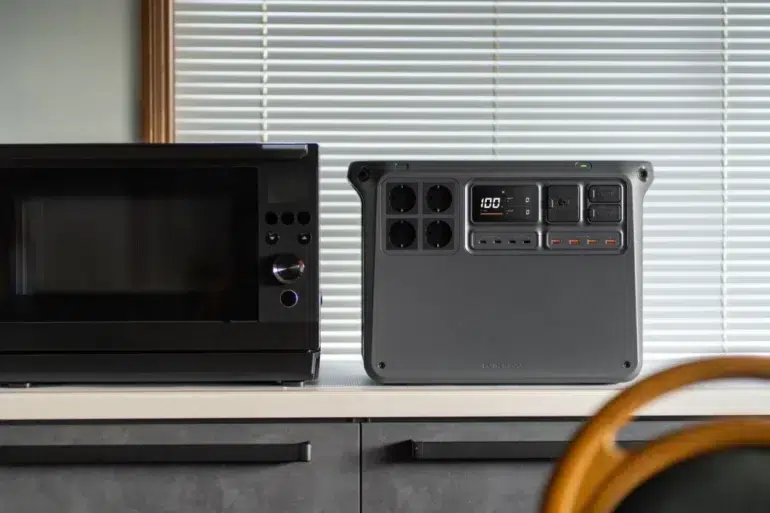
Its battery capacity increases to 2,048 Wh, while maximum continuous output rises to 3,000 W. It has four AC outputs, four USB-C ports, four USB-A ports, and two SDC ports, making it better suited to multi-device setups.
Capacity can also be expanded considerably. DJI specifies support for up to ten Power Expansion Battery 2000 units, taking the system to as much as 22,528 Wh. With the optional DJI Power 1.8kW Solar/Car Super Fast Charger, solar input can reach up to 1,800 W under compatible conditions, although actual solar charging naturally depends on the installation and available sunlight.
That makes Power 2000 more appropriate when portability is still important but energy reserve matters more than minimizing size and weight.
Which Type Should You Choose?
Choose a gas generator when the priority is prolonged, very high-load outdoor operation and you have a safe location plus reliable access to fuel.
For camping, RV travel, content production, cottages, quieter home backup, and everyday electronics, a battery-based system is generally easier to live with. There is no engine to start, no local combustion exhaust while supplying power, and solar, vehicle, and grid charging provide more flexible ways to replenish the battery.
Within DJI’s current lineup, Power 1000 V2 is the more balanced option when portability and useful output both matter. Power 2000 is the stronger choice when backup capacity, appliance loads, and future expansion take priority.
The better generator is therefore not simply the one with the largest output number. It is the one whose energy source, noise level, runtime strategy, and operating environment actually match the way you plan to use it.