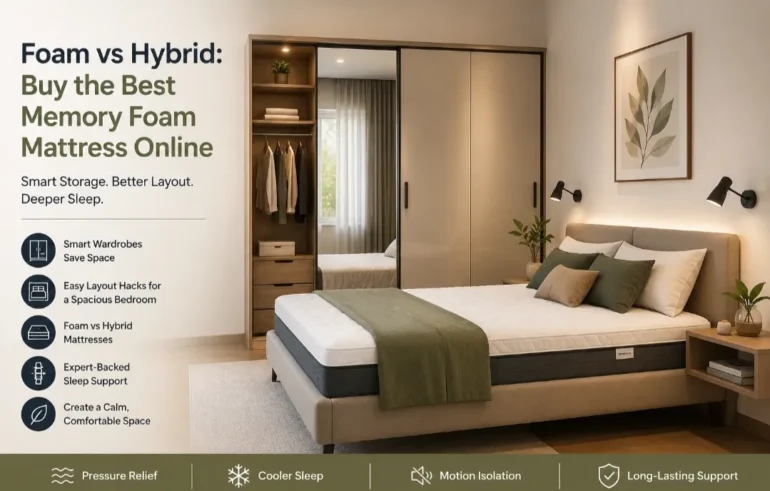
Small Spaces with Big Sleep Goals
Most people expect a bedroom to do two things well: hold everything they own and help them sleep properly. In smaller rooms, these two demands sit in direct tension with each other. Storage takes up floor space. Floor space affects how the room feels to move around in. And the way a room feels has a real impact on how easily you switch off at night.
The challenge is not unsolvable. It simply requires making deliberate choices about what enters the room, where it goes, and how it functions once it is there. Oversized furniture is one of the most common mistakes in small bedrooms. A bed frame that extends to every edge of the available footprint, combined with matching bulky nightstands, leaves almost no visual breathing room. The result is a space that feels like a storage unit with a mattress in it rather than a place to rest.
Layouts built around calm and openness consistently outperform those built around maximizing furniture count. The goal is always a room that supports sleep rather than interfering with it.
Smart Wardrobes That Maximize Floor Space
Wardrobes are non-negotiable in any bedroom, but the type you choose makes a significant difference to how the room functions and feels. Tall wardrobes that run close to ceiling height make use of vertical space that standard units waste entirely. The storage capacity increases substantially without the unit taking up any additional floor area.
Sliding wardrobe furniture is worth serious consideration here. Traditional hinged doors require clearance space in front of them to open properly, which effectively removes a strip of usable floor area from the room. Sliding systems eliminate this entirely. The door moves along a track rather than swinging outward, keeping the footprint of the wardrobe strictly within its own boundaries.
Mirrored sliding doors offer a secondary benefit that goes beyond storage. They reflect light across the room, making the space read as larger and brighter without any structural change. This is particularly useful in north-facing bedrooms that receive limited natural light. Internal organization matters too. Shelving that divides the wardrobe interior into zones for different clothing categories reduces the daily friction of getting dressed and keeps the visible parts of the room tidy by keeping the messy parts hidden.
Easy Layout Hacks for a More Spacious Bedroom
Furniture placement shapes how a room feels more than most people realize until they experiment with it. Positioning a bed into a corner rather than centering it against a wall opens up a diagonal stretch of floor that immediately changes the sense of scale. The room does not get larger, but it feels more navigable.
Floating shelves mounted at a comfortable arm’s reach beside the bed replace traditional nightstands without occupying any floor area at all. A shelf holding a water glass, a book, and a phone charger does everything a bedside table does while giving back the square footage beneath it. Wall-mounted reading lights extend this logic further, eliminating the table lamp entirely and leaving the surface clear.
The broader principle is restraint. Every piece of furniture that enters a small bedroom should earn its place by performing a clear function. Decorative pieces that exist purely for visual interest belong on walls and shelves, not on the floor. Keeping floor space as clear as possible makes the room feel open and calm, which feeds directly into sleep quality.
How Experts Evaluate Mattresses for Better Sleep
Mattress selection often gets reduced to a conversation about firmness, which is only one of several factors that determine how well a mattress actually performs over time. Sleep specialists and product testers typically assess mattresses across several distinct criteria: spinal alignment under sustained pressure, heat retention across the sleeping surface, and how well the mattress absorbs movement without transferring it across the bed.
Spinal alignment is the foundation. A mattress that allows the spine to curve or sink unevenly during the night creates the kind of muscular tension that leads to waking up with stiffness regardless of how many hours were spent sleeping. Pressure relief at the shoulders, hips, and lower back is equally important, particularly for side sleepers whose contact points carry more concentrated weight.
Motion isolation is relevant for anyone sharing a bed. A mattress that transmits movement freely means that one person shifting position regularly disturbs the other. Higher quality materials tend to absorb rather than transfer this motion, which has a measurable impact on actual sleep continuity across the night.
Foam vs Hybrid Mattresses: What’s Better?
The memory foam mattress online category has expanded considerably over the past several years, which has made comparison more complicated but also made quality more accessible across a wider range of price points. Memory foam works by responding to body heat and pressure, slowly conforming to the shape of the person sleeping on it. This produces genuine pressure relief, particularly around joints, and is one reason why it became so popular among people dealing with recurring back or hip discomfort.
The limitation of traditional memory foam is heat retention. The material’s density, which gives it its contouring quality, also traps warmth, which becomes uncomfortable for those who sleep hot. Many current formulations address this through open-cell structures or added cooling gel layers, though performance varies considerably between products.
Hybrid mattresses approach the problem differently by combining a foam comfort layer with a coil support system beneath it. The coils introduce airflow that foam alone cannot provide, and they deliver a degree of responsiveness and pushback that pure foam does not. The result tends to suit a broader range of sleep positions and body types, though hybrids generally sit at a higher price point.

Neither format is universally superior. The better question is which one addresses your specific sleep habits and comfort preferences, and whether the materials used are dense and well-constructed enough to maintain their performance over several years rather than compressing and sagging within the first twelve months.
Creating a Calm, Comfortable Bedroom Space
A bedroom that functions well does not require a large footprint. It requires that each element within it, the storage, the furniture layout, the lighting, and the sleep surface, has been chosen with some care and placed with some thought.
Smart storage keeps visual clutter contained. A clear floor keeps the room feeling open. Thoughtful layout decisions make daily routines easier without conscious effort. And a quality mattress ensures that the hours spent in that room are genuinely restorative rather than merely spent lying down.
These are not expensive principles to follow. Many of the most effective changes in small bedroom design involve choosing differently rather than spending more. A sliding wardrobe instead of a hinged one. A wall-mounted shelf instead of a freestanding nightstand. A mattress selected on the basis of how it actually performs rather than how it looks in a showroom photograph.
The bedroom is the one space in most homes that exists entirely for the person living in it. That makes it worth getting right, not with grand gestures, but with the quiet, considered choices that add up to a room that genuinely supports rest.