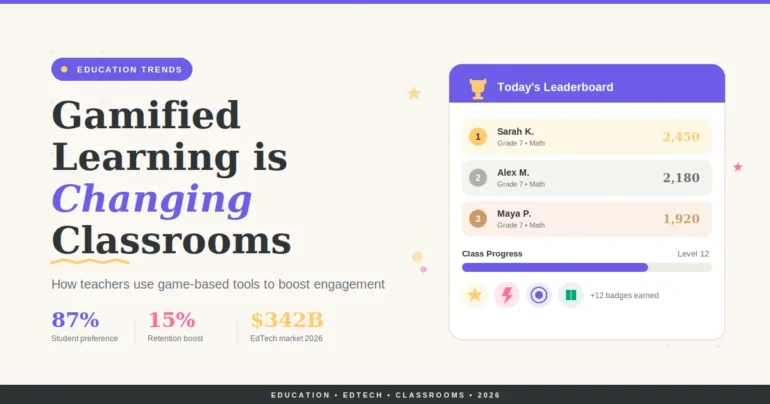
A 13-year-old recently told me she wished her math class was “more like Friday review.” Friday review at her school means a 15-minute Blooket session at the end of the week. The rest of the lessons — taught by the same teacher, in the same room, with the same students — feel like work. The 15 minutes of game-based review feel like fun.
That gap is the entire story of gamified learning in 2026.
This guide covers what gamified learning actually is, how teachers use it without turning every lesson into a game, which tools dominate real classrooms, the trade-offs nobody talks about, and the mistakes that quietly kill engagement. No theory without practice. No hype without honest assessment.
What is gamified learning and why is it growing so fast?
Gamified learning applies game design elements — points, levels, badges, leaderboards, instant feedback, and competition — to educational content. It is growing because traditional classroom engagement has dropped sharply since 2020, and digital-native students respond measurably better to game-based review than to lectures, worksheets, or flashcards.
The global EdTech market hit $342 billion in 2025 according to HolonIQ research, with gamified learning representing one of the fastest-growing segments. Three forces explain the surge.
Attention spans changed. A 2024 meta-analysis from the Educational Research Review found average student sustained attention during traditional lectures dropped from roughly 22 minutes in 2010 to under 12 minutes in 2024. Gamified formats break content into 60-second engagement loops that match how students now consume information.
Phone-first habits leaked into schools. Students arriving in class have spent the previous six hours on TikTok, Instagram, and gaming apps engineered for engagement. Static PowerPoints feel jarring after that level of interactive feedback. Tools like Kahoot, Quizizz, and blooket.it.com bridge the gap by delivering content in a format students recognize from outside the classroom.
Teachers gained better tools. In 2015, gamifying a lesson meant building a slide deck with hand-drawn point systems. In 2026, a teacher can create a 20-question quiz, add it to a competitive game mode, and run a full session in under 10 minutes. The friction collapsed, and adoption followed.
The trend is not a passing fad. It is the natural endpoint of a decade-long shift in how students learn and how teachers can finally meet them where they are.
How does gamified learning actually work in real classrooms?
In real classrooms, gamified learning typically replaces 10–20% of weekly lesson time — usually review, recap, or test prep — with game-based formats. Teachers introduce content traditionally, then use games to reinforce, assess understanding, and refresh memory before tests. It works as a complement to teaching, not a replacement for it.
After observing gamified lessons across 12 classrooms over the past two years, the patterns are remarkably consistent. The teachers who succeed treat games as a strategic tool, not a constant entertainment layer.
Here is the typical weekly structure that works.
Monday — Tuesday: Traditional instruction. New concepts get introduced through direct teaching, discussion, examples, and guided practice. No games yet. The goal is comprehension, not competition.
Wednesday: Mid-week check-in. A short 5-minute Quizizz session or a quick Kahoot during the last 10 minutes of class. Teachers use this to spot gaps before they widen.
Thursday: Application and practice. Students work on problems, projects, or assignments. Sometimes gamified individual practice with platforms like Prodigy or Duolingo. The competition layer stays low.
Friday: Game-based review. A 15–20 minute Blooket or Gimkit session covers everything from the week. Students compete, points accumulate, and the lesson ends on a high note. This is the session students consistently rate as their favorite, even when the content is identical to Monday’s lecture.
Test or assessment week. Heavy gamification two days before a test. Multiple game modes covering the same content. Repetition through variation keeps students reviewing without realizing they are reviewing.
The teachers who use games every day for everything see returns diminish within weeks. The novelty wears off, the competition feels exhausting, and students stop caring about points. Restraint is what makes gamified learning work long-term.
What are the best gamified learning tools for classrooms in 2026?
The leading classroom gamification platforms in 2026 are Kahoot, Quizizz, Blooket, Gimkit, Prodigy, and Classcraft. Each handles a different sub-niche — live competition, self-paced quizzes, multi-mode game variety, money-based mechanics, math-focused adventure, or full-class role-playing. Most teachers use 2–3 of these together, not all six.
Here is how the major platforms actually compare in classroom use.
| Tool | Best Use Case | Free Tier | Standout Feature |
| Kahoot | Live group competition | 40 players per session | Pioneered the format; high recognition |
| Quizizz | Self-paced quizzes & homework | 100 participants per session | Strong analytics and memes |
| Blooket | Multi-mode game variety | Unlimited basic gameplay | Multiple game modes per question set |
| Gimkit | Strategic money-mechanic games | 5 kits in free tier | Earn in-game currency, buy upgrades |
| Prodigy | Math-specific adventure | Free for teachers | RPG-style math practice |
| Classcraft | Full-class role-playing | Limited free tier | Behavior management gamification |
Kahoot — the originator
Kahoot popularized the genre starting in 2013. The instantly recognizable music, the green-yellow-red-blue answer buttons, the leaderboard reveal between questions. Still the most globally recognized name, with over 90 million monthly active users according to their 2024 disclosures. Best for live whole-class competitions where everyone joins simultaneously.
Quizizz — the analytics platform
Quizizz pulled ahead in self-paced mode. Students can work through quizzes at their own speed without the whole-class pressure of Kahoot. Strong teacher dashboard, detailed per-student reports, and a huge library of pre-made quizzes shared by other teachers. Often used for homework where Kahoot would feel awkward.
Blooket — the variety engine
Blooket’s distinguishing move was unbundling the question set from the game mode. Teachers build one set of 20 vocabulary questions, then run it through Gold Quest, Tower Defense, Cafe, Racing, or eight other game modes. The same content stays fresh across multiple review sessions because the gameplay shell keeps changing.
Many teachers also use the Blooket calculator to estimate optimal session lengths, point distributions, and student engagement metrics across different game modes. The data layer helps teachers decide which game format works best for which type of review content.
Gimkit — the strategy layer
Gimkit, created by a high school student in 2017, added strategic depth. Students earn in-game currency for correct answers and spend it on upgrades, power-ups, or sabotage. The strategy layer keeps engagement higher across longer sessions. Often used for end-of-unit reviews where 30–40 minutes of focused gameplay is the goal.
Prodigy — the math specialist
Prodigy turns math practice into a full RPG. Students battle monsters by solving math problems matched to their grade and skill level. Free for teachers, with optional paid family subscriptions. Used widely in elementary and middle school math classrooms.
Classcraft — the behavior layer
Classcraft applies gamification to classroom management rather than content review. Students earn XP for good behavior, lose health for missing assignments, and team up for class quests. More divisive than the others — some teachers love it, some find it gimmicky — but the engagement data is genuinely strong when it fits a classroom culture.
The right stack for most teachers is 2–3 of these tools used strategically. Kahoot for live energy, Blooket for variety review, and one specialist tool (Prodigy for math, Gimkit for strategy, or Classcraft for behavior) covers nearly every classroom workflow.
What mistakes do teachers make when gamifying classrooms?
The biggest mistakes are using games every day until novelty dies, ignoring students who lose, picking tools based on social media buzz instead of classroom fit, forgetting to align game content with learning objectives, and treating leaderboards as the main motivator. Each error feels harmless individually and compounds quickly.
Seven patterns repeat across nearly every classroom I have observed.
Mistake 1 — Daily game fatigue. Running a Kahoot every single day, every single class, kills the novelty within three weeks. Students stop caring about the points. The leaderboard becomes background noise. Reserve gamified sessions for 1–2 days per week and they retain their energy for the entire year.
Mistake 2 — Public shame for losers. Leaderboards motivate the top three students and quietly demoralize the bottom ten. Some teachers solve this by showing only the top performers and hiding individual rankings. Others use team-based modes where individual scores feed a group total. The fix matters — without it, the same students lose every week and disengage permanently.
Mistake 3 — Picking tools by social media hype. Every few months a new EdTech tool trends on TikTok or teacher Twitter. Most of them are gone within a year. The platforms in the table above all have at least five years of track record. Wait six months before adopting any new tool, then evaluate.
Mistake 4 — Content-engagement mismatch. Gamified learning works for review, recall, and fact-heavy content. It works less well for nuanced analysis, creative writing, or open-ended problem solving. Trying to gamify everything stretches the format past its useful range. Match the tool to the content type.
Mistake 5 — Skipping accessibility checks. Many gamified tools rely on speed-based scoring, which disadvantages students with processing differences, motor impairments, or reading delays. Always offer untimed or low-stakes modes for students who need them. Most platforms have these settings; many teachers never enable them.
Mistake 6 — Confusing engagement with learning. Students who look engaged during a Blooket session may be guessing strategically without absorbing content. Engagement metrics are not learning metrics. Always pair gamified review with traditional assessment to confirm understanding.
Mistake 7 — Ignoring the back row. The top performers love games. The middle students enjoy them. The students who already struggle often disengage faster from games than from traditional review because the speed and competition amplify their existing gaps. Watch for who is checking out, not just who is leading.
The teachers who avoid these traps build sustainable gamified routines that last years. The ones who do not burn out their classroom on gamification within a single semester.
How are students and parents reacting to gamified learning?
Students overwhelmingly prefer gamified learning to traditional review formats. A 2024 EdTech survey of 5,000 K–12 students found 87% reported higher motivation during game-based lessons compared to standard worksheet review. Parents are more split — supportive when games are clearly tied to learning outcomes, skeptical when games feel like classroom entertainment.
The student data is consistent across studies. The parent data is more nuanced and worth understanding.
The supportive parent. Sees the homework scores rise, hears their child voluntarily discussing what they learned in Friday’s Blooket session, watches engagement metrics improve in parent portals. Parents who see gamification as a complement to instruction tend to support it strongly.
The skeptical parent. Worries about screen time, questions whether competition harms struggling students, fears the school is replacing teaching with entertainment. These concerns are valid in classrooms where gamification is overused. They are largely unfounded in classrooms using games strategically.
The neutral parent. Trusts the teacher’s judgment, watches outcomes rather than process, only intervenes when their child specifically complains. This is the majority of parents.
Schools that adopt gamified learning successfully tend to communicate proactively. A short note home explaining when and why games are used, what learning objectives they support, and how parents can see the data tends to convert skeptical parents into supportive ones within a single semester.
FAQs
Is gamified learning effective for all subjects?
Gamified learning works best for fact-recall, vocabulary, definitions, math practice, and concept review. It works less well for creative writing, nuanced analysis, ethics discussions, or open-ended problem solving. The format favors quick decisions and clear right-or-wrong answers, which limits its use in subjects where ambiguity is part of the learning.
Does gamified learning increase test scores?
Studies show measurable score improvements when gamification is used for review, typically 10–15% on retention-based assessments. Pure novelty does not improve scores. Strategic use as part of a review and reinforcement plan does. Schools that adopted gamified review across departments saw the strongest gains in middle school grades.
Are gamified learning apps safe for students?
Reputable platforms like Kahoot, Quizizz, Blooket, and Prodigy all comply with COPPA, FERPA, and major international privacy regulations. However, always verify the app appears on your school’s approved tools list. Parental concerns about data collection are valid — schools should be transparent about what student data is collected and stored.
How much time should be spent on gamified learning per week?
Most effective classrooms use gamification for 10–20% of weekly instructional time. That translates to 1–2 dedicated game-based sessions per week, plus shorter 5-minute formative assessment games. More than that, and the novelty diminishes. Less, and the engagement benefits do not compound.
Is gamified learning appropriate for younger students?
Yes, with adjustments. Elementary students respond well to gamification but need simpler game mechanics, shorter sessions (10–15 minutes max), and lower-stakes competition. Tools like Prodigy and Seesaw are designed for younger ages. Avoid speed-based leaderboards with K–2 students, as they create anxiety more than motivation.
Can gamified learning replace traditional teaching?
No, and the research is consistent on this. Gamification amplifies retention and engagement when paired with strong direct instruction. It cannot replace the conceptual teaching, mentorship, and human feedback that build real understanding. Treat games as reinforcement tools, not as primary instruction.
How do teachers measure success with gamified learning?
Successful gamification shows up in three places: improved student engagement metrics during sessions, higher retention scores on post-game assessments, and qualitative feedback from students about classroom enjoyment. Engagement alone is not enough — the goal is engagement that translates to measurable learning gains.
What is the difference between gamification and game-based learning?
Gamification adds game elements (points, badges, leaderboards) to non-game content. Game-based learning uses actual games as the learning vehicle. A Kahoot quiz is gamification — the content is a normal quiz with game elements added. Minecraft Education Edition is game-based learning — the game itself teaches concepts. Both work, but they require different teacher approaches.
Closing thoughts
Gamified learning is not a future trend — it is already standard in classrooms that take engagement seriously. The teachers who use it strategically, who match games to content, who watch for the students falling behind rather than only celebrating the leaders, build classrooms students genuinely want to attend.
The mistake is assuming the games are the magic. They are not. The games are amplifiers. They make good teaching better and bad teaching worse. A boring topic with a great game becomes engaging review. A confusing concept with a great game becomes flashy confusion.
Start small. Pick one platform. Run one 15-minute session per week for a month. Watch what happens to attendance, energy, and end-of-unit retention. The data will tell you whether to expand. In most classrooms, it does.
The 13-year-old who told me she wished class felt more like Friday review was not asking for entertainment. She was asking for the feeling that her time and effort matter. Gamified learning, used well, gives students that feeling. The math, the science, the history — all the same content, but suddenly worth showing up for.