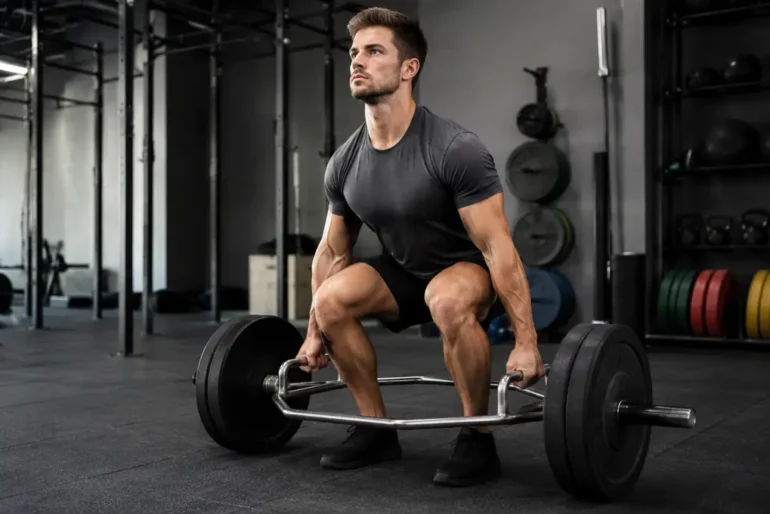
The Trap Bar Deadlift has become one of those exercises that makes sense almost the moment you try it. It feels strong, balanced, and practical. You stand inside the bar instead of behind it, grip the handles at your sides, brace your body, and drive through the floor. For many lifters, that small change makes the movement feel more natural than a traditional barbell deadlift.
That does not mean it is “easy” or less effective. It can still build serious strength, power, muscle, and athletic performance. The difference is that the trap bar often lets people train hard without feeling as awkward or beaten up as they might with a straight bar deadlift.
For beginners, it can be a smoother way to learn how to lift from the floor. For athletes, it can be a powerful tool for speed and force production. For older adults or people who simply want stronger legs and a tougher back, it can be a smart choice when coached properly.
What Is a Trap Bar Deadlift?
A Trap Bar Deadlift is a deadlift variation performed with a hex-shaped bar. Instead of standing behind a straight barbell, you stand inside the frame. The handles sit beside your body, which changes how the weight lines up with your center of mass.
This setup usually allows a more upright torso, a stronger starting position, and a movement pattern that feels like a blend of a deadlift and a squat. You still hinge at the hips. You still use your glutes, hamstrings, back, core, and grip. But the knees often get more involved than they do in a conventional straight-bar deadlift.
Research comparing hex bar and straight bar deadlifts has found that the hex bar can change joint demands and may allow lifters to produce higher velocity and power in some conditions. A well-known biomechanical study by Swinton and colleagues compared straight and hexagonal barbell deadlifts and found differences in force, power, and joint loading patterns between the two lifts.
In simple terms, the exercise lets many people lift heavy while feeling more balanced.
Why the Trap Bar Deadlift Feels More Natural
One reason the Trap Bar Deadlift feels comfortable is that the load is not pulling you forward in the same way a straight bar can. With a conventional deadlift, the bar sits in front of the body. If you do not keep it close, it can drift away and increase stress on the lower back.
With the trap bar, the weight sits more in line with your body. This can make it easier to keep your chest up, brace your core, and push through the floor.
That is why many coaches use it with beginners, athletes, and general fitness clients. It reduces some of the technical barriers that make conventional deadlifts intimidating. You still need good form, but the setup is often easier to understand.
Think of it like carrying two heavy grocery bags at your sides instead of holding one heavy box in front of you. The load feels easier to control because it is closer to your natural balance point.
Key Trap Bar Deadlift Benefits
The benefits go beyond “it is easier.” This exercise can fit into strength training, athletic training, fat loss programs, and general health routines.
Here are the biggest reasons people use it:
- Builds lower-body strength
- Trains glutes, quads, hamstrings, back, and core together
- May feel easier on the lower back for some lifters
- Helps develop explosive power
- Works well for athletes
- Easier to learn than many barbell deadlift styles
- Allows heavy loading with a stable setup
- Useful for beginners and experienced lifters
- Fits strength, muscle, and conditioning goals
The real value is that it gives you a heavy compound lift without forcing every person into the same straight-bar deadlift position.
Trap Bar Deadlift Muscles Worked
The Trap Bar Deadlift is a full-body lift, but most of the work happens through the lower body and posterior chain.
The main muscles involved include:
- Glutes
- Hamstrings
- Quadriceps
- Spinal erectors
- Traps
- Lats
- Forearms
- Core muscles
- Calves
The quads often work harder than they do in a conventional deadlift because the body position usually includes more knee bend. At the same time, the hips and hamstrings still play a major role, especially when you push your hips back and keep tension through the floor.
Your upper back also works hard. The traps and lats help keep the shoulders stable and the bar controlled. Your grip has to stay strong from the first rep to the last.
This is why the trap bar is so useful. It does not isolate one muscle. It teaches the body to produce force as one connected system.
Strength Benefits of the Trap Bar Deadlift
If your goal is to get stronger, the Trap Bar Deadlift deserves a place in your program. It allows many lifters to use challenging loads while maintaining a solid position.
Because the handles are at your sides, you can often create a strong brace and drive through the legs with confidence. That can help you train heavy without fighting the bar path as much as you might with a straight bar.
For beginners, this matters because early strength gains depend on learning proper movement and building confidence under load. If a lift feels awkward, people often avoid it or perform it poorly. The trap bar can make the learning curve smoother.
For advanced lifters, it can be used as a heavy strength builder, a secondary deadlift movement, or a way to train hard while reducing some fatigue from conventional pulling.
A practical example would be a lifter who struggles with lower-back fatigue after heavy barbell deadlifts. Instead of removing deadlifts completely, they may use trap bar pulls for a training phase. They still train strength, but with a setup that may feel more manageable.
Power and Athletic Performance
Power is the ability to produce force quickly. That matters for sprinting, jumping, cutting, tackling, climbing, and many real-world movements.
The Trap Bar Deadlift can be especially useful here because it allows strong leg drive and high force output. Some research suggests that hex bar deadlifts may produce greater velocity and power than straight-bar deadlifts in certain settings. Swinton’s biomechanical research found that the hex bar version allowed greater peak force, peak velocity, and peak power compared with the straight bar version under the tested conditions.
A more recent biomechanical comparison also reported that the hex-bar technique produced greater barbell velocity and different knee and hip demands compared with conventional and sumo deadlifts.
This is one reason strength coaches like the movement for athletes. It can train the body to push hard into the ground, which is exactly what athletes need when they sprint or jump.
For power training, the goal is not always to grind the heaviest weight possible. Sometimes the better choice is a moderate load moved fast with clean form. A trap bar makes that style of training easier for many people.
Is the Trap Bar Deadlift Safer for the Lower Back?
No exercise is automatically safe. Poor form, too much weight, weak bracing, and fatigue can make any lift risky. That said, the Trap Bar Deadlift may be a more back-friendly option for some people because of its body position and load placement.
With the weight beside the body, many lifters can keep a more upright torso. This may reduce the forward pull that often causes beginners to round their backs during conventional deadlifts.
A review on low-back biomechanics during deadlifting explains that deadlifts can be useful in training and rehabilitation settings, but technique, load, volume, and individual tolerance all matter.
So the better question is not, “Is it safe?” The better question is, “Can you perform it with control, good bracing, and the right load?”
For many lifters, the answer is yes. The trap bar often gives them a stronger starting position and more room to learn.
Trap Bar Deadlift vs Conventional Deadlift
Both lifts are valuable, but they do not feel the same.
A conventional deadlift uses a straight bar in front of the body. It usually demands more hip hinge, more hamstring tension, and more technical control over the bar path.
A Trap Bar Deadlift places the lifter inside the bar. The movement often allows more knee bend, a more upright torso, and a stronger push from the legs.
Here is a simple comparison:
| Feature | Trap Bar Deadlift | Conventional Deadlift |
|---|---|---|
| Bar position | Around the body | In front of the body |
| Torso angle | Often more upright | Usually more forward lean |
| Main feeling | Push through the floor | Pull the bar up |
| Learning curve | Usually easier | Often more technical |
| Quad involvement | Usually higher | Usually lower |
| Hip hinge demand | Moderate to high | High |
| Best for | Strength, power, beginners, athletes | Posterior chain strength, powerlifting, hinge development |
Neither one is “better” for everyone. The best choice depends on your goal, body type, training history, and comfort.
If you compete in powerlifting, the straight bar deadlift matters more because it is part of the sport. If you train for general strength, athletic performance, or safer lifting mechanics, the trap bar may be the better everyday option.
How to Do a Trap Bar Deadlift Properly
Good form matters. The trap bar is forgiving, but it is not magic.
Start by standing inside the bar with your feet about hip-width to shoulder-width apart. Your midfoot should feel balanced. Grip the handles firmly and pull your shoulders slightly back and down.
Before lifting, brace your core like you are about to take a punch. Keep your chest proud, your spine neutral, and your eyes looking slightly ahead on the floor.
Then push the ground away. Do not yank the weight with your arms. Your arms are hooks. Your legs and hips do the work.
At the top, stand tall without leaning back. Squeeze your glutes, keep your ribs down, and avoid overextending your lower back.
Lower the bar with control by bending at the hips and knees. Let the plates settle before starting the next rep if you are training strength.
Simple Form Checklist
- Feet flat on the floor
- Hands centered on the handles
- Chest up without over-arching
- Core braced before the pull
- Shoulders packed and stable
- Bar lifted by leg drive, not arm pulling
- Hips and chest rise together
- No leaning back at the top
- Controlled lowering
If a rep feels loose, rushed, or uneven, reduce the weight.
Common Mistakes to Avoid
The Trap Bar Deadlift is easier to learn than many barbell lifts, but people still make mistakes.
One common mistake is starting with the hips too low. This turns the movement into an awkward squat and can make the bar drift or cause the knees to collapse inward.
Another mistake is starting with the hips too high. That turns the lift into a stiff-legged pull and can place more demand on the lower back.
Some lifters also forget to brace. They grab the handles and lift quickly without creating tension first. That is when the spine loses position.
Watch out for these errors:
- Rounding the lower back
- Letting knees cave inward
- Pulling with the arms
- Jerking the weight from the floor
- Looking too high and straining the neck
- Leaning back at lockout
- Using too much weight too soon
- Dropping the bar without control
The best reps look calm, strong, and repeatable. You should feel powerful, not panicked.
High Handles vs Low Handles
Many trap bars have two handle options. High handles reduce the range of motion because your hands start higher. Low handles make the lift deeper and more demanding.
High handles are useful for beginners, taller lifters, people with limited mobility, or anyone returning after time away from heavy lifting.
Low handles are better when you want a deeper pull and more range. They may increase the challenge for the legs, hips, and back.
Neither option is cheating. They are tools. If high handles help you train pain-free with better form, use them. If low handles give you a better strength challenge, use them.
A smart approach is to start with high handles, master the pattern, then move to low handles when your mobility and control improve.
Best Rep Ranges for Strength, Muscle, and Power
The way you program the Trap Bar Deadlift depends on your goal.
For strength, use heavier loads and lower reps. A common range is 3 to 5 sets of 3 to 6 reps.
For muscle growth, use moderate loads and slightly higher reps. Try 3 to 4 sets of 6 to 10 reps.
For power, use lighter to moderate loads and move the bar fast. Try 3 to 6 sets of 2 to 4 reps with full rest between sets.
For conditioning, lighter trap bar carries or higher-rep deadlifts can work, but form must stay clean. Once fatigue ruins your position, the set is no longer productive.
Here is a simple programming table:
| Goal | Sets | Reps | Load Feel |
|---|---|---|---|
| Strength | 3 to 5 | 3 to 6 | Heavy but controlled |
| Muscle | 3 to 4 | 6 to 10 | Moderate to hard |
| Power | 3 to 6 | 2 to 4 | Fast and explosive |
| Beginner practice | 2 to 4 | 5 to 8 | Light to moderate |
Most people do well training this lift once or twice per week.
Trap Bar Deadlift for Beginners
Beginners often feel nervous around deadlifts. That is understandable. The word “deadlift” sounds intense, and many people worry about hurting their backs.
The trap bar can make the first step easier. The handles are simple to grip, the body position feels natural, and the movement teaches full-body tension.
A beginner does not need to chase heavy numbers. The first goal is to learn the pattern.
Start light. Practice smooth reps. Keep the same setup every time. Once the movement feels automatic, add weight slowly.
A good beginner session might look like this:
- Warm up with bodyweight squats and hip hinges
- Perform 3 sets of 5 light trap bar reps
- Rest 90 seconds between sets
- Add weight only if every rep looks stable
- Stop before form breaks down
Progress comes from consistency, not rushing.
Trap Bar Deadlift for Athletes
Athletes need strength they can use. They need to produce force quickly, absorb impact, change direction, and stay resilient.
The Trap Bar Deadlift fits that goal well because it trains leg drive, hip extension, grip, posture, and core stiffness at the same time.
A sprinter can use it to build force into the ground. A basketball player can use it to support jumping power. A football player can use it to build total-body strength without spending months mastering a more technical barbell pull.
A 2024 study comparing high-load resistance training with barbell half squats and trap bar deadlifts in recreationally active females found that exercise selection may be less important than using heavy loads, high effort, and relevant movement patterns when the goal is improving sprint and jump performance.
That does not mean athletes should only do trap bar pulls. It means the movement can be a useful part of a bigger program that also includes sprinting, jumping, mobility work, and sport-specific practice.
Who Should Use the Trap Bar Deadlift?
This lift can work for many people, but it is especially useful for:
- Beginners learning to lift from the floor
- Athletes training strength and power
- Lifters who dislike straight-bar deadlifts
- People with long legs or awkward conventional deadlift mechanics
- Older adults building practical strength
- Gym users who want a strong full-body movement
- Coaches training groups with different skill levels
It may not be ideal for everyone. If you have an injury, serious back pain, or medical restrictions, get professional guidance before loading the movement heavily.
But for a healthy lifter with decent coaching and proper progression, the trap bar is one of the most practical strength tools in the gym.
Real-World Example: Why It Works So Well
Imagine two people starting a strength program.
The first person tries conventional deadlifts. They struggle to keep the bar close, their hips shoot up too fast, and their lower back feels tired before their legs do.
The second person starts with a trap bar. They stand inside the bar, grip the handles, brace, and push through the floor. The movement feels less confusing, so they train consistently.
After eight weeks, the second person may have built stronger legs, better posture under load, and more confidence with lifting. Not because the trap bar is magic, but because the exercise matched their body and skill level better.
That is the real lesson. The best exercise is not always the hardest-looking one. It is the one you can perform well, progress safely, and repeat over time.
How Heavy Should You Go?
The right weight depends on your experience, technique, and goal.
A beginner should start with a load they can lift smoothly for 5 to 8 reps while keeping perfect control. An intermediate lifter can work with heavier sets of 3 to 6 reps. Advanced lifters may use the trap bar for near-max strength work, but only when their setup is consistent.
A simple rule: leave one or two good reps in the tank most of the time.
You do not need to hit failure on this lift. In fact, grinding ugly reps can teach bad habits. Strength improves when you practice strong reps often.
Warm-Up Tips Before Lifting
Do not walk into the gym, load the bar heavy, and start pulling. Your body needs preparation.
A good warm-up can be simple:
- 5 minutes of light cardio
- Bodyweight squats
- Hip hinges
- Glute bridges
- Light kettlebell deadlifts
- Empty or lightly loaded trap bar reps
The goal is to wake up the hips, legs, core, and grip. Your first heavy set should not feel like your first real movement of the day.
How to Add It to Your Workout
You can place the Trap Bar Deadlift near the start of your workout because it is a demanding compound lift. Do it after your warm-up, before smaller accessory exercises.
A simple lower-body workout could look like this:
- Trap bar pulls
- Split squats
- Hamstring curls
- Calf raises
- Planks or farmer carries
For a full-body workout, pair it with pressing, rowing, and core work.
Example:
- Trap bar pulls
- Dumbbell bench press
- Seated row
- Walking lunges
- Side planks
Keep the rest of the workout balanced. Heavy deadlifts already demand a lot from the nervous system, grip, and back.
Is It Better for Muscle Growth or Strength?
It can help with both.
For strength, it lets you train heavy and build force from the floor. For muscle growth, it creates tension across large muscle groups. The legs, glutes, traps, back, and forearms all get meaningful work.
If your main goal is bodybuilding, you may still want squats, Romanian deadlifts, leg presses, lunges, and hamstring curls. But the trap bar can be a powerful main lift that supports overall size and strength.
For general fitness, it gives you a lot of return for your effort. Few exercises train so many muscles at once while still being relatively easy to learn.
Frequently Asked Questions
Is the Trap Bar Deadlift good for beginners?
Yes, it is often a strong choice for beginners because the setup feels more balanced than a straight-bar deadlift. The handles sit at your sides, which can make it easier to brace, keep the chest up, and push through the legs.
Does it build the back?
Yes. It trains the upper back, traps, lats, and spinal erectors. However, it is not only a back exercise. It also works the quads, glutes, hamstrings, core, and grip.
Can it replace squats?
It can support lower-body strength, but it does not fully replace squats. The movement pattern is different. Squats usually involve more knee bend and a deeper range of motion. The trap bar is best seen as a powerful hinge-and-leg-drive movement.
Can it replace conventional deadlifts?
For general fitness, yes, it can. For powerlifting, no, because conventional or sumo deadlifts are competition lifts. If your goal is strength, muscle, and safer lifting mechanics, the trap bar can be your main deadlift variation.
How often should you do it?
Most people can train it once or twice per week. Heavy sessions need more recovery. Lighter power or technique sessions may be easier to recover from.
Should you use straps?
Use your grip first when possible. If grip becomes the only thing limiting your leg and hip training, straps can help on heavier sets. Just do not let straps replace all grip work.
Conclusion
The Trap Bar Deadlift is one of the most useful strength exercises for people who want power, muscle, and practical lifting ability without making the movement more complicated than it needs to be. It trains the legs, hips, back, core, and grip in one strong pattern. It also gives many lifters a more natural setup than a straight bar deadlift.
Its biggest advantage is not that it is easy. It is that it lets you work hard from a better position. You can build strength, develop power, and improve confidence under load while keeping the movement simple enough to repeat consistently.
For beginners, it can be the first serious strength lift that feels approachable. For athletes, it can be a reliable tool for force production. For everyday lifters, it can make heavy training feel more stable and useful.
The trap bar also reminds us of something important about weight training. The goal is not to prove that one exercise is superior for everyone. The goal is to choose movements that fit your body, your goals, and your ability to train well over time.
Used with smart loading, clean technique, and steady progression, the Trap Bar Deadlift can become one of the most valuable lifts in your routine.