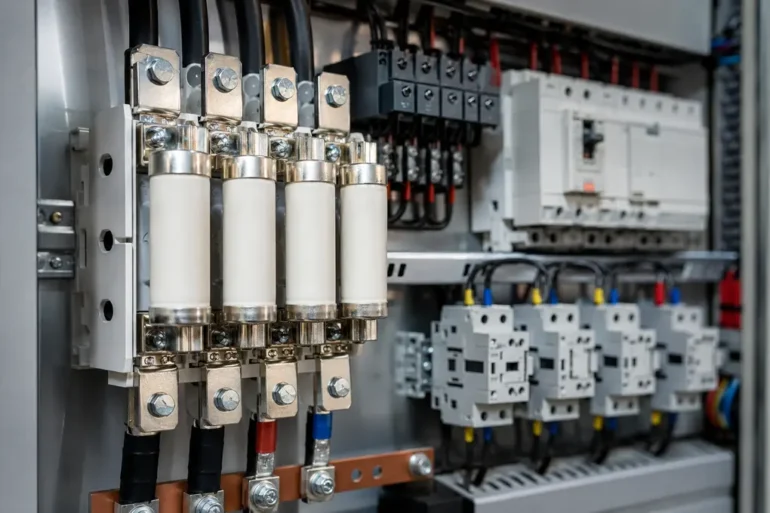
Electrical protection is one of those things people rarely think about until something goes wrong. A machine stops suddenly. A panel trips. A cable overheats. In worse cases, a short circuit can damage equipment in seconds. That is where High Rupturing Capacity fuses become important.
A High Rupturing Capacity fuse, often called an HRC fuse, is designed to safely break very high fault currents without exploding, arcing dangerously, or allowing damage to spread through an electrical system. In simple words, it protects circuits when the current becomes far higher than normal.
These fuses are common in industrial panels, distribution boards, motor circuits, transformers, commercial buildings, and some heavy-duty electrical installations. They are not just ordinary fuses with a stronger body. Their design, materials, filling, and breaking ability make them suitable for fault conditions where a normal fuse may fail.
What Is a High Rupturing Capacity Fuse?
A High Rupturing Capacity fuse is a protective device that can interrupt large short-circuit currents safely. The word “rupturing capacity” refers to the maximum fault current a fuse can break without causing unsafe damage.
Every fuse has a limit. If a fault current is higher than what the fuse can safely interrupt, the fuse may rupture, produce excessive arc energy, or fail to isolate the circuit properly. HRC fuses are built for higher fault levels, which makes them useful in systems where short-circuit current can be very strong.
A fuse works by allowing normal current to pass through a metal element. When excessive current flows, the element heats up and melts, opening the circuit. This stops the current and helps protect cables, devices, and connected equipment. The basic purpose of a fuse is overcurrent protection, and fuse designs are made with different current ratings, voltage ratings, breaking capacities, and response times.
In an HRC fuse, the internal element is usually enclosed inside a strong ceramic or heat-resistant body. Many designs are filled with quartz sand or similar arc-quenching material. When the fuse element melts, the filling helps absorb energy, cool the arc, and reduce the chance of a dangerous flash.
Why Rupturing Capacity Matters
Rupturing capacity is not just a technical label printed on a fuse. It is a safety boundary.
Imagine a commercial building where a short circuit happens near the main distribution board. The available fault current may be much higher than what a small domestic fuse can handle. If the fuse cannot safely break that current, the result can be violent arcing, equipment damage, fire risk, and danger to anyone nearby.
That is why the breaking capacity of a fuse must match the electrical system where it is installed. In low-voltage systems, standards such as IEC 60269 cover requirements for low-voltage fuses and help create consistency in fuse performance and interchangeability.
A High Rupturing Capacity fuse is selected when the system has a high prospective short-circuit current. This is the amount of current that could flow if a fault happened at a certain point in the circuit.
The higher the available fault current, the more important it becomes to use a fuse that can interrupt it safely.
How High Rupturing Capacity Fuses Work
The working principle is simple, but the actual design is carefully engineered.
During normal operation, current flows through the fuse element without interruption. The element is sized to carry its rated current under normal conditions. If the current rises slightly above normal for a short moment, some fuse types may tolerate that depending on their time-current characteristics.
But during a major fault, the current rises very quickly. The fuse element heats up almost instantly and melts. Once it melts, the circuit opens. The arc created inside the fuse is controlled and cooled by the fuse body and internal filling.
In many HRC fuses, the quartz sand surrounding the element melts partly during the fault and forms an insulating glass-like material. This helps stop the arc and prevents the fault from continuing.
This fast interruption is one of the main reasons HRC fuses are trusted in industrial and commercial protection systems.
Main Parts of an HRC Fuse
Although designs vary, most High Rupturing Capacity fuses include a few key parts.
| Part | Purpose |
|---|---|
| Fuse element | Melts when current exceeds safe limits |
| Ceramic body | Provides heat resistance and mechanical strength |
| End caps or blade contacts | Connect the fuse to the holder or circuit |
| Arc-quenching filler | Helps cool and extinguish the arc |
| Indicator pin or striker | Shows when the fuse has blown in some models |
The ceramic body is especially important because it can withstand high temperatures and internal pressure during a fault. The filler material also plays a major safety role by reducing arc energy.
Common Uses of High Rupturing Capacity Fuses
High Rupturing Capacity fuses are used where electrical faults can be powerful enough to damage ordinary protection devices.
Industrial Control Panels
Factories rely on control panels for motors, automation systems, production lines, pumps, compressors, and heavy machinery. A fault in one section can affect expensive equipment if it is not isolated quickly.
HRC fuses help limit damage by clearing short circuits fast. They are often used with contactors, motor starters, and distribution circuits.
Motor Protection Circuits
Motors can draw high starting current. A normal fuse may blow during startup if it is not selected correctly. On the other hand, the fuse still needs to respond quickly during a real short circuit.
That balance makes proper fuse selection important. HRC fuses are commonly paired with overload relays in motor circuits. The overload relay deals with long-term overload, while the fuse handles short-circuit faults.
Transformer Protection
Transformers can experience high fault currents if winding insulation fails or if a downstream short circuit occurs. HRC fuses help protect transformer circuits by interrupting dangerous currents before they cause wider damage.
They are used in low-voltage and medium-voltage applications, depending on the fuse type and system design.
Distribution Boards
In commercial buildings, apartment blocks, warehouses, and workshops, distribution boards feed many sub-circuits. HRC fuses provide dependable protection for main feeders, sub-main circuits, and equipment lines.
They are especially useful where the incoming supply has high short-circuit capacity.
Capacitor Banks
Power factor correction capacitor banks need reliable protection. Capacitors can produce high inrush currents and may fail internally. HRC fuses are often used to protect capacitor circuits because they can handle demanding electrical conditions when properly rated.
Semiconductor and Electronic Equipment
Some sensitive electronic and power semiconductor devices need very fast protection. Special fast-acting fuses are used in circuits with rectifiers, variable frequency drives, UPS systems, and inverters.
Not every HRC fuse is suitable for semiconductor protection, but many high-breaking-capacity designs are made specifically for these applications.
Benefits of High Rupturing Capacity Fuses
The biggest advantage of a High Rupturing Capacity fuse is safe fault interruption, but that is not the only benefit.
Fast Fault Clearing
HRC fuses can disconnect a fault very quickly. This reduces the time that damaging current flows through cables and equipment.
In a high-current fault, even a fraction of a second matters. The faster the fault is cleared, the lower the thermal and mechanical stress on the system.
High Breaking Capacity
The key feature is the ability to interrupt large fault currents safely. Some modern current-limiting fuses are designed with high interrupting ratings, and current-limiting fuse documents from major manufacturers describe their role in safely interrupting fault currents up to their rated maximum interrupting current.
This makes them useful in power systems where fault levels are too high for ordinary fuses.
Current Limiting Action
Many HRC fuses are current limiting. That means they can stop the fault before the current reaches its full possible peak.
This reduces energy let-through, often described as I²t. Lower let-through energy means less heat, less equipment stress, and lower risk of damage.
Reliable Performance
Fuses are simple devices with no moving mechanical parts. Once correctly selected and installed, they are generally dependable. They do not need calibration in the same way some adjustable protective devices do.
This simplicity is one reason fuses are still widely used, even though circuit breakers are common in many systems.
Better Equipment Protection
A correctly selected HRC fuse can protect cables, busbars, switches, contactors, motors, transformers, and sensitive electronic equipment.
In many cases, it limits the damage to the faulted section instead of allowing the fault to affect the entire installation.
Cost-Effective Safety
Compared with some high-spec protective devices, HRC fuses can be cost-effective. The fuse link must be replaced after operation, but the upfront cost and protection quality are often attractive for many applications.
HRC Fuse vs Normal Fuse
A normal fuse and an HRC fuse both interrupt overcurrent, but they are not built for the same conditions.
| Feature | Normal Fuse | HRC Fuse |
|---|---|---|
| Breaking capacity | Usually lower | Much higher |
| Body material | Glass, plastic, ceramic, or other materials | Strong ceramic or heat-resistant body |
| Fault handling | Suitable for lower fault levels | Suitable for high fault currents |
| Arc control | Limited in simple designs | Strong arc-quenching design |
| Common use | Small appliances, light circuits, electronics | Industrial, commercial, heavy-duty systems |
| Safety during major faults | Depends on rating | Designed for safer high-current interruption |
A normal fuse may be perfectly fine in a small electronic circuit. But it should not be used in a high-fault industrial panel if its breaking capacity is too low.
The problem is not whether the fuse melts. The problem is whether it can break the fault safely.
HRC Fuse vs Circuit Breaker
Many people ask whether a fuse is better than a circuit breaker. The honest answer is that both have their place.
A circuit breaker can be reset after it trips. That is convenient. Circuit breakers also provide switching and protection functions, and many modern designs include monitoring features. Schneider Electric describes circuit breakers as devices used for protection, switching, and monitoring in electrical systems.
A fuse, however, is often faster in short-circuit conditions and can provide excellent current limitation. Once it operates, it must be replaced. That replacement step can be seen as a disadvantage, but it also forces the fault to be investigated instead of simply resetting the device again and again.
Here is a practical way to think about it:
| Question | Better Fit |
|---|---|
| Need easy reset after trip? | Circuit breaker |
| Need very fast short-circuit clearing? | HRC fuse |
| Need high current limiting performance? | HRC fuse |
| Need adjustable protection settings? | Circuit breaker |
| Need simple, dependable protection? | HRC fuse |
| Need frequent switching? | Circuit breaker |
In real installations, fuses and circuit breakers are often used together. A main breaker may protect one section, while HRC fuses protect specific feeders, motors, or equipment.
Safety Applications in Real-World Electrical Systems
High Rupturing Capacity protection is not just about preventing equipment loss. It also supports human safety.
Reducing Fire Risk
Short circuits can generate intense heat. If the protection device does not clear the fault quickly, insulation, enclosures, and nearby materials may overheat. An HRC fuse reduces this risk by disconnecting the faulted circuit quickly.
Protecting Maintenance Workers
When electrical panels fail violently, maintenance staff can be exposed to arc flash, hot gases, and flying material. A correctly rated fuse helps reduce the chance of uncontrolled fault energy.
This does not replace safe work practices, lockout procedures, PPE, or proper panel design. But it is one important part of electrical safety.
Preventing Equipment Chain Failure
In factories and commercial buildings, one electrical fault can damage several connected devices. A properly selected HRC fuse helps isolate the fault before it spreads.
For example, if a short circuit happens in a motor branch circuit, the fuse should disconnect that branch without taking down the whole distribution system.
Supporting Selective Coordination
Selective coordination means the protective device closest to the fault operates first. This keeps the rest of the system running.
Fuse coordination requires matching time-current curves between upstream and downstream protection devices. Good coordination can reduce downtime and make troubleshooting easier.
How to Choose the Right HRC Fuse
Choosing a High Rupturing Capacity fuse is not just about matching the amp rating. Several factors matter.
Rated Current
The fuse current rating must match the load and circuit design. It should carry normal operating current without nuisance blowing.
But oversizing the fuse is dangerous because it may not protect the cable or equipment properly.
Voltage Rating
The fuse voltage rating must be equal to or higher than the circuit voltage. A fuse rated for a lower voltage may not safely interrupt the arc.
This is especially important in DC circuits because DC arcs can be harder to extinguish than AC arcs.
Breaking Capacity
The breaking capacity must be higher than the prospective short-circuit current at the installation point.
This is one of the most important checks. If the available fault current is 50 kA, the fuse must be rated to interrupt at least that level under the correct voltage and system conditions.
Fuse Class and Application
Different fuse types are designed for different uses. Some protect cables, some protect motors, some protect semiconductor devices, and some are used for general-purpose protection.
Common application categories include:
- General cable and line protection
- Motor circuit protection
- Transformer protection
- Semiconductor protection
- Capacitor bank protection
- Distribution board protection
Time-Current Characteristics
A fuse does not operate at the same speed for every overload. Its operating time depends on how much current flows through it. Fuse manufacturers provide time-current curves to help engineers choose the right fuse for coordination and protection.
This is important where temporary inrush current is normal, such as motor starting or transformer energizing.
Physical Size and Holder Compatibility
The fuse must fit the correct holder, base, or switch-fuse unit. Using the wrong size, wrong holder, or improvised connection can create heat, loose contact, and failure risk.
Common Mistakes to Avoid
Even good protection devices can fail if used incorrectly.
Using a Fuse With Too Low Breaking Capacity
This is one of the most serious mistakes. A fuse may have the right current rating but the wrong fault rating. Always check both.
Replacing a Fuse Without Finding the Fault
A blown HRC fuse usually means something happened. Replacing it without checking the circuit may lead to another failure.
Before replacing the fuse, inspect the load, wiring, terminals, and connected equipment.
Oversizing the Fuse
Some people install a bigger fuse because the original keeps blowing. That is risky. The fuse may be blowing because of overload, poor wiring, motor trouble, or a short circuit.
A larger fuse can allow dangerous current to flow for too long.
Mixing Fuse Types
Two fuses may look similar but have different ratings and characteristics. Never assume a fuse is correct just because it fits.
Check the marking, current rating, voltage rating, breaking capacity, and application type.
Ignoring Heat and Ventilation
Electrical panels generate heat. Loose terminals, overloaded circuits, and poor ventilation can increase fuse temperature. Heat can affect performance and shorten component life.
Practical Example: HRC Fuse in a Workshop Panel
Think about a medium-sized workshop with welding machines, air compressors, lighting, and motor-driven tools. The main distribution panel is connected close to a transformer. Because the supply source is strong, a short circuit could produce a high fault current.
If a standard low-breaking-capacity fuse is installed on a feeder, it may not safely interrupt a serious fault. An HRC fuse with the correct interrupting rating gives the panel a much safer layer of protection.
Now imagine a compressor motor develops an internal short. The HRC fuse clears the fault quickly, limiting damage to the motor circuit. Other parts of the workshop may remain protected, and the electrical team can inspect the failed branch without dealing with a wider electrical disaster.
That is the real value of proper fuse selection. It is not only about passing current. It is about controlling failure when things go wrong.
Maintenance Tips for HRC Fuse Systems
HRC fuses do not need complicated maintenance, but the surrounding system does.
Here are practical checks that help keep fuse-protected systems safe:
- Inspect fuse holders for discoloration, cracks, or heat marks.
- Tighten terminals according to manufacturer torque recommendations.
- Replace blown fuses only with the correct type and rating.
- Keep spare fuses clearly labeled and stored safely.
- Check for dust, moisture, corrosion, and loose connections inside panels.
- Review fuse ratings whenever equipment is upgraded.
- Use proper isolation before replacing any fuse.
- Never bypass a fuse with wire, metal strips, or makeshift links.
A fuse is a safety device, not an inconvenience to work around.
Are High Rupturing Capacity Fuses Used in Homes?
In many modern homes, miniature circuit breakers are more common than HRC fuses. However, HRC fuses can still appear in some service equipment, main fuse carriers, older installations, or specific high-capacity circuits.
For ordinary household circuits, the protection device is chosen according to local electrical codes, system design, and utility requirements. A homeowner should not replace or upgrade main protective devices without a qualified electrician.
In commercial or industrial buildings, HRC fuses are much more common because the available fault current is often higher.
Frequently Asked Questions
What does High Rupturing Capacity mean?
High Rupturing Capacity means a fuse can safely interrupt a large fault current without dangerous rupture or failure. It refers to the fuse’s maximum safe breaking ability under specified conditions.
Is an HRC fuse the same as a normal fuse?
No. A normal fuse may protect small circuits, but an HRC fuse is designed for much higher fault currents. It has stronger construction and better arc control.
Why is breaking capacity important?
Breaking capacity matters because a fuse must not only melt during a fault. It must also safely stop the current. If the fault current is higher than the fuse rating, the fuse can fail dangerously.
Can I replace an HRC fuse with a normal fuse?
No, not unless the normal fuse has the correct current rating, voltage rating, breaking capacity, and application type. In most high-fault systems, replacing an HRC fuse with a normal fuse is unsafe.
Do HRC fuses protect against overload?
Some HRC fuses can protect against overload depending on their type and time-current curve. In motor circuits, overload relays are often used along with fuses because motors have special starting behavior.
Are HRC fuses reusable?
No. Once an HRC fuse operates, it must be replaced with a new fuse of the correct rating and type.
Conclusion
A High Rupturing Capacity fuse is a small device with a big safety role. It protects electrical systems by safely interrupting high fault currents before they can damage equipment, overheat cables, or create serious hazards.
The main advantage is not just that it blows during a fault. The real value is that it breaks dangerous current in a controlled way. That is why HRC fuses are used in industrial panels, motor circuits, transformer protection, distribution boards, and other systems where fault current can be intense.
When selecting one, always consider rated current, voltage, breaking capacity, fuse class, time-current behavior, and holder compatibility. A properly selected fuse can protect people, equipment, and production time. A poorly selected one can create risk instead of reducing it.
In electrical safety, details matter. The right fuse is not just another part in the panel. It is a planned weak point that protects everything around it. For readers who want a broader technical background on the basic electrical fuse, the general principle is simple: stop unsafe current before it causes greater harm.