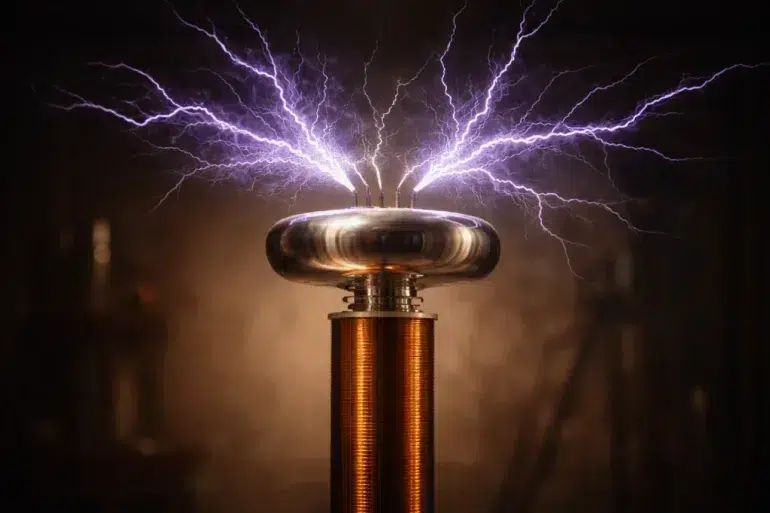
If you have been seeing the phrase Tesla Transzformátor pop up online and wondering what it actually means, you are not alone. People search it for different reasons: curiosity about Nikola Tesla, interest in high-voltage experiments, school projects, or just the classic “how do those lightning-like sparks happen?” moment.
At its core, Tesla Transzformátor is usually used as a local-language way of referring to a Tesla-style high-frequency transformer, most commonly the device we know as a Tesla coil: an air-cored resonant transformer that can generate very high voltages at high frequency. Britannica describes a Tesla coil as a transformer that produces very high voltage, often exceeding one million volts in some configurations.
But here is the important part: when people say Tesla Transzformátor, they are often talking about more than just a single gadget. They are pointing toward a bigger set of ideas Tesla explored: resonance, high-frequency power, wireless transmission, and how energy behaves when you tune circuits to work with each other instead of fighting each other.
This article breaks it down in a practical, modern way. No mystery language, no overhyped claims, and no “magic electricity” storytelling. Just the real concepts, why they matter today, and what people often misunderstand.
What does “Tesla Transzformátor” mean?
The phrase “Tesla Transzformátor” is typically used to describe a Tesla-type transformer that operates in the high-frequency range and uses resonance to amplify voltage. In English, the closest everyday term is “Tesla coil,” but it is also fair to think of it as a “resonant transformer” in the Tesla style.
A Tesla coil is a high-frequency, air-cored resonant transformer that can produce extremely high voltages. A commonly cited operating range is roughly 50 kV up to several million volts for larger coils, with frequencies often in the tens of kilohertz up to around a megahertz.
So when someone searches Tesla Transzformátor, they are usually looking for:
- A clear explanation of the device (what it is and what it does)
- How Tesla’s high-voltage ideas worked in his era
- How those ideas connect to modern engineering
Nikola Tesla’s big idea: resonance changes everything
Many inventors worked with transformers in the late 1800s, but Tesla’s approach leaned hard into one powerful concept: resonance.
A normal transformer steps voltage up or down mostly based on turns ratio and magnetic coupling through a core. A Tesla-style resonant transformer uses tuned circuits that “ring” together, like two matching musical notes that reinforce each other. In this setup, voltage gain comes largely from resonant energy transfer, not simply turns ratio.
That one shift in thinking is why the Tesla Transzformátor topic still gets attention:
- It demonstrates resonance in a way you can literally see in the air
- It links power electronics and radio-frequency behavior
- It connects to the early history of wireless communication
How a Tesla Transzformátor works (without making it feel like homework)
Even if you never want to build one, the underlying logic is clean and surprisingly modern.
The two-circuit idea
Most classic Tesla coils are basically two resonant circuits coupled together:
- Primary circuit: a power source charges a capacitor and drives a low-turn coil.
- Secondary circuit: a high-turn coil with its own capacitance (often helped by a top terminal) resonates at the same frequency.
When tuned correctly, energy moves from the primary to the secondary efficiently, building up very high voltage at the top terminal. That is why you get dramatic arcs even though the current is typically low.
Why the top “donut” matters
That toroid or sphere at the top is not decoration. It increases capacitance and helps control electric field intensity so the voltage can rise higher before breaking out into air discharge.
Spark gap vs modern switching
Historically, Tesla used spark gaps as fast switches to kick the system into oscillation. Many modern versions use solid-state electronics instead, which can be quieter, more controllable, and easier to tune, depending on the design.
Tesla Transzformátor vs “normal” transformer
A quick comparison makes the differences feel obvious.
| Feature | Standard power transformer | Tesla-style resonant transformer (Tesla Transzformátor) |
|---|---|---|
| Core | Usually iron or ferrite | Usually air-cored |
| Frequency | 50/60 Hz (typical mains) | High frequency (often kHz to MHz) |
| Voltage gain | Mostly turns ratio | Mostly resonance and energy transfer |
| Typical goal | Efficient power delivery | High voltage demonstration, RF experiments, research |
This is why the Tesla Transzformátor gets grouped with high-frequency engineering rather than everyday power transformers.
What Tesla was really trying to do with high voltage
Tesla did not pursue high voltage just for sparks. His work pointed toward:
- Better lighting systems (high-frequency experiments were tied to early lighting research)
- Wireless signaling concepts
- Ambitious wireless power transfer ideas
Wardenclyffe Tower, Tesla’s famous project on Long Island, was built as an experimental wireless transmission station. Tesla intended it for long-distance wireless communication and pursued ideas related to wireless power transfer as well.
Even if you do not buy every claim Tesla made, the historical arc is real: these experiments helped shape the early ecosystem of radio-frequency engineering and wireless technology.
Colorado Springs: where theory met big sparks
Tesla’s Colorado Springs work (1899) is often referenced because it was a place where he pushed scale and took extensive notes. The details are debated in pop culture, but the core point is straightforward: Tesla conducted large-scale experiments and documented them in his notes, and those experiments became a major anchor in how people talk about his high-voltage ideas today.
If you are reading about Tesla Transzformátor and seeing Colorado Springs mentioned, that is why.
Modern relevance: where Tesla’s ideas show up today
This is where the topic becomes more than nostalgia.
1) Resonant power transfer and wireless charging
Modern wireless charging is not a Tesla coil, but it absolutely borrows from the broader concept of resonant coupling, especially in more advanced resonant systems. Tesla’s experiments helped popularize the idea that tuned circuits can transfer energy more effectively than “brute force” approaches.
2) RF engineering mindset
A Tesla Transzformátor forces you to think in RF terms:
- Stray capacitance is not a rounding error, it is part of the circuit
- Geometry matters
- Grounding and coupling change behavior dramatically
3) STEM education
Modern Tesla coil designs are used as multidisciplinary teaching examples because they touch circuits, electromagnetism, resonance, and safety. There are even teaching-focused papers that model Tesla coil behavior at the undergraduate level.
4) Early radio history (and the interference problem)
Spark-based systems are electrically noisy. That is not just a fun fact; it shaped regulations and engineering approaches. Spark-gap systems were notorious for creating wideband interference, and the problem was serious enough that spark emissions were prohibited by international law in the early 20th century.
So if you ever wondered why modern systems moved away from sparks, the answer is simple: sparks are messy, loud, and disruptive in the radio spectrum.
A practical mental model: think “energy sloshing,” not “electricity shooting upward”
A common misconception around Tesla Transzformátor devices is that electricity is being “boosted” the same way a normal transformer boosts voltage. Resonant systems behave differently.
A cleaner way to imagine it:
- The primary circuit stores energy (often in a capacitor).
- A switching event (spark or electronics) releases that energy into oscillation.
- The coupled secondary picks up that oscillation and builds voltage through resonance.
The Wikipedia technical overview (not linking here yet) describes how resonance, not turns ratio, drives the very high secondary voltage in this kind of transformer.
That is also why tuning matters so much. If the primary and secondary are not aligned in frequency, performance collapses fast.
Real-world components people mention in Tesla Transzformátor discussions
When you read forums, watch videos, or browse DIY pages, you will see recurring parts. Here is what they usually mean, in plain language:
- Primary coil: few turns, thick conductor, handles high current
- Tank capacitor: stores energy for the primary oscillation
- Spark gap or switching electronics: “kicks” energy into oscillation
- Secondary coil: many turns, builds high voltage
- Top load (toroid or sphere): increases capacitance, controls discharge behavior
- Grounding system: critical for predictable behavior and safety
Safety: the part that should never be treated casually
A Tesla Transzformátor topic attracts a lot of DIY energy, so it is worth being blunt: high voltage systems can be dangerous, even deadly. The risk is not only shock. Arc flash, burns, and RF-related injuries can also be part of the hazard landscape in high-energy electrical environments.
OSHA describes arc flash hazard awareness and emphasizes risk assessment and proper protective approaches in energized electrical work contexts.
High-voltage safety tutorials also point out burns from arc flash and resistive heating, and note that frequency and available current matter greatly in injury risk.
So if your interest in Tesla Transzformátor is hands-on, treat it like serious electrical engineering, not a weekend craft.
Common questions people ask about Tesla Transzformátor
Is Tesla Transzformátor the same as a Tesla coil?
Most of the time, yes in practice. People use it to refer to the Tesla coil or Tesla-style resonant transformer concept. The exact hardware varies, but the core idea is the same: resonant voltage amplification in a coupled RF transformer.
How much voltage can it produce?
It depends on design and size. A widely cited range for Tesla coils is from around 50 kV to several million volts for large coils.
Why does it make “lightning”?
At high enough electric field strength, air breaks down and becomes conductive, producing visible arcs and corona discharge. The high voltage at the top terminal drives that breakdown.
Is it useful, or just for show?
It can be educational and useful for demonstrating resonance, RF behavior, insulation limits, and high-voltage phenomena. In practical industry, the exact device is niche, but the principles behind it show up across RF and power electronics.
Why did spark-based designs fade out?
Because sparks create broad electromagnetic interference and are inefficient and noisy. Early radio engineering moved toward continuous-wave methods that were cleaner and more controllable.
A short “case study” scenario: why tuning and grounding change everything
Imagine two people build similar-looking Tesla Transzformátor setups. One gets long, stable arcs. The other gets weak sputtering and random behavior.
What usually explains that difference is not “better parts.” It is fundamentals:
- The resonant frequencies are not actually matched
- Coupling is too tight or too loose
- Grounding is poor, so the return path is unpredictable
- The top load is mismatched, so energy leaks into premature breakout
This is a good lesson beyond Tesla coils. In real engineering, systems that look identical on a schematic can behave totally differently when stray capacitance, geometry, and grounding enter the picture. Tesla-style systems force you to respect those hidden variables.
How to talk about Tesla’s wireless power ideas without falling into hype
Tesla’s name gets used to sell everything from miracle power boxes to questionable “free energy” claims. If you are writing or reading about Tesla Transzformátor, a healthy filter helps.
A grounded way to frame Tesla’s wireless power ambition:
- Tesla demonstrated that high-frequency high-voltage systems can create strong electric fields and can couple energy into nearby devices.
- Scaling that into efficient, safe, global wireless power is a much harder engineering and infrastructure challenge.
- Wardenclyffe was a bold attempt to build a wireless transmission station, and Tesla pursued it with both communication and power goals in mind.
That framing keeps the respect for the history without turning it into a fantasy story.
Conclusion
The reason Tesla Transzformátor still grabs attention is simple: it sits at the intersection of dramatic visuals and serious physics. The device is a gateway into resonance, RF thinking, and the practical reality that electricity is not just “voltage and current” on paper. Shape, frequency, coupling, and grounding all matter.
Nikola Tesla’s high-voltage work helped push electrical engineering into new territory, from resonant transformers to early wireless experimentation. Today, the same concepts echo through wireless charging ideas, RF design, and hands-on STEM education. If you want a single reference point for the classic device most people mean when they say Tesla Transzformátor, the best starting definition is the Tesla coil.