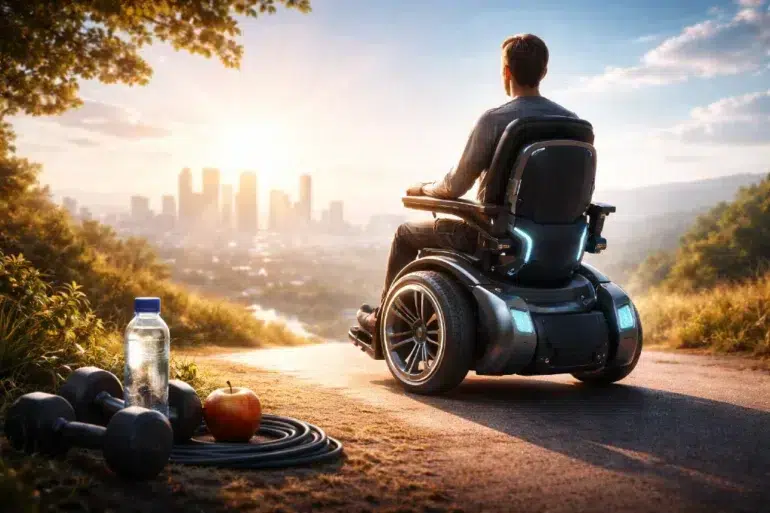
The phrase Tesla Wheelchair has been popping up in searches, social feeds, and comment sections, and it taps into something bigger than a product rumor. People aren’t just curious about a new chair. They’re imagining what happens when the kind of battery tech, safety thinking, and software driven design we associate with modern EVs gets applied to mobility.
To be clear, the internet often runs ahead of reality. Sometimes Tesla Wheelchair is used to describe a real, near future category: advanced power wheelchairs and smart wheelchair prototypes that combine stronger batteries, better motors, sensors, and assisted driving features. Other times, it’s used like a brand name for a chair that does not officially exist.
Either way, the question is worth exploring because the need is real. The World Health Organization estimates 1.3 billion people live with significant disability worldwide, roughly 1 in 6 of us. When mobility becomes hard, the right technology can change health outcomes, daily independence, and how free a person feels to live on their own terms.
This article breaks down what people usually mean by Tesla Wheelchair, what smart mobility can realistically do, and what it could mean for health, independence, and freedom if the best ideas in modern engineering truly arrive in everyday wheelchairs.
What people mean when they say Tesla Wheelchair
When most readers search Tesla Wheelchair, they’re usually looking for one of these things:
- A real product announcement or launch news
- A concept chair inspired by Tesla style and EV technology
- A next generation powered wheelchair with smart features like obstacle avoidance, assisted steering, or app controls
- A discussion of what an EV company could bring to mobility and accessibility
So think of Tesla Wheelchair as a shorthand for a “high performance, software smart, safety focused” wheelchair vision.
And that vision isn’t science fiction. Researchers and manufacturers have been building smarter wheelchairs for years, including work on autonomous navigation, obstacle avoidance, and shared control systems where the user stays in charge while the chair helps avoid hazards.
Why the idea matters for health, not just convenience
Mobility equipment often gets treated like a “nice to have” upgrade, but the health side is huge.
Limited mobility is connected to real medical risk. WHO notes people with disabilities experience major health inequities and higher risk of many conditions. That doesn’t mean disability automatically causes illness. It often means the environment, access barriers, and lack of appropriate support make healthy living harder.
A Tesla Wheelchair style leap in mobility tech could support health in a few practical ways:
- Fewer injuries from overuse, strain, and repetitive motion
- More daily movement and community participation
- Better safety and fewer falls for some users
- Less caregiver burden, which reduces stress on families too
This is also where powered and power assist mobility shows measurable benefits. Studies on powered wheelchairs report positive psychosocial impact and improvements linked to quality of life and independence for users.
Less strain, fewer secondary injuries
One of the most common hidden problems for manual wheelchair users is upper body strain. Shoulders, wrists, and elbows take the workload day after day, often on rough surfaces and steep ramps.
Evidence reviews and clinical discussions around power assist devices highlight benefits like reduced repetitive strain and reduced risk of upper extremity pain, plus enabling longer distances and easier participation in daily activities.
A Tesla Wheelchair concept often implies strong motors and efficient power delivery. If that translates into smoother starts, smarter torque control, and less effort to navigate slopes, that is not just comfort. It’s prevention.
Better participation is a health intervention
Health isn’t only about vitals and lab results. It’s also social, mental, and practical.
Research on powered wheelchair users highlights that independent mobility affects participation, usability, safety, cost, and stigma across life stages. Another study emphasizes that independence remains crucial and that understanding powered wheelchair users’ experiences matters for quality of life.
In plain terms, being able to decide when you go out, who you see, and what you do is closely tied to mental health and life satisfaction. A Tesla Wheelchair style product would be meaningful if it increased access without increasing stress.
Independence: what a next generation chair could actually change
Independence looks different for every person. For one user, it’s being able to make breakfast without help. For another, it’s commuting to work reliably. For someone else, it’s simply not having to plan their entire day around someone else’s availability.
Here’s where a Tesla Wheelchair idea becomes practical. The most helpful innovations aren’t flashy. They remove friction from daily life.
Mobility that feels predictable
A major frustration with many mobility devices is unpredictability: battery anxiety, uneven terrain, jerkiness, or small issues that become big ones when you rely on the chair every day.
A Tesla inspired approach would likely emphasize:
- Battery management that gives accurate range estimates
- Better traction control for wet surfaces
- Smoother acceleration curves and braking
- Suspension tuned for bumps, curb cuts, and uneven sidewalks
Some of these exist in high end mobility devices already, but the dream behind Tesla Wheelchair is making them more reliable, more common, and more affordable.
Smarter support without taking control away
People worry that “smart wheelchairs” could become too automated. The more realistic direction is shared control. You drive, the chair assists.
Research literature discusses shared control systems where sensor data helps achieve the user’s intended outcome, rather than replacing the user. Work on obstacle avoidance and autonomous navigation explores how sensors and planning algorithms can reduce collisions and navigate complex environments.
For a Tesla Wheelchair, the best version is not a chair that drives you around like a taxi. It’s a chair that helps you avoid scraping doorframes, drifting off a ramp edge, or misjudging a tight turn when you’re tired.
Freedom: the part people don’t always say out loud
Freedom is a loaded word, but it fits here.
Freedom is spontaneity. It’s not needing a detailed plan for a simple outing. It’s not having to measure every doorway in advance. It’s being able to say yes to life without negotiating every step.
A Tesla Wheelchair vision connects to freedom when it improves three things:
- Confidence that the chair will get you there
- Safety that reduces anxiety
- Convenience that reduces reliance on others
Safety and falls are a big deal
Falls don’t only affect walkers. Wheelchair and scooter users fall too, and the impact can be serious.
A University of Illinois report on a survey of full time wheelchair or scooter users highlights a very high rate of falls and emphasizes the need for specialized fall prevention and wheelchair safety training. Research also points to the unique nature of falls among wheelchair users in certain settings and the need for specialized interventions.
A Tesla Wheelchair style approach could bring safety features that are normal in modern vehicles, adapted for mobility:
- Better lighting and visibility features
- Stability sensing to detect risky tilt or terrain
- Intelligent speed limiting in tight indoor spaces
- Optional fall detection that alerts a trusted contact
Not every user wants connected features, and privacy matters. But for many people, the choice to enable safety support would be empowering.
What would a Tesla Wheelchair probably include if it existed
Let’s talk about the “if” without drifting into fantasy.
If a premium modern engineering team built a Tesla Wheelchair, these are the core areas they would likely focus on, because they deliver real daily value.
Battery and range that match real life
Wheelchair range claims can feel like phone battery claims: perfect on paper, messy in the real world.
A serious Tesla Wheelchair concept would likely include:
- Range estimates that adapt to user weight, terrain, and driving style
- Health monitoring for battery degradation over time
- Fast, safe charging with clear guidance
- Cold weather and heat performance planning
The goal is not just “long range.” The goal is trust.
Motors, torque, and smooth control
For many users, the pain point isn’t top speed. It’s torque on ramps, curb cuts, and uneven pavement. Smooth low speed control indoors matters too.
A good Tesla Wheelchair would prioritize:
- Precise low speed movement for kitchens and tight hallways
- Confident ramp performance
- Quiet motor behavior and minimal vibration
- Good thermal management so performance doesn’t drop mid day
Sensors and assisted driving features
Smart wheelchairs already use a mix of sensors, including lidar, IMUs, and other modules for environment sensing and safety features. Research prototypes explore 2D and 3D perception approaches to obstacle detection.
In a consumer ready Tesla Wheelchair, you might see optional features like:
- Obstacle proximity warnings
- Assisted turning in narrow spaces
- Auto slow down near drop offs or ramps
- Indoor safe mode and outdoor performance mode
A simple, useful app, not a confusing one
An app can be helpful if it improves daily life. It becomes annoying when it adds steps.
The most useful Tesla Wheelchair app features would be practical:
- Battery status with accurate remaining time
- Maintenance reminders and diagnostics
- Service logs and warranty tracking
- Optional location sharing for safety when requested
A quick comparison table: traditional power chair vs Tesla Wheelchair style features
| Area | Traditional powered wheelchair | Tesla Wheelchair style expectation |
|---|---|---|
| Range estimate | Basic battery meter | Predictive range based on terrain and habits |
| Safety assist | Limited, varies by model | Strong sensor suite and assisted control options |
| Updates and diagnostics | Often service center dependent | Built in diagnostics and guided troubleshooting |
| Ride quality | Varies, often functional | More focus on suspension, comfort, stability |
| Custom modes | Limited presets | Indoor/outdoor profiles and customizable controls |
| Accessibility ecosystem | Separate add ons | More integrated accessories and smart options |
This is not a guarantee. It’s the direction people are imagining when they use the term Tesla Wheelchair.
The realities that matter: cost, repairability, and access
Here’s the part that separates a cool idea from a meaningful impact.
Even the smartest Tesla Wheelchair won’t help most people if it’s priced out of reach, hard to repair, or impossible to get covered by insurance or health systems.
Cost and coverage can block innovation
High tech mobility devices are expensive, and coverage rules can lag behind innovation. If features are labeled “convenience” rather than “medical necessity,” people lose access.
A truly health focused Tesla Wheelchair approach would need:
- Clear clinical justification for safety and independence features
- Repair networks and local service partners
- Strong parts availability and predictable maintenance
- Options across price tiers, not only luxury
Repairability is freedom too
Independence disappears fast when your chair is stuck waiting on a part.
So if you’re imagining Tesla Wheelchair as a category shift, repairability should be part of the conversation:
- Modular parts that can be replaced quickly
- Transparent service timelines
- Remote diagnostics that reduce unnecessary visits
- Reasonable warranty terms for high use devices
Real world scenarios: how a Tesla Wheelchair style leap could change a day
Sometimes it’s easier to see the value through everyday moments.
Scenario 1: the ramp that decides your schedule
A user has a short ramp outside their building that is slightly uneven. Their current chair struggles on cold mornings, slipping and requiring assistance.
A Tesla Wheelchair style traction control and better torque delivery could reduce that daily stress. No dramatic “autonomy.” Just a reliable ramp climb that protects dignity and saves time.
Scenario 2: grocery shopping without “doorframe anxiety”
Crowded aisles and narrow turns can be exhausting. A small bump can damage a chair or cause embarrassment.
Assisted turning or proximity alerts, used quietly in the background, could help a user move through tight spaces with less mental load.
Scenario 3: a caregiver gets breathing room
If the chair is safer and more predictable, a caregiver can step back. That changes relationships. The user feels less supervised. The caregiver feels less on edge.
That’s the human side of Tesla Wheelchair as an idea: independence expands for everyone involved.
Actionable tips: what to look for today if you want Tesla Wheelchair level benefits
You don’t have to wait for a headline to get real improvements.
If you want the practical benefits people associate with Tesla Wheelchair, focus on these areas when evaluating current options with a clinician or seating specialist:
- Fit and posture support first
Comfort and skin protection matter as much as tech. A powerful chair that fits poorly can cause pain and pressure issues. - Battery confidence over headline range
Ask how range changes with hills, rough sidewalks, and user weight. - Indoor control quality
Test low speed movement. Can you line up with a table? Can you turn in a narrow hallway without stress? - Stability features
Ask about anti tip design, center of gravity adjustments, and how the chair behaves on ramps. - Service network and parts availability
Before you buy, ask who repairs it locally, typical part wait times, and what’s covered. - Training and safety coaching
Falls research emphasizes that targeted interventions and safety training matter for wheelchair users. Good training improves confidence.
These points help you capture the real benefits behind the Tesla Wheelchair search term without chasing hype.
FAQ: common questions people ask about Tesla Wheelchair
Is Tesla Wheelchair an official Tesla product?
Often, no. Many searches use Tesla Wheelchair as a concept term or a rumor. If you’re looking for official confirmation, rely on verified announcements, not viral posts.
Do smart wheelchairs actually exist today?
Yes. There are research platforms and commercial features that involve sensors, alternative control methods, and assisted navigation concepts. Research continues actively in shared control and obstacle avoidance.
Could smart features improve safety?
Potentially, yes. Falls among wheelchair and scooter users are a recognized concern, and research highlights the need for specialized prevention and safety approaches. Sensor driven assistance may help reduce certain types of collisions or risky maneuvers, though outcomes depend on design and training.
Will high tech mobility make life more independent?
For many users, powered mobility is linked to improved independence and psychosocial outcomes, especially when it supports participation and daily activities. The best designs reduce effort and friction, rather than forcing users to learn complicated systems.
What should matter most: autonomy or usability?
Usability. A chair that feels natural, reliable, and easy to service often improves freedom more than advanced automation that fails in messy real world environments.
Conclusion: the best meaning of Tesla Wheelchair is human, not hype
At its best, Tesla Wheelchair is not about a logo. It’s about taking mobility seriously as a health intervention, an independence tool, and a freedom multiplier.
We already know the need is massive. WHO estimates 1.3 billion people live with significant disability, and the health equity gap is real. We also know powered mobility can support quality of life, participation, and independence for many users. And we know safety, including fall prevention and training, deserves far more attention than it gets.
So if the Tesla Wheelchair idea pushes the industry toward better batteries, smoother control, smarter safety, and more reliable service, that’s not just innovation. That’s dignity.
In the end, what people want from a Tesla Wheelchair is the same thing they want from any mobility device: to move through the world with confidence, to protect their health, to reduce dependence, and to feel free to say yes to life.
When we talk about assistive technology, that’s what we’re really talking about.