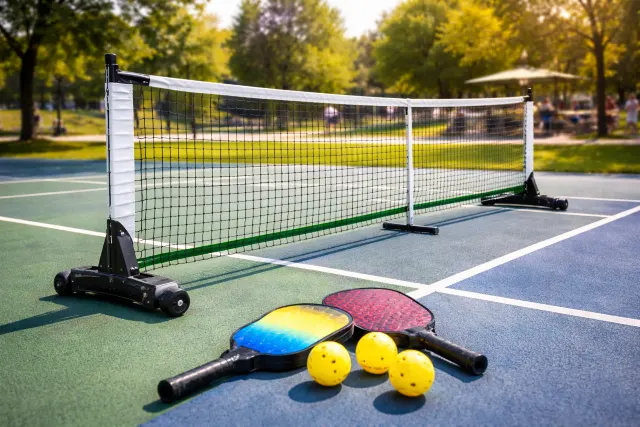
Pickleball has a funny way of turning “we should do something active” into a weekly tradition. One minute you’re tapping a ball back and forth for laughs, and the next you’re texting friends about court time and arguing (politely) over kitchen rules. With participation climbing fast in recent years, many players are running into the same problem: courts are busy, space is limited, and you don’t always have a lined-up facility when the urge to play hits.
That’s where a Portable Pickleball Net earns its keep. Instead of planning your schedule around open courts, you can turn a driveway, gym floor, park slab, or cul-de-sac into a playable setup in minutes. When the net is stable, regulation-friendly, and easy to assemble, the whole game feels smoother. You spend less time wrestling with gear and more time actually rallying.
In this guide, you’ll learn what makes a portable net truly worth using, how to choose one that fits your space and playing style, and how to set it up so it feels close to a “real” court, even when you’re improvising.
Why pickleball’s boom makes portable nets more useful than ever
Pickleball isn’t just “popular.” It’s become a serious part of the recreation landscape. The Sports & Fitness Industry Association (SFIA) has highlighted rapid growth, including triple-digit percentage increases across multi-year windows and strong participation across age groups. That growth is great for the sport, but it also means two practical realities for everyday players:
- Public courts get crowded, especially evenings and weekends.
- New courts take time and money to build, so demand can outpace supply.
USA Pickleball’s own growth reporting also shows how quickly “places to play” and court counts are changing, which is another way of saying: the sport is expanding, but so is the squeeze for space.
A Portable Pickleball Net is the simple workaround. It gives you options. You’re not waiting for a court to open, and you’re not forced to skip a session because the facility is booked. If you’ve ever arrived at a park and found every court taken, you already understand the value.
What a portable net actually needs to do well
A portable net isn’t “just a net.” It’s a system: frame, posts, base, net material, and tensioning method. When those parts work together, you get a net that feels solid and predictable during play. When they don’t, you get a wobbly barrier that sags, drifts, or tips in light wind.
Here are the core jobs your net system should handle.
1) Match regulation dimensions closely
Even if you’re playing casually, the closer you are to regulation, the more your shots and habits translate to real courts.
Most standard pickleball nets are 36 inches high at the sidelines/posts and 34 inches at the center, creating the slight dip you’re used to seeing in proper setups.
A net that sits too high changes dinks and resets. A net that sits too low makes speed-ups and put-aways feel “too easy” and trains the wrong margin.
2) Stay stable during real rallies
Stability isn’t about being fancy. It’s about the net staying put when the pace picks up.
A stable net setup typically depends on:
- A wider, weighted, or well-braced base
- Solid joints that don’t flex under tension
- A center strap or center support that prevents sagging
- Feet or end supports that grip the surface (especially indoors)
3) Tension evenly so the ball response feels consistent
If the top band sags, your visual read changes. If the net bows forward, you’ll feel it when the ball clips tape and drops oddly. Good tension makes the net “disappear” as a problem so you can focus on the rally.
4) Set up quickly without tools
Portability means you’ll actually use it. If setup takes 30 minutes, people quietly stop bringing it. The sweet spot is a system that assembles in a few minutes once you’ve done it once or twice, using snap-fit connections, labeled parts, or simple push buttons.
Portable Pickleball Net vs permanent net: what changes in real play?
Permanent nets are locked in, often anchored or installed in a dedicated facility. Portable nets live in the real world: wind, uneven ground, tight storage, and people carrying them in car trunks.
The good news is that modern portable nets can feel very close to permanent ones if you choose the right build and take a couple of setup steps seriously.
Quick comparison table
| Feature | Portable net system | Permanent net |
|---|---|---|
| Setup time | Minutes | Installed once |
| Portability | High | None |
| Stability | Varies by model and setup | Typically very high |
| Best surfaces | Driveways, gym floors, flat park areas | Dedicated courts |
| Storage | Folds/collapses | Not applicable |
| Cost range | Usually moderate | Often higher once installation is included |
If you play in multiple locations or you’re trying to build a routine with friends or family, a Portable Pickleball Net usually wins on convenience alone.
Where a portable net shines: real scenarios that make sense
A lot of people buy a net thinking it’s only for travel. In practice, most owners use it in a few repeatable places.
Driveway games that actually feel organized
A driveway is the classic “quick game” location, but it’s only enjoyable if the net stays square and the space is safe. With a portable setup, you can run short games, practice dinks, or do serve-and-return drills without needing a facility.
Parks and open courts when pickleball courts are full
Many parks have flat multi-use areas. When dedicated courts are occupied, a portable net lets you create your own mini-court using cones or temporary lines.
Indoor gyms, community halls, and school spaces
Indoor play is often more consistent because you remove wind. A portable system with good feet and a stable base can feel surprisingly “court-like” on polished floors.
Training and skill work without needing full court time
If you’re working on soft game control, a net plus a small marked area can be enough. You don’t need a perfect full-court layout to improve touch, resets, and dinks.
How to choose the right Portable Pickleball Net for your needs
Not every net suits every player. Some are built for quick recreational use. Others are closer to tournament training quality. The key is matching the build to your most common use.
Frame material: steel vs aluminum
You’ll see this debate everywhere for a reason.
- Steel frames tend to be heavier and more stable, which can be a big advantage outdoors and in breezy conditions.
- Aluminum frames tend to be lighter and easier to carry, which matters if you’re moving it often or storing it in a small space.
If you’re playing outside regularly, weight can be your friend. If you’re traveling, carrying, or setting up solo, lighter builds can be easier.
Net material and edge finish
The net takes constant impact and rubbing. Look for:
- Tight mesh that keeps shape under tension
- Reinforced edges (stitching matters more than you think)
- A sturdy headband that helps the top line sit cleanly
Base design and footprint
A narrow base can be tippy. A broad base is usually steadier, but it can also create toe-stub zones. The best designs balance stability and foot safety.
Pay attention to:
- How far the feet extend outward
- Whether the base is flat or raised
- Whether it includes end supports that resist twisting
Center support and sag control
That slight “dip” in the middle is normal by regulation, but uncontrolled sag is different. Nets that include a center strap or center support help you maintain a consistent middle height closer to the expected 34 inches.
Carry bag and storage practicality
It sounds boring, but it matters. If the bag rips, zippers fail, or parts don’t fit easily, you end up tossing pieces loose in your trunk, and eventually something gets lost.
A good bag:
- Holds all parts without forcing it
- Has a shoulder strap or comfortable handles
- Has space for extras (tape lines, cones, spare balls)
Fast setup anywhere: a simple method that works
Once you’ve chosen a net, the next step is making setup repeatable and smooth. Here’s a practical approach that keeps the net stable and the session flowing.
Step 1: Pick the flattest area you can
A net can only be as level as the ground beneath it. Look for:
- Minimal slope
- No loose gravel where feet can slide
- Enough space behind baselines for safe movement
Step 2: Assemble the frame first, then add tension
Build the frame so it sits square. Then attach the net and apply tension gradually. If you tension the net while the frame is twisted, you lock in that twist.
Step 3: Set height at the posts, then check the center
Aim for the familiar standard: 36 inches at the sidelines/posts and 34 inches in the center.
A simple tape measure check takes seconds and keeps play fair.
Step 4: Secure it for the surface
Different surfaces need different approaches:
- Outdoor concrete/asphalt: use the net’s own base stability, and if wind is an issue, place a small weight near the base ends (without creating trip hazards).
- Indoor gym floors: ensure feet are non-marking and grippy. If the base slides, your rallies get interrupted.
- Grass: it can work, but bounce changes and leveling becomes harder. Use it for casual play and drills, not for “serious” practice.
Step 5: Do a quick “rally test”
Before everyone starts keeping score, hit 10 to 15 balls across the net. You’ll immediately notice if:
- The center is sagging too much
- One end is drifting
- The net is leaning forward/back
Fixing it early prevents that slow frustration that ruins a session.
Common mistakes that make portable nets feel “cheap”
Even a decent Portable Pickleball Net can feel bad if setup is rushed. These are the typical issues.
Ignoring tension and playing with a saggy tape line
A sagging top band messes with visual cues and makes net clips unpredictable. Use the strap or tension method your net includes and re-check after a few minutes of play.
Setting up on a slope and wondering why the net looks uneven
If the ground slopes, one sideline ends up “higher” relative to the surface. Your brain notices it even when you don’t measure it.
Leaving parts slightly unclicked or half-seated
Push-button joints and snap connectors need to lock fully. If they don’t, the frame flexes under tension and you get wobble.
Treating outdoor wind like a minor detail
Even mild wind can move a light frame. If you play outdoors often, stability features matter, and placement choices matter too.
Simple drills that work great with a portable setup
A portable net isn’t only for games. It’s also a training tool, especially if you can’t always grab full-court time.
Dink consistency ladder
- Stand at the kitchen line (or mark an equivalent)
- Aim for 10 straight dinks crosscourt without popping up
- If you miss, reset and start again
This drill builds touch and patience quickly.
Third-shot drop practice
- One player serves
- The other returns deep
- The server practices a softer third-shot drop over the net
Portable nets help here because you can repeat the same pattern without waiting for court availability.
Volley stability work
- Stand a step behind the kitchen line
- Exchange controlled volleys, keeping the ball below shoulder height
This improves reaction time and paddle control.
FAQ: quick answers people actually ask before buying or using one
Is a Portable Pickleball Net good enough for serious practice?
Yes, if it’s stable and close to regulation height. When the net holds 36 inches at the posts and 34 inches at the center, practice becomes transferable to real courts.
Can you set up pickleball on a tennis court with a portable net?
You can, and many people do. The main challenge is court lines and net placement, not the surface itself. If you use temporary lines or understand the spacing, it works well.
How long does setup usually take?
With a user-friendly system, once you’ve practiced it a couple times, setup can be quick enough that it doesn’t feel like “work.” The difference usually comes down to how the frame connects and how the net tensions.
What should you do if the net keeps sliding?
First, check you’re on a clean, dry surface. Then confirm the frame is square and fully seated. On very slick surfaces, a grippier foot design helps. Indoors, footwear and dust can also make sliding worse.
Do portable nets hold up outdoors?
Many do, but outdoor durability depends on materials, finishes, and how you store it. Keeping it dry, wiping grit off, and storing it in its bag extends life.
Care and storage that keeps the net reliable
A little routine makes your net last longer and keeps setup consistent.
- Wipe down after outdoor play to remove dust and grit that wear joints.
- Dry the net before storing if it’s damp from dew or light rain.
- Avoid leaving it in a hot car long-term if the net material is sensitive to heat.
- Check connectors occasionally for looseness, especially after heavy use.
This is the unglamorous part of ownership, but it’s what separates “works for years” from “starts wobbling in three months.”
Conclusion: why a Portable Pickleball Net is the smart fast-setup move
A Portable Pickleball Net is one of those purchases that quietly changes how often you play. Instead of hunting for open courts, you create a court. Instead of cancelling because the gym is booked, you set up in a usable space and get your reps in. And because pickleball participation has grown rapidly in recent years, having your own reliable setup can feel less like a luxury and more like a practical way to keep playing consistently.
The best part is how flexible it makes your routine. Quick after-work games in the driveway. Weekend park rallies. Indoor sessions when the weather turns. When your net is stable, regulation-friendly, and easy to assemble, the sport stays simple and fun, exactly how pickleball is supposed to feel.
If you’re curious about the sport’s background and how it evolved from a backyard game into a global phenomenon, it’s a fun read and adds context to why so many people are now building their own play setups at home.