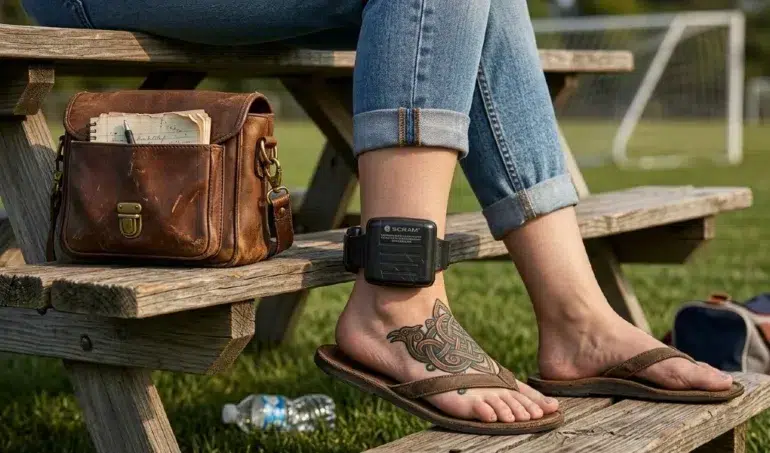
If you’re facing a DWI charge, there’s a good chance a SCRAM device has come up in conversation. SCRAM stands for Secure Continuous Remote Alcohol Monitor, an ankle bracelet that tests your sweat for alcohol every 30 minutes, around the clock.
Courts use it to keep tabs on defendants required to stay sober as a condition of bail, probation, or a deferred sentence. It transmits data wirelessly to a monitoring agency, so there’s no checking in manually. The device does it for you, constantly.
So, what is a scram device in plain terms? It’s a court-ordered ankle monitor that detects ethanol in perspiration and sends tamper alerts if anyone tries to remove or block it. Think of it as a breathalyzer you can’t leave at home.
According to SCRAM Systems, the technology has been used in over 500,000 cases across the U.S. since its introduction. It’s a standard part of DWI case management in many states.
Knowing how it works, what courts do with the data, and where the device’s limits actually are can matter a great deal, whether you’re the one wearing it or trying to understand what’s at stake.
How SCRAM Actually Works
The device sits on the ankle and samples insensible perspiration. A built-in sensor measures ethanol concentration in that sweat every 30 minutes and logs each reading automatically.
Those readings upload to a secure server monitored by a third-party agency. If alcohol is detected above a set threshold, the agency flags it and notifies the court or probation officer. Any attempt to tamper with the device triggers an alert as well.
One point that gets missed is SCRAM doesn’t measure blood alcohol content directly. It measures transdermal alcohol concentration (TAC), which correlates with BAC but isn’t the same number. That difference has real consequences in court.
When Judges Order SCRAM Devices
SCRAM isn’t a standard issue for every DWI. Courts tend to order it in specific circumstances:
- Repeat offenders with a documented history of alcohol-related charges
- High-BAC arrests where the reading at the scene was well above the legal limit
- Pre-trial release conditions requiring verified sobriety
- Probation or deferred adjudication agreements tied to alcohol abstinence
In Texas, courts can order SCRAM monitoring under Texas Code of Criminal Procedure Art. 17.441, which allows magistrates to require alcohol monitoring as a bail condition for defendants charged with certain intoxication offenses.
The device usually runs alongside other requirements rather than replacing them.
What the Data Can and Can’t Prove
SCRAM data is admissible in court, and judges take it seriously. A confirmed alcohol event can trigger bail revocation, a probation violation, or additional charges depending on what the original order required.
The data isn’t always perfect. Defense attorneys challenge SCRAM readings based on:
- Hygiene products containing alcohol like certain hand sanitizers, nail polish removers, or cleaning agents used near the ankle
- Medical conditions affecting sweat composition
- Device calibration issues or malfunctions
SCRAM Systems trains analysts to tell the difference between ingested alcohol and environmental exposure. Ingested alcohol produces a distinct TAC curve (a gradual rise, a peak, a fall).
Environmental interference typically doesn’t follow that pattern. Courts have still seen that methodology challenged, and expert testimony often becomes necessary to interpret the readings properly.
The Real-World Impact on DWI Defendants
Wearing SCRAM changes daily life in ways many people do not expect. The device is waterproof but not submersion-proof, so swimming pools and hot tubs are out. Showering is fine as long as the device doesn’t go underwater. Even getting too close to certain products can raise questions about a later reading.
The cost falls on the defendant in most cases, which is typically $10 to $15 per day. Over a monitoring period of several months, that adds up to real money.
Where it gets interesting is a clean SCRAM record can actually help a defendant. Verified, unbroken sobriety over weeks or months is the kind of concrete evidence that carries weight in plea negotiations and sentencing discussions. Prosecutors and judges can see it. It’s not self-reported.
A SCRAM device is both a monitoring tool and a way for individuals to demonstrate that they are complying with court-ordered conditions. For defendants who take the terms seriously, it can become one of the stronger arguments in their favor.
Key Takeaways
- A SCRAM device is an ankle monitor that checks for alcohol use 24 hours a day.
- Courts require SCRAM devices for certain DWI defendants.
- SCRAM devices contain a built-in sensor that measures ethanol concentration in sweat every 30 minutes.
- A confirmed alcohol event can trigger bail revocation or additional charges depending on what the original order required.
- A clean SCRAM record actually helps a defendant in many ways.