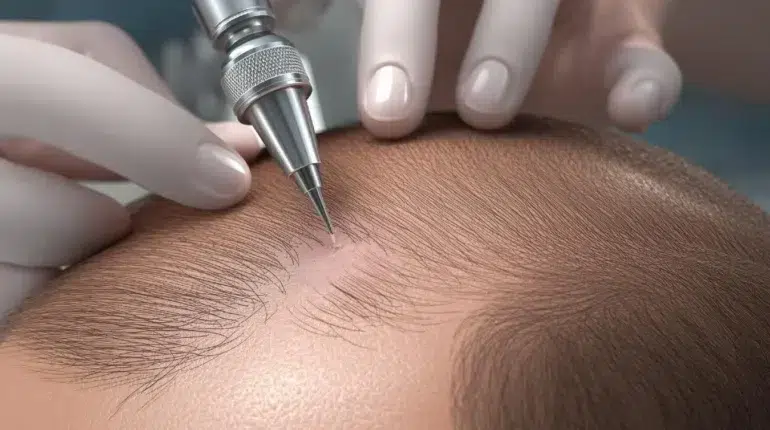
Pattern hair loss is one of the most common reasons people visit a dermatologist, yet it remains one of the most misunderstood conditions. Many people spend years trying shampoos and oils before realizing that what they are dealing with is a medical condition — one that has a name, a clear biological mechanism, and actual treatment options backed by clinical evidence.
What Pattern Hair Loss Actually Is
Androgenetic alopecia, the medical term for pattern hair loss, affects both men and women. In men, it typically begins with a receding hairline or thinning at the crown. In women, it usually shows up as diffuse thinning across the top of the scalp without a fully receding hairline.
The driving force behind this condition is dihydrotestosterone, or DHT — a hormone derived from testosterone. In people who are genetically sensitive to DHT, hair follicles gradually miniaturize over time. The hairs they produce become thinner, shorter, and eventually stop growing altogether. This process does not happen overnight. It unfolds over years, sometimes decades, which is why early recognition matters.
Why Lifestyle Remedies Alone Often Fall Short
There is no shortage of advice online — eat more protein, massage your scalp, try castor oil. These things are not necessarily harmful, but they do not address the root mechanism. If DHT is actively shrinking your follicles, no amount of oil massage will reverse that process.
This is the point where many people lose time. They spend months on remedies that feel proactive but do not touch the underlying cause. By the time they consult a doctor, more follicles have miniaturized. Treatment works best when it is started early, which is exactly why understanding the medical options matters.
The First-Line Treatments Doctors Typically Recommend
When a dermatologist diagnoses pattern hair loss, the conversation usually starts with two well-established treatments.
Minoxidil is a topical solution or foam that is applied directly to the scalp. It works by widening blood vessels around hair follicles, improving blood flow and extending the active growth phase of the hair cycle. It does not block DHT, but it helps follicles function better despite DHT’s presence. Both men and women can use minoxidil. Results take time — usually three to six months — and the treatment needs to be continued to maintain the benefit.
Finasteride is an oral medication approved primarily for men that works differently. It inhibits the enzyme responsible for converting testosterone into DHT, directly reducing the hormone that causes follicle miniaturization. Clinical studies show it can slow hair loss and, in many cases, lead to visible regrowth. It is considered more targeted in its mechanism than minoxidil and is often prescribed when the condition is progressing despite topical treatment.
When Doctors Consider Additional Interventions
For cases where topical and oral medications have not produced sufficient results, or when the condition has progressed significantly, doctors may consider other options.
Platelet-rich plasma therapy, commonly referred to as PRP, involves drawing a small amount of the patient’s blood, processing it to concentrate growth factors, and injecting it into areas of thinning. The evidence is still growing, but several studies show meaningful improvement in hair density with repeated sessions.
Hair transplant surgery is typically discussed for people with stable pattern hair loss who have not responded adequately to medications. Follicular unit transplantation moves healthy follicles from areas resistant to DHT to areas that have thinned. It is not a cure and does not stop ongoing loss, which is why doctors usually recommend continuing medical treatment alongside it.
The Role of Integrated, Root-Cause Treatment
What dermatologists increasingly recognize is that pattern hair loss rarely exists in complete isolation. Nutritional deficiencies, thyroid imbalances, chronic stress, and poor sleep can all accelerate the process even when the genetic predisposition is the primary driver.
Platforms like Traya take this view seriously by combining clinically proven treatments with assessments that account for these contributing factors — which often makes the overall response to treatment more complete.
Final Thoughts
Pattern hair loss responds better to treatment than most people expect, but only when the right approach is taken at the right time. The treatments doctors recommend — minoxidil, finasteride, PRP, and in some cases surgery — are not guesswork. They are backed by real evidence and work by addressing what is actually happening at the follicle level. The best thing anyone can do is get a proper diagnosis early and treat it as the medical condition it is, rather than a cosmetic inconvenience.