The announcement of an acquisition is usually a moment of organizational optimism. Two companies with complementary strengths, a shared market opportunity, and a leadership team that has talked through the strategic rationale with genuine conviction. By six months after the close, the optimism has frequently been replaced by a more complicated reality: two teams with different tools, different communication norms, different process vocabularies, and different cultural assumptions about how decisions get made are trying to work together on a shared roadmap without any of the operational infrastructure that would make that alignment feel natural. The integration planning that preceded the close focused on the strategic and financial mechanics. The operational integration, the one that determines whether the two teams can actually work as one, was an afterthought. The organizations that execute acquisitions well do not have better integration consultants or more thorough due diligence processes. They have better operational infrastructure: project management tools that can absorb a new team’s working patterns without requiring them to rebuild from scratch, and that create a shared operational layer from day one rather than months into integration.
Shared knowledge that travels from day one with Lark Wiki
The most immediate cultural friction in any acquisition is knowledge asymmetry. The acquiring company’s team knows how the acquiring company works. The acquired team knows how the acquired company works. Neither knows how the combined company is going to work, and the people who are supposed to figure that out do not have a shared knowledge base to build from.
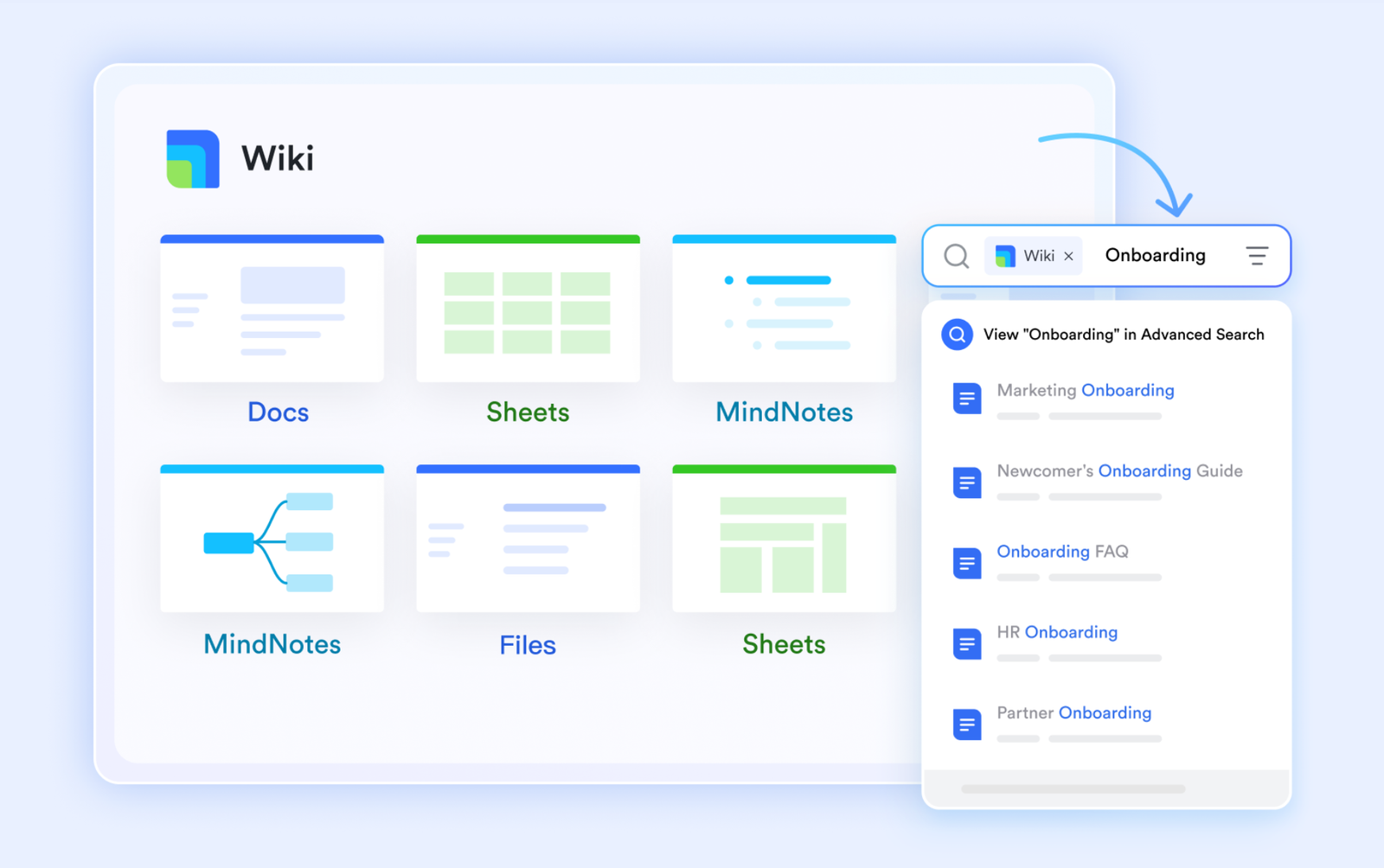
- “Migration” from Confluence, Word, Excel, and other formats. Both teams can bring their existing documentation into a shared Lark Wiki without manual recreation, so the combined knowledge base of both organizations is accessible to every team member from the same platform rather than existing in two separate systems that neither team can search across.
- “Permission Settings” for staged knowledge access. During the integration period, some knowledge from each organization may be sensitive or not yet ready for full cross-team visibility. Permission controls at the user and department level allow the integration team to make knowledge progressively more available as the integration process creates the right context for each piece of information to be shared.
- Structured hierarchy for combined organizational knowledge. Wiki spaces can be organized to reflect the combined organizational structure before the org chart is finalized, giving both teams a shared navigational framework for the combined knowledge base that orients everyone around a common structure from the start.
Communication that includes both teams from day one with Lark Messenger
The communication environment is where integration succeeds or fails fastest. If the two teams maintain separate communication systems after the acquisition closes, integration exists on paper but not in daily practice. Every day that both teams communicate separately is a day that the cultural and operational distance between them grows rather than shrinks.
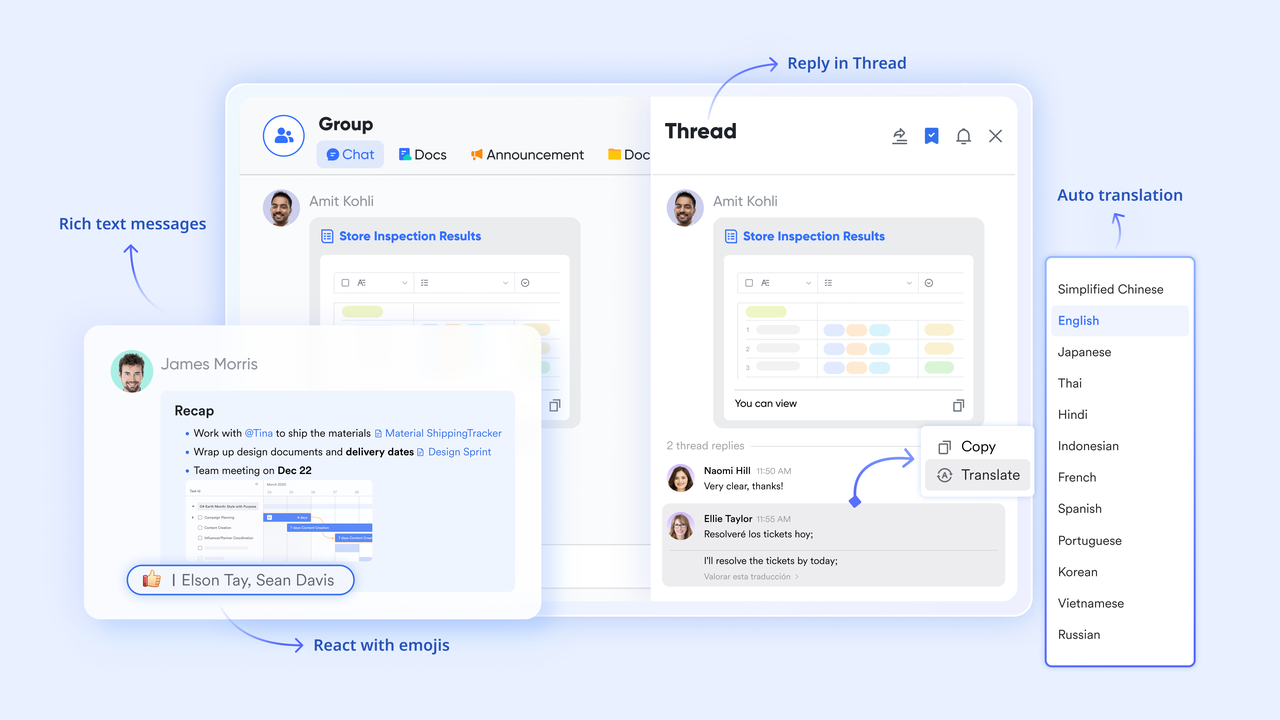
- “Real-time Auto Translation” across 24 languages for multinational acquisitions. When an acquisition crosses language boundaries, the communication environment that both teams share from day one can accommodate every language background automatically, removing one of the most significant barriers to genuine cross-team communication in the integration period.
- Group folder organization for combined organizational communication. The combined organization’s communication environment can be structured to reflect integration immediately, with cross-team groups organized into folders that both teams can navigate, creating a shared communication architecture from the first day of integration rather than leaving each team in its own silo.
- “Scheduled Messages” for leadership-to-combined-team communication. Leadership can communicate with the combined organization at consistent intervals using scheduled messages that reach every team member simultaneously, maintaining the transparency and inclusivity that integration anxiety requires without creating an expectation of real-time leadership availability across two organizations simultaneously.
A shared operational view for the combined entity with Lark Docs
Integration planning documents are typically created before the closing and rarely reflect the reality that emerges after it. The integration plan that was right in month two needs to be revised in month three, and the team that is supposed to be executing it needs a document that reflects the current state of the plan rather than the state it was in when it was last formally updated.
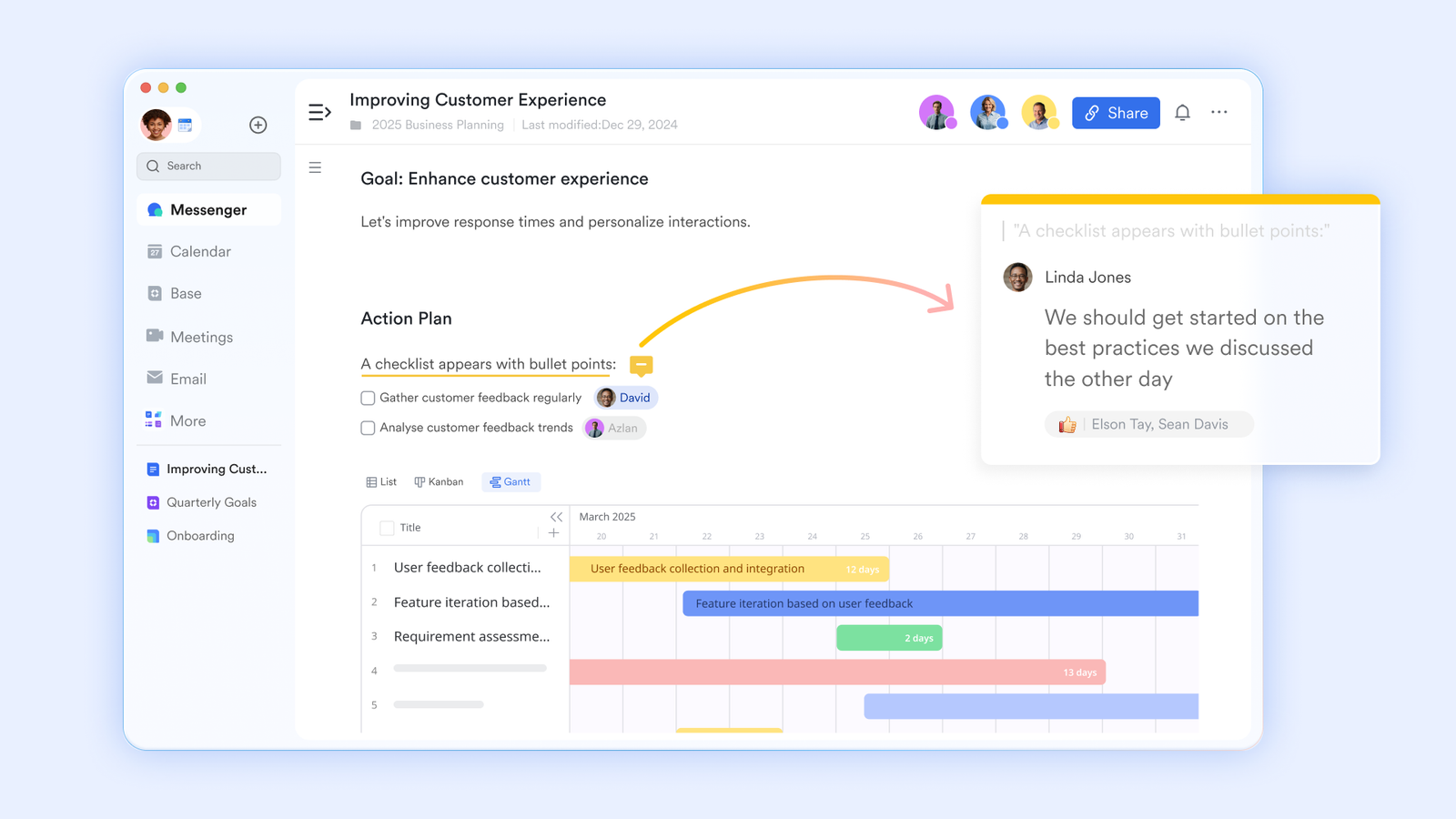
- Real-time co-editing for joint integration planning. Integration workstreams that span both teams can be documented and updated simultaneously by contributors from both organizations, so the integration plan reflects the combined team’s current thinking rather than one team’s plan that the other is asked to execute.
- “Version History” for integration decision traceability. Every change to an integration planning document is logged with the editor’s name and timestamp. When an integration decision turns out to have been made on incomplete information and needs to be revisited, the full history of the decision and the context in which it was made is available to everyone who needs to understand it.
- “@mention” for cross-team action assignment. When an integration planning document identifies an action that belongs to a team member from the acquired organization, mentioning them directly within the document creates an immediate, contextual assignment that connects the action to the integration logic that generated it rather than delivering it as a decontextualized task.
Shared operational tracking for cross-team work with Lark Base
Integration workstreams involve tasks that span both organizations, and those tasks need to be tracked in a way that is equally visible to both teams rather than requiring one team to check the other’s task management system to understand the current state of shared work.
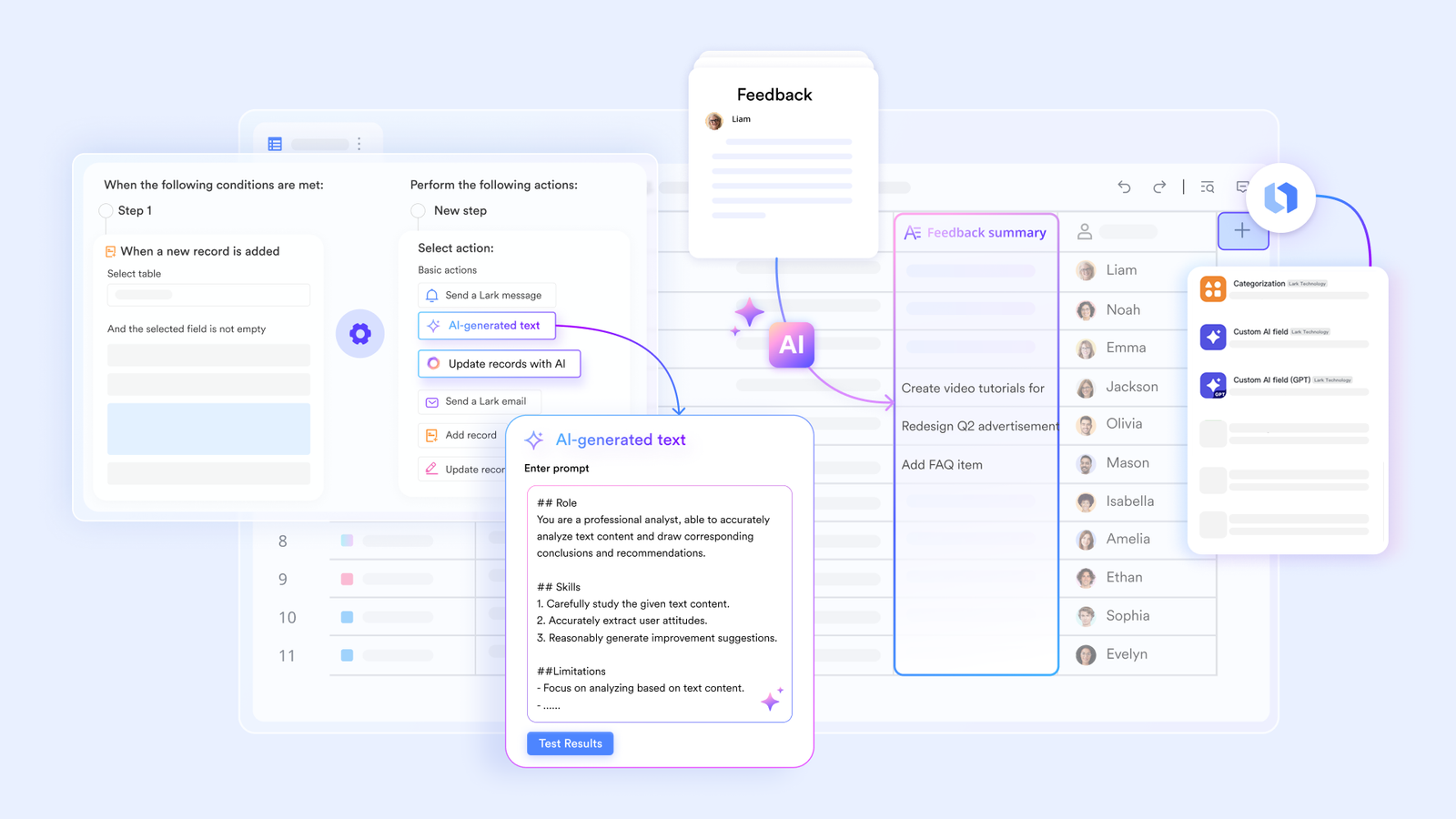
- Shared Base tables for joint tracking. Every workstream can be tracked in a shared Lark Base table that both teams access simultaneously, so the integration status is always the same for every participant regardless of which organization they came from.
- Gallery and Kanban views for visual progress. Milestones can be displayed in visual formats that make the overall progress of the integration legible to both leadership teams simultaneously, without requiring a dedicated integration coordinator to compile and present a status report for every review session.
- Automated notifications for cross-team dependency management. When a task in one team’s workstream is completed and another team’s work can now begin, the automated notification travels directly to the team member who was waiting, removing the manual coordination step that is one of the most consistent sources of integration delay.
Goals that align both teams from the moment of close with Lark OKR
The most common strategic alignment failure in an acquisition is the period between close and the first shared planning cycle, during which both teams are executing against their pre-acquisition goals without any structure connecting those goals to the combined company’s direction. The goals of the acquired company were set in a context that no longer exists, and nobody has explicitly reset them to reflect the new strategic reality.
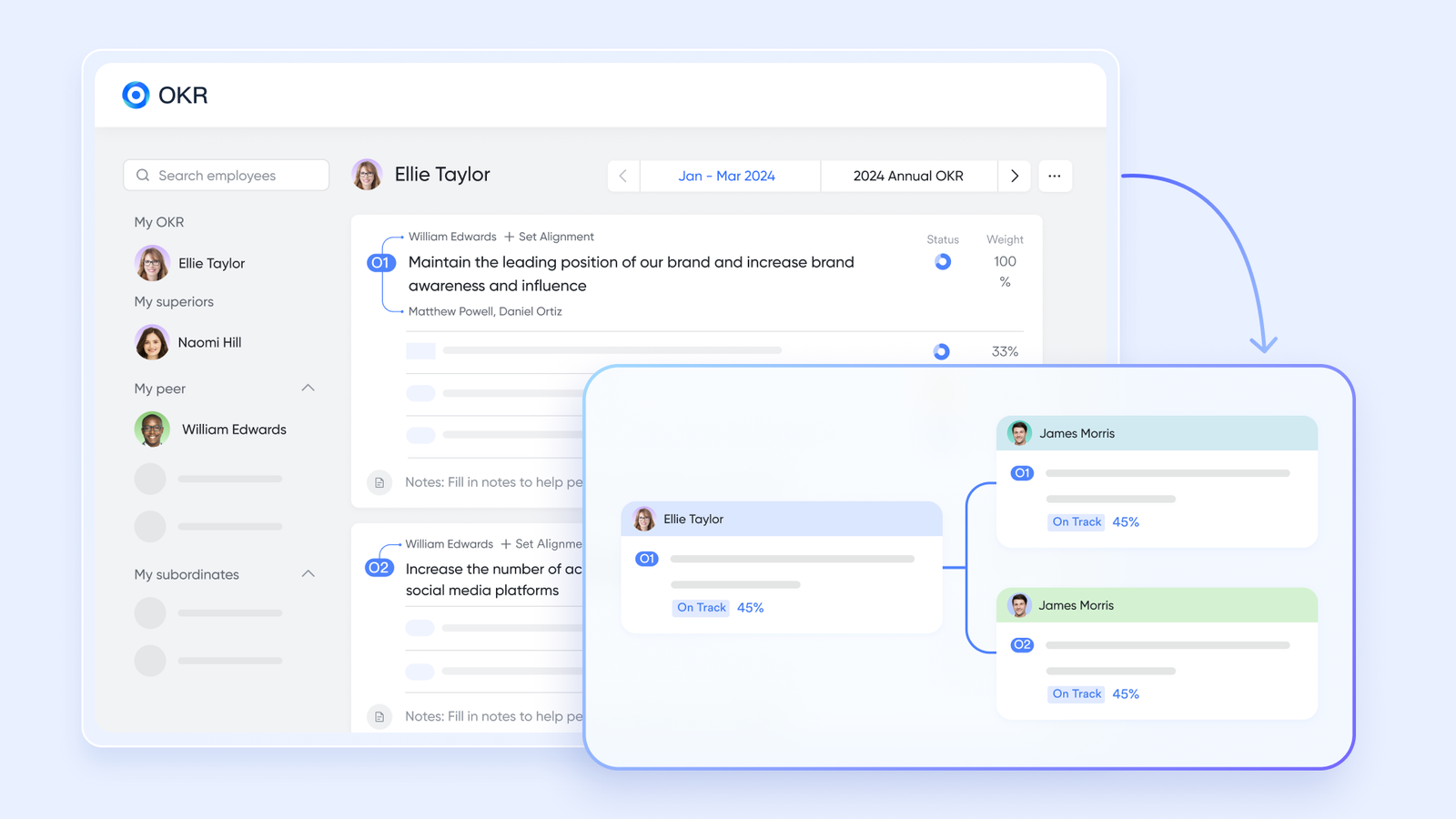
- Company-wide objective visibility from the first day of integration. When the combined company’s objectives are visible to every team member from both organizations in Lark OKR from day one, both teams can see the shared direction they are supposed to be moving toward rather than defaulting to their pre-acquisition goals during the gap between close and the first integrated planning cycle.
- Individual key results connected to combined team objectives. Team members from the acquired organization can set their own key results that connect to the combined company’s goals, giving them the strategic orientation they need to make good decisions in the integration period without waiting for a formal goal-setting cycle to be completed.
- Real-time key result progress visible across both organizations. Leadership teams from both sides of the acquisition can see how both teams are tracking against the combined objectives, enabling the cross-team conversations about resource allocation and priority conflicts that integration requires without waiting for periodic reporting cycles to surface the information.
Bonus: Why acquisitions fail to deliver their projected value
Most acquisition value destruction happens not in the negotiation or the legal execution but in the operational integration. Two teams that cannot communicate effectively, that maintain separate knowledge systems, that track work in separate tools, and that pursue goals that were set in different strategic contexts cannot create the operational synergies that the acquisition thesis projected. Platforms like Slack and Zoom make cross-team communication possible but do not connect the communication to the operational systems. Notion and Confluence provide documentation but in separate instances that require manual synchronization.
Teams evaluating Google Workspace pricing during periods of growth or consolidation often find that collaboration tools alone are not enough. They frequently add separate platforms for communication, knowledge management, project tracking, and goal management, creating parallel systems that require ongoing coordination when organizations combine. Lark brings these functions into one shared environment, helping teams operate from a unified system earlier instead of maintaining disconnected workflows.
Conclusion
The acquisition that delivers its projected value is the one where the operational integration is designed as carefully as the strategic rationale. A connected set of productivity tools that creates a shared knowledge base, a shared communication environment, a shared planning layer, a shared operational tracker, and a shared goal framework for two organizations from the moment of close is how acquisitions deliver the integration value they were designed to create rather than spending months rebuilding the operational foundation before any of the strategic work can begin.