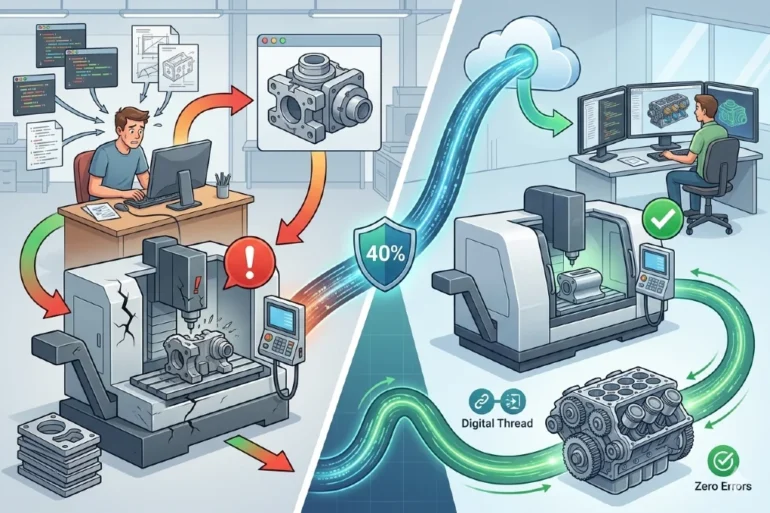
In many cases where engineers need to upload a complicated model for aerospace brackets or medical implants housing online to a CNC machining provider, they end up facing a waiting period, getting a rough quote, and a lead time that will take several hours or even days. Engineers do not have much transparency about their designs’ manufacturability, as the entire process is shrouded in darkness until the final stage of production is reached. As a result, the manufacturing process often leads to significant costs overruns of up to 15-25%, due to the high amount of manufacturing risk involved.
The problem lies in the fact that online platforms have simply digitized the purchasing aspect of the process but have failed to do the same in terms of the engineering aspect. As such, engineers cannot get quick access to information related to design intent and manufacturability from the platform before making an informed decision about their sourcing needs. This article sheds light on a key difference between contemporary and next-generation online CNC machining services through a case study scenario.
How Is Instant DFM Not Just a Checklist? The Artificial Intelligence (AI) Powered Digital Twin First Article.
When it comes to sophisticated digital manufacturing, it starts with an intelligent engineering discussion, not with the quote request. Today’s online custom CNC machining services use an AI-powered digital twin to conduct an instantaneous first article inspection as soon as the CAD file is uploaded. Instantaneous DFM is no longer just a checklist but a comprehensive, predictive analysis of manufacturability and the cost drivers, as well as the possible failure modes.
1. From Geometrical Analysis to Physics-Based Machining Simulation
Starting from a deconstruction of the 3D model, the platform automatically highlights critical manufacturing characteristics that represent major risks, such as deep pockets, which will be problematic to machine with conventional tools; thin walls susceptible to vibration during cutting; and interior edges that may break under mechanical stress. In addition, the artificial intelligence performs a physics-based machining simulation that calculates tool paths, analyzes cutting forces, and determines the possibility of collisions between the tooling and holder.
2. Transmitting Design Intention with Digital Standards
Precision requires clarity in the communication process. The system analyzes the GD&T callout from the 2D drawing compared to the 3D model and assesses the feasibility of achieving the tolerances defined using the selected machining process. Where special processes or exponential costs will be incurred, alerts are generated. Such clarity is essential to ensure that the digital design intention is fully captured and executable, one of the tenets in advanced product lifecycle management software.
3. The Outcome of Collaboration: A Mitigation Risk Report
It is not a pass or fail outcome but rather an interactive DFM report where comments and recommendations are pinned to the 3D model: “this 8:1 ratio for a hole depth/diameter may need a custom drill. Perhaps re-design as 5:1.”, or “the +0.01mm tolerance for this non-critical component raises costs by 35%.” The DFM report becomes the basis of collaboration as the quotation transforms into a technical discussion with optimization and de-risking at the core.
Beyond Cost: Interpreting an “Online CNC Machining Quote” as a Collaborative Manufacturing Strategy Proposal.
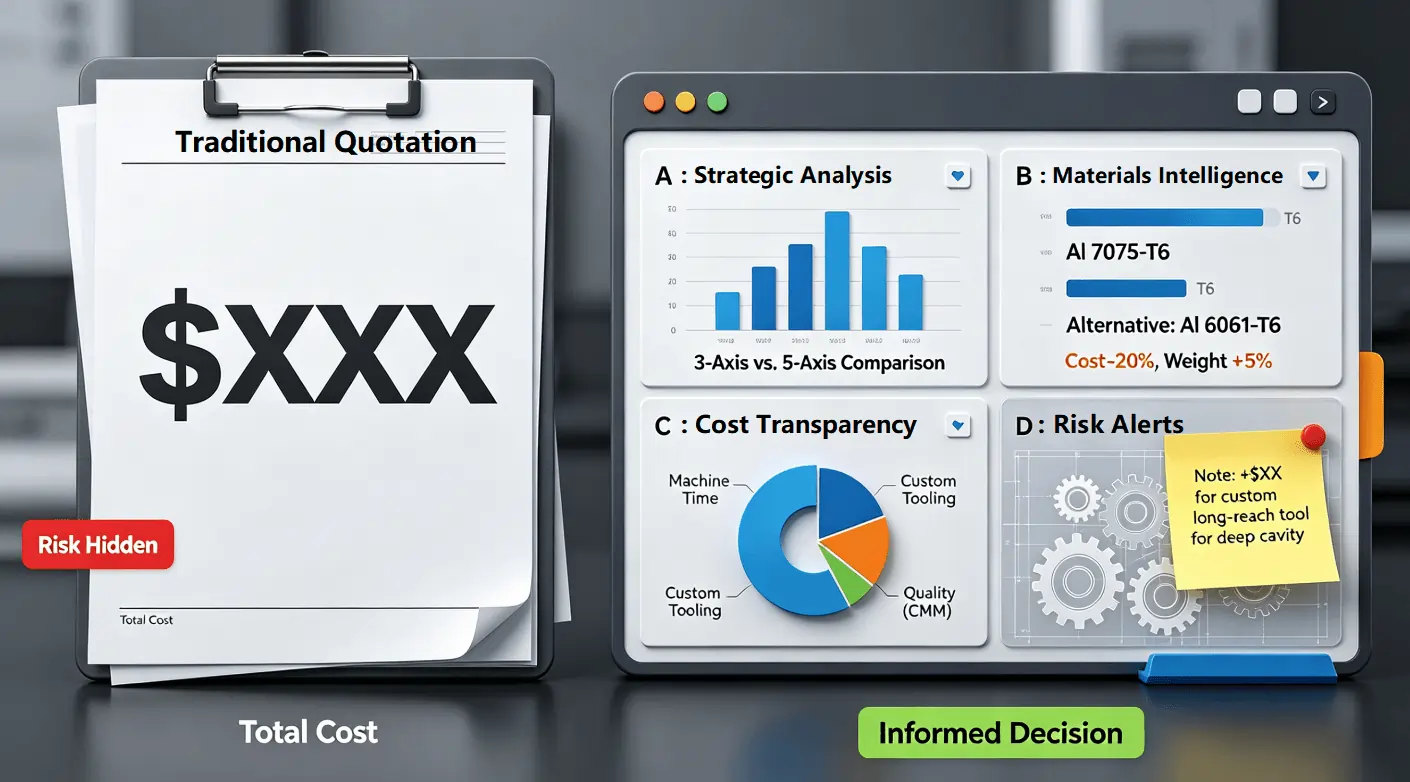
The advanced online CNC machining quote for an intricate part is not simply a cost figure. It is an intelligent manufacturing strategy document, which makes the process more transparent by revealing the trade-off between cost, time, quality, and capabilities. It informs the buyer to make data-driven decisions without being forced to choose one cost figure over another.
1. Multi-Strategy Analysis: The Advantage of Options
In contrast to a single cost, the advanced quote includes a comparative manufacturing strategy analysis. In case of an intricate part, it can analyze: 3-axis machining (cheaper, however, may need multiple setups), 3+2 axis positioning (effective for parts with deep holes, medium cost), and continuous 5-axis machining (maximum geometric flexibility, one-time setup, fast machining). Each solution is accompanied by the cost estimation, lead-time calculation, and acceptable tolerance band.
2. Materials Intelligence & Substitution Logic
In this context, the quote is also acting as a consultant on material intelligence. Depending on the geometry of the part and its use (as specified in the quote; e.g., “Load-bearing bracket for drone”), it can make recommendations about which materials would be better for what reasons, with respect to strength to weight ratio, ease of machining, durability to corrosion, and most importantly the effect on the total cost of production.
3. Cost Transparency & Risk Allocation
No expense goes unaccounted. Machine hours, raw material costs, setup/programming fees – all of this is included in the quote. Even more interestingly, it specifies risk premium costs: “An additional XXisincludedfor100YY tooling fee covers a custom, long-reach end mill for this deep cavity.” Total cost transparency ensures the customer’s complete satisfaction with the purchase.
In What Way Does the Use of “Industrial IoT” and Real-Time Tracking Make “Fast Delivery” an Assured Commitment?
Fast delivery may be only a wish when not assured. Through Industrial Internet of Things (IIoT) sensors and data integration within a technologically sophisticated smart factory, lead times can be changed from mere estimates into reliable and traceable commitments. This is done through the creation of a digital replica of the manufacturing process flow.
1. Digital Planning and Resource Booking
As soon as the order has been confirmed, it is not simply stored. Instead, a digital twin of the shop floor schedules the optimal time on a CNC machine after taking into account its existing load and scheduled downtimes. At the same time, material procurement is launched using approved suppliers. As such, a lead time estimate is converted into a booked manufacturing session, a key notion in production systems.
2. The Live Production Dashboard: “In Production” Becomes “On Machine 12, Pass 3”
Classic notifications end with “machining has begun.” With an IIoT-enhanced system, engineers will know that their part is being machined right now “on 5-Axis Machine #7,” “roughing has progressed by 70 percent,” and that the spindle load is within its normal limits. Such detailed, in-the-moment visibility is made possible by machine telemetry data. This kind of visibility ensures there is no more need for panic status emails and creates total trust in the process.
3. Predictive Alerts and Proactive Management
The system doesn’t only collect information but is capable of making sense out of data. For instance, when the system notices abnormally high tool vibration indicating future premature wear, the shop floor is immediately alerted about the coming tool change to prevent production of defective parts. At the same time, it can even notify the customer about the possible deviation from the agreed-upon schedule with new estimated arrival date and a valid reason. Proactivity of operations instead of reactiveness to problems is what makes for dependable fast delivery CNC machining services.
Invisible Backbone: Why “Precision” in Digital Manufacturing Requires Certified Management Systems
The brilliant face of any digital platform is as good as the invisible backbone behind it. For the digital manufacturing process to be precise, it should run on certified management systems such as ISO 9001, IATF 16949, and AS9100D. These systems act as an operating system that manages all activities, starting from file uploading to product inspection.
1. ISO 9001: The Basis of Process Control
The first standard is ISO 9001, which acts as a basis for implementing a quality management system. As far as digital manufacturing is concerned, it ensures the control of processes for receiving, storing, and controlling versions of CAD files; validation of CAM programming and simulation; and recording inspection data.
2. IATF 16949: Integration of Prevention in the Digital Thread
In the case of automotive quality standard IATF 16949, prevention goes further, since the company is legally obliged to manage risks proactively. In the context of online services, it means that automated design for manufacturability (DFM) is based on a digital FMEA, which alerts the user of parts with known history of high scrap rate. Moreover, the digital traceability is guaranteed for each part – from its program version to machine calibration and inspection – leaving no gaps in the digital thread.
3. AS9100D: The Highest Standards for Aerospace Parts
If the CNC component is considered critical for the operation of the product, the part must comply with AS9100D. It represents the highest standards for traceability and configuration management, which mean that any changes in the CAD model or manufacturing process are recorded in the digital system and formally approved. The digital platform itself becomes the sole database of the whole life cycle, giving the manufacturer an audit-proof record for aerospace, medical and other highly regulated CNC precision machining operations.
Case Study: Co-Development of a 7-Axis Robot Housing Across Continents Within 5 Weeks
A case of highly innovative cooperation for Europe’s robotics leader is the best proof of a digital co-development process’s revolutionary potential. It was critical to machine oil galleries at a very tight tolerance of 0. 02mm to manufacture the complex 7-axis collaborative robot housing made out of 7075-T6 aluminum, which requires high tolerances. Long distances and problems in e-mail communication made finishing impossible, so collaboration was needed.
- Digital Collaboration Sprint: From the start of the engagement, the client posted his model to the digital platform. Rather than emailing back and forth, the parties held several video conferences directly through the collaboration tool, reviewing the results of the AI-generated DFM analysis and simulation of the toolpaths. Engineers from both sides were able to use the common 3D model, analyzing the pros and cons of 5-axis flank machining vs. a more conventional one in terms of critical bores.
- Virtual Verification and Live Oversight: An important factor in ensuring success was virtual verification. The part was designed using the manufacturer’s CAD software, and the toolpath simulation video was uploaded to the platform prior to any physical machining occurring. Once the part was being machined, the client received real-time video access to the CNC machine cell. They were able to observe the machining process of key features, as well as view instant measurement data generated by probes on the machine displayed in the project dashboard.
- Measurable Success: Speed, Determination, and Collaboration: The housing was manufactured without issue and met all dimensional and sealing requirements. In total, it took only 5 weeks to design and manufacture the part — an impressive 40% faster than originally expected. More than just completing the project quickly, this demonstrated an innovative approach to engineering. The development of the project showed that, given the appropriate digital framework, customized CNC components online can be developed more efficiently than by conventional co-location-based processes.
Assessing a CNC Machining Supplier for the “Online” Age: A Digital Competence Checklist.
Finding an effective supplier in the digital world calls for a different kind of evaluation system. Do not limit yourself with just listing the equipment that the supplier provides; rather, evaluate its digital competence level and collaboration capabilities. It takes a great deal of wisdom to make the most of the systematic transparency, analytics, and engineered risk mitigation offered by a truly digital partner.
1. Engineering Dialogue: Static Report or Collaboration Interface?
Does the platform offer you a static PDF report or a live, interactive DFM interface where comments can be made and discussions on DFM alternatives are possible? Are you able to resolve all the issues raised by the software automatically? The potential for hosting a live dialogue within the platform itself makes for a much greater advantage than the automatic generation of reports.
2. Operational Transparency: Insights or Granular Control?
To what extent does your provider give visibility on its operations? Does this extend only to “Order Received/Shipped” status messages? Or is there real-time insight through Gantt charts, machine telematics data, and inspection updates? Being able to know not only whether, but how and when your part is being manufactured elevates the role of the client from simple orderer to active participant in the process, which is a key characteristic of intelligent manufacturing.
3. Systemic Integrity: Digital Window-Dressing or End-to-End Platform?
Perhaps most importantly, does the company’s digital front end amount to simply a cosmetic overlay hiding traditional manufacturing under the hood? Or do they have a true end-to-end digital solution? Look for evidence of how quality management system requirements, such as PPAP in accordance with IATF 16949 standards, are handled through digital tools. Does your provider offer digital first article packages incorporating data generated by CMMs connected to work orders? If they do, this is a clear indication of a supplier that integrates its digital systems deeply with proven operational processes.
Conclusion
The real revolution in digital manufacturing is not putting the order form into the Internet age. This is the revolution of integrating detailed engineering expertise, stringent quality management, and real-time production data into a clear, collaborative, and predictable digital thread. Cutting through the informational constraints of conventional manufacturing, this digital thread makes the process of complex component production into a predictable voyage rather than a risky trip. Collaboration with such providers allows innovators to speed up development, secure supply chain management, and bring their boldest ideas to life efficiently and reliably.
FAQs
Q: Is the quoted price for complex parts generated by an online CNC machining service truly accurate?
A: For complex parts, consider the quoted price as your initial plan. It gives you high-accuracy costing of the basic features, including a comparative analysis of process (3 axis/5 axis) and material used. The benefit lies in having a transparent cost driver analysis. The price will be finalized following a discussion of the DFM analysis.
Q: Can an online CNC machining service provide me with a functional prototype without requiring my input at all?
A: For a complex prototype, a good online service would allow for effective and efficient communication. It offers an interactive DFM report on your 3D design using chat/video features. This is a more streamlined process compared to email exchanges.
Q: How does quality control work in online services, particularly when dealing with essential parts in controlled industries?
A: Top online platforms automate their quality control processes. They provide digital inspection certificates with CMM data, full traceability of materials, and each piece retains a digital traveler as well. In highly regulated industries, the whole process should be performed to the standard, for example, AS9100D or ISO 13485, and the online platform becomes the document for the audit.
Q: Complex parts ordered via an online service, what is the estimated lead time and is it reliable?
A: Complex parts will take 2 to 6 weeks.Digital scheduling allows time for machines to be planned and real-time production monitoring provides live updates for all the production milestones such as machining and inspection. A live dashboard is also provided for the whole process and any hold-ups can be seen on it.
Q: What is the best way to submit my files so that I receive top-notch service from a CNC machining online company?
A: The best results come from:1. A clean/unblemished 3D CAD model (STEP/IGES format)2. Drawings (PDF) with all dimensions, GD&T specifications, and surface finishes identified3. Indicate the material grade with the necessary certificates4. Give the number required. A complete package will enable quickest the analysis.
Author Bio
The author specializes in digital precision manufacturing, emphasizing the application of innovative production technology and collaboration in bringing complex parts to life. The author of this article is a member of LS Manufacturing team that enables global innovators to take their concepts to production by means of engineering-led digital collaboration. Get your free Smart Manufacturing Strategy Report based on your CAD files and get instant manufacturability analysis and multiple manufacturing processes comparison.