
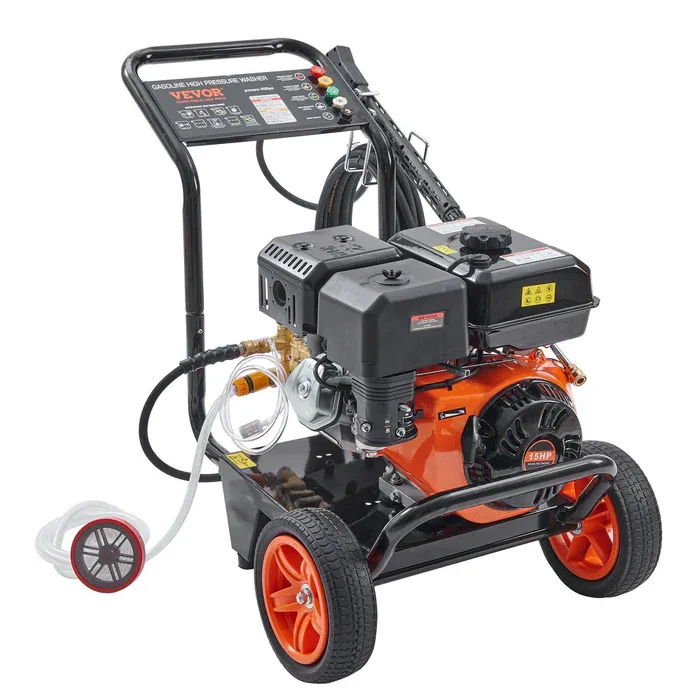
Across the United States, contractors, facility managers, and property owners rely on high-pressure cleaning, often called power washing, to maintain buildings, equipment, and paved surfaces. Dirt, grease, mold, and oxidation build up on outdoor surfaces and resist ordinary washing. Gas pressure washer removes them by combining force and flow in a controlled stream. Understanding how a gas pressure washer works helps operators and purchasers match the equipment to the task and use it safely.
How a Pressure Washer Works
A pressure washer raises the pressure of a water supply far above household levels and directs it through a narrow nozzle. An engine drives a pump, the pump pressurizes the water, and the nozzle converts that pressure into a fast, concentrated jet. The result is mechanical force that lifts dirt without heavy scrubbing.
Two numbers describe output. Pressure, measured in pounds per square inch, indicates cleaning force. Flow, measured in gallons per minute, indicates how quickly the machine rinses a surface. A unit rated at four thousand four hundred pounds per square inch and four gallons per minute sits at the upper end of the range, suited to heavy commercial work.
Why Pressure and Flow Both Matter
Pressure alone does not determine cleaning speed. Flow carries loosened dirt away and covers more area in less time, so the two ratings work together rather than in isolation.
• Pressure breaks the bond between dirt and the surface
• Flow rinses the debris away and speeds coverage
• The two combined describe real cleaning performance
Technical Foundations
The Pump
The pump is the core of any pressure washer. A copper or brass pump head resists corrosion and carries heat away from the seals, which extends service life. Many heavy units use a triplex plunger pump, which moves water with three pistons for steady pressure and durable operation under continuous load.
The Engine
A gasoline engine drives the pump directly or through a gearbox. The engine power must match the pump, since an underpowered engine stalls under load. A gas unit offers mobility on sites without electrical power, which suits construction, agriculture, and fleet maintenance.
Performance Factors
Several variables affect cleaning results in the field:
• Nozzle angle, where a narrow angle concentrates force and a wide angle covers area
• Water supply volume, which must meet the pump’s demand
• Hose length and diameter, which affect pressure loss
• Surface type and the distance the operator holds the wand
A contractor cleaning a concrete lot, for example, uses a wider nozzle and higher flow than a worker stripping paint, who needs a concentrated jet held closer to the surface.
Safety Practices
The equipment produces a stream strong enough to injure skin and damage surfaces, so disciplined operation is essential.
• Never point the wand at people, animals, or yourself
• Wear eye protection and closed footwear
• Operate gasoline engines outdoors to avoid carbon monoxide
• Stop and cool the engine before refueling
• Test on a small area to confirm the nozzle does not harm the surface
High-pressure water can cut skin, and an injection injury requires immediate medical care even when the wound looks minor.
Equipment Types and Accessories
Cleaning equipment varies by power source and capacity:
• Electric pressure washers for light residential cleaning
• Gas units for heavy commercial and remote work
• Hot-water machines that add heat to dissolve grease
• Attachments such as surface cleaners, turbo nozzles, and extension wands
A surface cleaner attachment, for example, spreads the spray across a wide rotating disc, which speeds driveway and sidewalk work and reduces streaking compared with a single nozzle.
Advantages and Limitations
Advantages:
• High cleaning force for tough deposits
• Mobility without an electrical outlet
• Faster than manual scrubbing
• Copper or brass pumps resist corrosion
Limitations:
• Requires fuel and regular engine maintenance
• Produces noise and exhaust during use
• Can damage soft surfaces if misused
• Heavier than a comparable electric model
Industry Outlook
As construction, fleet maintenance, and property management expand across the United States, demand for durable cleaning equipment holds steady. Engine efficiency and pump design continue to improve, and operators increasingly weigh water use alongside cleaning power. For heavy, mobile cleaning that an electric model cannot match, the gas pressure washer remains a practical and widely used tool.