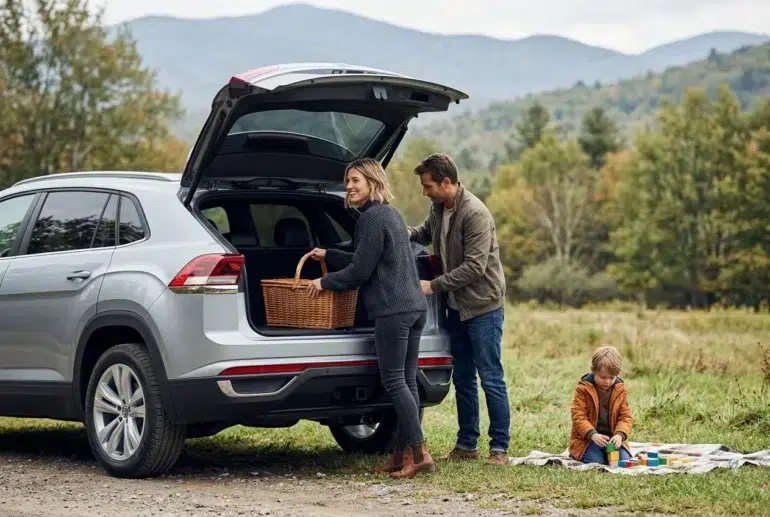
The Volkswagen Atlas Cross Sport sits in an interesting spot in the SUV market. It is not trying to be the flashiest coupe SUV on sale, and it is not pretending to be a rugged off road machine either. What it does offer is a very clear value proposition: the bold look many buyers want, the two row layout many families actually use, and the kind of cabin space that makes daily life easier. For a lot of people, that matters more than chasing a sporty badge or shaving a second off a 0 to 60 run.
That is what makes the Volkswagen Atlas Cross Sport worth talking about. On paper, it brings strong horsepower from a turbocharged 2.0 liter engine, generous cargo room, a roomy second row, available all wheel drive, and a feature list that leans heavily into comfort and convenience. Volkswagen also gives it a starting MSRP of $38,300 for the 2026 model year, along with 77.6 cubic feet of cargo space with the rear seats folded, which immediately tells you this SUV is built for real life, not just showroom impressions.
What makes the Volkswagen Atlas Cross Sport especially appealing is that it fixes a common SUV problem. Many midsize models look useful from the outside but feel cramped or awkward once you start living with them. This one takes a different approach. It gives up the third row of the regular Atlas, keeps the footprint and broad stance buyers already like, and turns that extra room into a more relaxed second row and a practical cargo area. That simple decision shapes almost everything about the vehicle’s personality.
First impressions of the Volkswagen Atlas Cross Sport
The first thing most people notice about the Volkswagen Atlas Cross Sport is the shape. It has a lower, sleeker roofline than the standard Atlas, which gives it a more stylish profile without becoming overly dramatic. That matters because plenty of buyers want an SUV that looks more refined than boxy family haulers but still feels substantial on the road. Volkswagen clearly understands that audience.
In person, the Volkswagen Atlas Cross Sport has more presence than photos sometimes suggest. The wide body, upright front end, and strong shoulder lines help it look planted and confident. Higher trims, especially the R Line versions, lean further into that personality with bolder visual details. The result is an SUV that looks upscale enough for a nice dinner downtown but never feels delicate or fussy.
That balance is a big part of the appeal. A lot of SUVs now try too hard to look aggressive or futuristic. The Volkswagen Atlas Cross Sport feels more mature than that. It is stylish, yes, but it still looks like something designed for everyday use. That makes it easier to imagine living with long term.
Performance and daily driving feel
Under the hood, the current Volkswagen Atlas Cross Sport uses a turbocharged 2.0 liter engine rated at 269 horsepower and 273 lb ft of torque, paired with an 8 speed automatic transmission. That is a healthy output for a midsize crossover, and it gives the vehicle enough strength for commuting, highway merging, and family road trips without feeling underpowered. Volkswagen lists that output on the official U.S. model page, and Car and Driver notes that the same setup also preserves a respectable 5,000 pound towing capacity.
On the road, the Volkswagen Atlas Cross Sport is not a performance SUV, but it does not need to be. What matters more is how it behaves in normal conditions, and here it makes a strong case for itself. Car and Driver describes the ride as comfortable and the cabin as notably quiet, which lines up with what many shoppers in this segment are really after. They want composure, not drama. They want something easy to drive every day, not something that constantly reminds them it has sport in the name.
That daily usability shows up in small ways too. The steering is approachable, visibility is generally SUV friendly, and the powertrain feels tuned for smoothness more than excitement. For drivers coming out of a sedan, the Volkswagen Atlas Cross Sport should feel like a natural step up. For drivers moving from a larger three row SUV, it will probably feel easier to manage in parking lots and city traffic.
Is the Volkswagen Atlas Cross Sport actually quick enough?
Yes, for most buyers, absolutely. Car and Driver estimates a 0 to 60 mph time in the high six second range for the updated model, which is more than enough for confident passing and freeway on ramps. That does not make the Volkswagen Atlas Cross Sport thrilling, but it does make it competent, and competence is underrated in this class.
Where some rivals try to impress with sharp handling, the Volkswagen Atlas Cross Sport takes a calmer approach. It feels tuned to reduce fatigue. That matters more than many buyers realize until they spend several hours behind the wheel. An SUV that keeps you comfortable, settled, and less irritated at the end of a long drive often ends up being the better real world choice.
Space, seating, and cargo practicality
This is where the Volkswagen Atlas Cross Sport starts to make its strongest argument. Even though it has a sportier roofline than the standard Atlas, it still offers the sort of interior room that families, couples, and frequent travelers can actually use. Car and Driver reports about 40 cubic feet of cargo space behind the second row and roughly 78 cubic feet with the rear seats folded, while Volkswagen’s official 2026 page lists 77.6 cubic feet with the rear seats down. Those numbers put it firmly in practical territory.
Passenger room is another strength. Car and Driver cites maximum passenger volume at 112 cubic feet, and the publication also notes that the Atlas family has long been known for generous space. That matters because one of the biggest reasons people move into a midsize SUV is not just cargo. It is comfort. Adults want to sit in the second row without feeling punished. Kids want room for boosters, backpacks, and general chaos. The Volkswagen Atlas Cross Sport handles that reality well.
For everyday life, the two row setup is actually a smart choice. Many households buy third row SUVs and rarely use the third row. In the Volkswagen Atlas Cross Sport, that unused space is effectively turned into easier cargo access and a cleaner cabin layout. Grocery runs, strollers, sports gear, carry on bags, and home improvement purchases all fit more naturally into the way this SUV is packaged.
Here is a quick look at the practical side of the Volkswagen Atlas Cross Sport:
| Practical Area | What Stands Out |
|---|---|
| Passenger Space | Wide cabin and roomy second row |
| Cargo Room | Around 40 cu ft behind rear seats and 77.6 to 78 cu ft folded |
| Layout | Two row design simplifies family use |
| Towing | Up to 5,000 lbs according to Car and Driver |
| Everyday Use | Easy fit for errands, travel, and commuting |
That table tells the real story. The Volkswagen Atlas Cross Sport is not about one headline number. It is about how those numbers add up in daily use.
Interior comfort and technology
One of the biggest improvements in the current Volkswagen Atlas Cross Sport is the overall cabin feel. Car and Driver notes more upscale materials than before and highlights standard features such as heated and ventilated front seats, a heated steering wheel, tri zone climate control, adjustable ambient lighting, and a leatherette trimmed dash with soft touch materials. For shoppers who care about day to day comfort, those features matter more than flashy marketing language.
The tech story is solid too. Car and Driver reports that every Volkswagen Atlas Cross Sport gets a configurable 10.3 inch digital display and a 12.0 inch infotainment screen, along with wireless Apple CarPlay, Android Auto, wireless charging, and multiple USB C ports. Volkswagen’s official model page also highlights wireless charging, wireless App Connect, Wi Fi hotspot capability, and the myVW connected experience.
There is one caveat. Car and Driver is not a fan of Volkswagen’s touch sensitive controls, and that criticism is fair. In real life, physical buttons are often easier to use quickly, especially when driving. So while the Volkswagen Atlas Cross Sport looks modern inside, some drivers may still prefer more traditional interfaces. That said, the broader tech package remains competitive and family friendly.
Safety and driver assistance
Safety is one of the reasons the Volkswagen Atlas Cross Sport deserves serious consideration. The Insurance Institute for Highway Safety applies several Atlas ratings to the Atlas Cross Sport and notes that the Cross Sport is derived from the Atlas platform. In the 2025 IIHS results, the vehicle earned an Acceptable rating in pedestrian front crash prevention, with standard Front Assist including automatic emergency braking and pedestrian monitoring. IIHS testing showed the system could avoid some low speed scenarios entirely and reduce impact speed in others.
Volkswagen also promotes IQ.DRIVE and driver assistance technology on the official Volkswagen Atlas Cross Sport page. While drivers should never treat these systems as substitutes for attention, their presence adds value for commuting, highway travel, and family use. Features like forward collision support, lane related aids, and connected services are no longer niche luxuries in this class. Buyers expect them, and Volkswagen knows it.
There is another part of the ownership story worth knowing. In March 2025, Reuters reported that Volkswagen recalled 177,493 Atlas and Atlas Cross Sport SUVs from the 2024 and 2025 model years over a potentially loose engine cover that could contact hot engine surfaces. The remedy was for dealers to remove the cover free of charge. That does not erase the strengths of the Volkswagen Atlas Cross Sport, but it is exactly the kind of practical ownership detail informed shoppers should check before buying used or new inventory from those model years.
Fuel economy and ownership value
Fuel economy is often where midsize SUVs start to reveal their compromises. The Volkswagen Atlas Cross Sport does reasonably well for a vehicle of this size and shape. Car and Driver reports EPA estimates of 20 mpg city and 27 mpg highway for front wheel drive versions, with all wheel drive reducing both figures by 1 mpg. Edmunds listings for recent trims also show combined figures generally in the low 20s, which is exactly where many buyers should expect this vehicle to land.
That means the Volkswagen Atlas Cross Sport is not the efficiency king of the segment, but it is also not wildly out of line for a roomy midsize crossover with nearly 270 horsepower. The more important question is value. If you prioritize cabin space, comfort features, and strong road trip manners, the fuel economy tradeoff will likely feel reasonable. If your top priority is squeezing every mile from every gallon, a smaller crossover or future hybrid option may make more sense. Recent reporting also suggests Volkswagen has confirmed hybrid versions for the Atlas family in the future, though not for the current model on sale today.
Volkswagen adds a meaningful ownership angle through Carefree Coverage. The official brand site says new vehicles include scheduled maintenance at 10,000 and 20,000 miles or for two years, plus roadside assistance for three years or 36,000 miles and a four year or 50,000 mile new vehicle limited warranty. That package helps the Volkswagen Atlas Cross Sport feel more reassuring for first time Volkswagen buyers.
Who should buy the Volkswagen Atlas Cross Sport?
The Volkswagen Atlas Cross Sport makes the most sense for buyers who want midsize SUV room without the burden of a third row. It is especially well suited to small families, couples with active lifestyles, empty nesters who still want cargo flexibility, and commuters who spend a lot of time in their vehicle and care about comfort. It also works well for buyers who want something larger than a compact SUV but do not want the extra bulk or complexity of full size alternatives.
It is also a smart fit for people who value ease over image. Yes, the Volkswagen Atlas Cross Sport looks more stylish than a plain boxy SUV, but its best quality is how normal life fits into it. School drop offs, airport runs, Costco trips, weekend luggage, dog crates, sports equipment, and the occasional piece of flat pack furniture all feel very much within its wheelhouse.
Buyers who may want to think twice are those who truly need a third row, those who care deeply about sharp handling, or those who want top tier fuel savings right now. The Volkswagen Atlas Cross Sport is practical and polished, but it is not pretending to be everything for everyone.
Pros and cons of the Volkswagen Atlas Cross Sport
Here is the honest version.
Pros
- Strong turbocharged power for everyday driving
- Spacious second row and useful cargo area
- Comfortable ride and quiet cabin
- Good standard comfort and tech features
- Stylish exterior without sacrificing too much practicality
- Helpful ownership coverage from Volkswagen
Cons
- Touch sensitive controls will not work for every driver
- Fuel economy is decent, not class leading
- No third row for buyers who sometimes need extra seats
- Sporty name may overpromise if you expect athletic handling
Those pros and cons sum up the Volkswagen Atlas Cross Sport well. It succeeds because it knows what it is. It is a practical midsize SUV with a cleaner style and a more focused interior layout.
Final verdict
The Volkswagen Atlas Cross Sport is one of those vehicles that makes more sense the longer you think about it. It may not dominate conversation the way some trendier SUVs do, but in real life it gets a lot right. It has enough power, enough space, enough comfort, and enough style to satisfy the needs of a wide range of drivers. Most importantly, it does all that without becoming difficult to live with.
If you want an SUV that feels roomy but not oversized, stylish but not impractical, and modern without losing sight of everyday usefulness, the Volkswagen Atlas Cross Sport is easy to recommend. It is not a niche product. It is a thoughtful, well judged answer to what many people actually need from a modern sport utility vehicle. And that is exactly why it works.
In the end, the Volkswagen Atlas Cross Sport delivers on the part that matters most: everyday practicality with enough style to keep ownership feeling special. For many buyers, that is a better formula than chasing extremes.