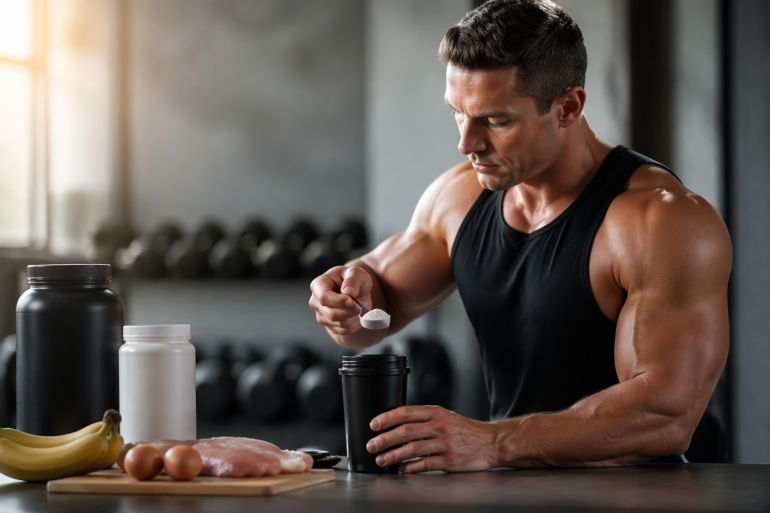
When people search for Dorian Yates’ Supplements Scientifically Proven, they are usually looking for something very specific. They do not want another hype-filled supplement article. They want to know which products or ingredients actually have science behind them, which ones make sense for muscle growth, and which ones are mostly branding.
That is exactly where this conversation gets interesting. Dorian Yates is not just another famous bodybuilding name. He is a six-time Mr. Olympia and founder of DY Nutrition, a brand that sells creatine, protein powders, pre-workouts, and other performance products. His reputation in bodybuilding gives the topic authority, but reputation alone is not proof. The better question is this: when people talk about Dorian Yates’ Supplements Scientifically Proven, which supplement categories are truly supported by credible research, and how should a real lifter use them for serious muscle growth?
The short answer is that a few supplement types consistently stand above the rest. Creatine monohydrate has some of the strongest evidence in sports nutrition. Protein supplements can help if your daily intake is not already high enough. Caffeine can improve training quality and output, which indirectly supports better long-term gains. Beta-alanine can help with repeated high-intensity training, though it is not as central to hypertrophy as creatine or protein. On the other hand, ingredients like BCAAs and glutamine are often discussed far more than the muscle-building data justifies.
Why Dorian Yates Still Matters in Supplement Conversations
Dorian Yates remains influential because he helped define a brutally efficient bodybuilding style. His training philosophy emphasized intensity, progression, recovery, and a no-nonsense approach to results. That matters because supplements only make sense inside that framework. They are not magic. They are add-ons that support hard training, enough calories, enough protein, and real recovery.
His current supplement relevance also comes from business involvement. DY Nutrition markets products such as creatine and other sports supplements under his name, so when readers ask whether Dorian Yates’ Supplements Scientifically Proven is a fair claim, the real job is to separate the athlete’s legacy from the ingredient-level evidence. That distinction matters for anyone spending money with the goal of adding lean mass, improving gym performance, and recovering better between sessions.
What “Scientifically Proven” Should Actually Mean
This phrase gets abused online. In responsible fitness writing, “scientifically proven” should not mean a supplement has flashy label claims or a celebrity endorsement. It should mean multiple controlled studies, systematic reviews, or respected position stands support a meaningful benefit.
In muscle growth, the best evidence usually looks at lean mass, strength, training output, recovery, and the ability to maintain enough high-quality work over time. That is why respected sources such as the International Society of Sports Nutrition and the U.S. National Institutes of Health Office of Dietary Supplements are much more useful than random brand blogs. They look at the body of evidence rather than one cherry-picked study.
Dorian Yates’ Supplements Scientifically Proven: The Ingredients That Actually Stand Up
Creatine is the strongest place to start
If someone wants the most evidence-backed supplement for muscle growth, creatine is usually first. The International Society of Sports Nutrition has repeatedly concluded that creatine is one of the most effective nutritional supplements for increasing high-intensity exercise capacity and lean body mass during training. That matters because better training performance is often what drives better hypertrophy over time.
This is also relevant to Dorian Yates specifically because DY Nutrition actively sells creatine products. In other words, if you are looking for a part of Dorian Yates’ Supplements Scientifically Proven that has real substance behind it, creatine is the clearest example. The science is far stronger than the marketing here.
For most people, the practical takeaway is simple. Creatine monohydrate is the benchmark. You do not need an overcomplicated formula to benefit. A daily dose of around 3 to 5 grams is commonly used after saturation, and while loading can speed up the process, it is not necessary for results. What matters most is consistency.
Protein powder works when it solves a real protein gap
Protein powder is not anabolic magic. It is convenient food. That is exactly why it can still be useful. The ISSN position stand on protein and exercise states that an overall intake of about 1.4 to 2.0 grams of protein per kilogram of body weight per day is sufficient for most exercising individuals, with about 20 to 40 grams of high-quality protein per serving being a reasonable target depending on size, age, and training context.
That means whey protein or similar products help most when your normal eating pattern makes those targets difficult. A lifter who already eats enough protein from meat, eggs, dairy, fish, soy, or legumes may not see extra muscle just because a powder was added. But for busy people, hardgainers, shift workers, students, and anyone who struggles to hit daily intake, a shake can make the difference between falling short and staying consistent.
A major meta-analysis found that protein supplementation can improve gains in muscle size and strength when combined with resistance training, particularly when it helps bring total protein intake to an effective level. Another more recent systematic review also supports that increasing daily protein can contribute to lean body mass gains under the right training conditions.
So yes, protein belongs in any honest discussion of Dorian Yates’ Supplements Scientifically Proven, but with context. The proof is not that a brand name itself builds muscle. The proof is that adequate protein intake supports muscle protein synthesis and training adaptation, and powders can be a practical way to get there.
Caffeine can improve workouts, which can improve results
Caffeine is not a direct muscle-building supplement in the same sense as protein or creatine, but it can improve performance in training sessions. The ISSN position stand on caffeine and exercise performance reports that caffeine consistently enhances several aspects of exercise performance, with 3 to 6 mg per kilogram body mass often cited as an effective range. Benefits can include muscular endurance, movement velocity, strength-related output, and broader training performance.
That matters for hypertrophy because better sessions often mean better progressive overload, more quality reps, and stronger training adherence. If a pre-workout under the Dorian Yates brand relies heavily on evidence-based caffeine dosing rather than vague proprietary blends, that is a much stronger case than simply claiming muscle growth on the label.
Still, caffeine is highly individual. Some people perform well with it and sleep fine. Others get anxiety, heart palpitations, stomach discomfort, or poor sleep, which can cancel out the benefits. If caffeine wrecks your recovery, it stops being a smart muscle-building tool.
Beta-alanine has evidence, but it is more situational
Beta-alanine is often included in pre-workouts, and the ISSN position stand notes that daily supplementation around 4 to 6 grams for at least 2 to 4 weeks can improve exercise performance, mainly by increasing muscle carnosine and helping buffer acidity during hard efforts.
This can matter for bodybuilding-style training with repeated sets, moderate to high rep work, short rest periods, and sessions that generate a lot of fatigue. But beta-alanine is not the first supplement to buy if the sole goal is “serious muscle growth.” It is more of a performance support ingredient than a foundational hypertrophy supplement.
That distinction is important. In a practical ranking for most lifters, creatine and sufficient total protein come first. Caffeine is useful if tolerated. Beta-alanine is a reasonable extra once the basics are already covered.
The Supplements That Get More Credit Than the Data Supports
BCAAs are not useless, but they are often oversold
BCAAs still show up constantly in bodybuilding discussions, and readers often assume they are central to muscle gain. The evidence is more complicated. The NIH Office of Dietary Supplements notes that some short-term studies suggest possible gains in muscle mass and strength, but overall the evidence remains inconsistent, especially when compared with simply getting enough complete high-quality protein. A separate review argues that BCAAs alone do not produce a full anabolic response comparable to complete protein because all essential amino acids are needed for maximal muscle protein synthesis.
That means BCAAs may help with soreness or perceived recovery in some settings, but for most people trying to grow, whey, whole-food protein, or total daily protein targets matter much more. If a person is already meeting protein goals, BCAA powders are often a weak use of money.
Glutamine is even less convincing for muscle growth
Glutamine is popular in supplement stacks, but the data for actual athletic performance or body composition is underwhelming. A meta-analysis found no meaningful effect on body composition, aerobic performance, or immune markers in athletes, and NIH-based summaries also note there is little scientific evidence that glutamine improves exercise or athletic performance in a meaningful way for the average healthy lifter.
So if your goal is serious muscle growth on a limited budget, glutamine is rarely where the smart money goes.
How Serious Lifters Should Actually Use These Supplements
The smartest way to think about Dorian Yates’ Supplements Scientifically Proven is not as a shopping list. It is as a hierarchy.
The first layer is training. Without progressive resistance work, no supplement is going to create meaningful hypertrophy. The second layer is nutrition, especially energy intake and total protein. The third layer is recovery, which includes sleep, training frequency, and consistency. Only after those are working does supplementation become worth optimizing.
A realistic evidence-based setup often looks like this:
- Creatine monohydrate: daily, consistently
- Protein powder: only when needed to help hit total daily protein
- Caffeine: before training if tolerated and if sleep will not suffer
- Beta-alanine: useful for high-intensity training blocks, but optional
- BCAAs and glutamine: low priority for most people focused on muscle gain
This is where many lifters get lost. They chase complexity because complexity feels advanced. But what the evidence repeatedly shows is that the basics win most of the time.
A Real-World Example
Imagine two lifters training four days a week.
The first buys a flashy stack with BCAAs, glutamine, testosterone boosters, and random pump products, but only eats 110 grams of protein at 90 kilograms body weight and sleeps six hours a night.
The second takes creatine every day, uses whey only when meals fall short, drinks caffeine before the hardest sessions, eats enough calories, gets 1.6 to 2.0 grams of protein per kilogram, and keeps training progressive for six months.
The second lifter is almost always going to get better real-world muscle-building results because the choices align with the stronger evidence. That is the difference between bodybuilding culture and bodybuilding logic.
What to Watch Out For Before Buying
Even when a supplement category is evidence-based, product quality still matters. The NIH warns that performance supplements vary widely in ingredient amounts, safety, and label accuracy. Some products contain blends that make it hard to know what dose you are really getting, while others combine stimulants in ways that increase risk.
That means readers looking into Dorian Yates’ Supplements Scientifically Proven should still check:
- whether the active ingredient is clearly disclosed
- whether the dose matches research-backed ranges
- whether the product relies on proprietary blends
- whether stimulant content is appropriate
- whether the product fits the person’s health status and medication use
For people with medical conditions, blood pressure issues, kidney concerns, pregnancy, or medication interactions, it is smart to speak with a qualified clinician before using performance supplements. That matters especially with stimulant-heavy formulas.
Conclusion
The most honest answer to the question behind Dorian Yates’ Supplements Scientifically Proven is this: some of the supplement categories associated with Dorian Yates and his brand are backed by strong science, but the science applies to the ingredients, not to celebrity status alone. Creatine has the deepest support for increasing high-intensity performance and lean mass over time. Protein supplements are useful when they help you reach effective daily intake. Caffeine can improve training quality if you tolerate it well. Beta-alanine has a place, but it is more situational. BCAAs and glutamine are usually far less impressive than the marketing suggests.
So if your goal is serious muscle growth, think like a disciplined bodybuilder, not an impulsive buyer. Put your money where the research is strongest. Train hard, recover properly, eat enough, and let supplements play a supporting role instead of the starring one. In the last analysis, the lasting appeal of Dorian Yates is not just the products attached to his name. It is the mindset of ruthless efficiency that made him a legend in professional bodybuilding.