If you run a salon, spa, lash studio, facial room, or massage practice, choosing between a Beauty Bed and a massage table is not a small decision. It affects client comfort, therapist posture, room layout, service quality, and even how premium your business feels the moment someone walks in.
A lot of people assume these two pieces of equipment do basically the same job. They do not. On the surface, both support a client lying down during treatment. But in day to day work, they serve different purposes. One is usually built around beauty and aesthetics services like facials, lashes, waxing, and skincare. The other is designed around bodywork, mobility, and therapist access during massage sessions.
That difference matters more than most business owners expect. The global wellness economy reached $6.3 trillion in 2023 and is projected to approach $9 trillion by 2028, while the spa industry itself has expanded sharply over the last decade, which means client expectations around comfort, presentation, and service quality are only getting higher.
So, which one works better for your services?
The honest answer is simple. If your business is centered on skincare, lashes, brows, injectables, waxing, or beauty treatments that require clients to remain in a stable, supported position for long periods, a Beauty Bed is usually the better choice. If your core work is body massage, sports recovery, deep tissue sessions, or mobile massage therapy, a massage table is usually the more practical tool.
Still, there is more to it than that. The right choice depends on what you offer, how long your appointments are, how your room is set up, and how much adjustability you need throughout the day.
What Is a Beauty Bed?
A Beauty Bed is a treatment bed commonly used in salons, spas, skin clinics, and beauty studios. It is usually wider, more padded, and more presentation focused than a massage table. Many models come with adjustable backrests, leg support, armrests, removable head cushions, hydraulic or electric height controls, and a design that looks more polished in a beauty setting.
In practical terms, a Beauty Bed is made for treatments where the client is lying still while the professional works mainly from the head, side, or upper body area. Think facials, threading, lashes, brows, waxing, peels, skin analysis, and some advanced aesthetic treatments.
The real appeal is not just comfort. It is positional control. When a client needs to recline slightly for a facial, sit more upright for consultation, or remain perfectly still for lash work, a Beauty Bed gives you a setup that feels more tailored to beauty services.
What Is a Massage Table?
A massage table is designed for manual therapy and bodywork. It is typically lighter, more portable, and shaped to give the therapist easier access to the client’s body from multiple angles. Many include a face cradle, arm shelf, and folding structure that makes transport easier for mobile therapists or businesses working in flexible spaces.
Its purpose is function first. A massage table allows a therapist to move freely around the client, apply pressure through different techniques, and maintain better body mechanics during longer sessions. That makes it especially useful for Swedish massage, sports massage, deep tissue therapy, and full body treatments.
Massage has also become more mainstream among consumers. AMTA reports that 91% of surveyed individuals view massage as beneficial to overall health and wellness, and 94% believe it can be effective in reducing pain.
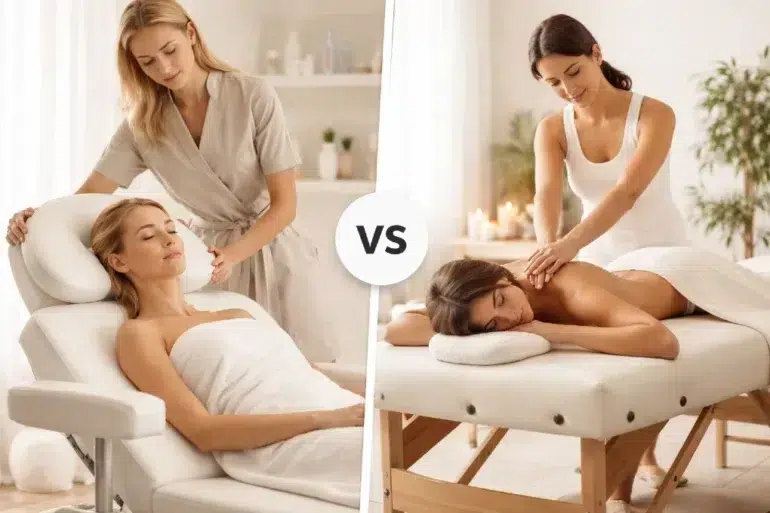
Beauty Bed vs Massage Table: The Core Difference
The easiest way to understand this comparison is to think about the service itself.
A Beauty Bed is built for precision treatments where the client stays relatively still and comfort, posture, and presentation matter a lot.
A massage table is built for movement based therapy where the practitioner needs clear body access, mobility around the table, and a stable working surface for hands on techniques.
That means the better choice is not about which one is more expensive or more stylish. It is about which one supports your actual workflow.
Here is a simple side by side breakdown:
| Feature | Beauty Bed | Massage Table |
|---|---|---|
| Best for | Facials, lashes, waxing, brows, skincare, aesthetics | Massage therapy, sports massage, deep tissue, bodywork |
| Comfort style | Plush, salon-style, reclined support | Firm, bodywork-focused support |
| Appearance | Premium and polished | Functional and clinical or portable |
| Portability | Usually limited | Often portable and foldable |
| Therapist access | Best for head, face, upper body, side access | Best for full body and multi-angle access |
| Adjustability | Often includes backrest and leg adjustments | Often flat, with fewer beauty-style positioning options |
| Client perception | Feels luxurious and treatment-focused | Feels therapeutic and massage-focused |
When a Beauty Bed Works Better
If your services are beauty led, a Beauty Bed usually wins without much debate.
1. Facials and skincare treatments
Facials often require a client to remain relaxed for 45 to 90 minutes while the practitioner works mostly around the face, neck, shoulders, and scalp line. A Beauty Bed allows a more natural reclined position, which feels more comfortable than lying flat the entire time.
It also helps during consultations and aftercare moments. You can raise the backrest slightly, maintain eye contact, and create a more personal treatment experience.
2. Lash extensions and brow services
These treatments demand stillness. Even slight discomfort can cause fidgeting, which slows down work and affects precision. A Beauty Bed usually provides better cushioning and a more supportive position for longer appointments.
For lash artists especially, client comfort is not a luxury. It is a productivity tool. A comfortable client moves less, rests more deeply, and makes the appointment easier to complete smoothly.
3. Waxing and aesthetics
For waxing, body contouring, skin treatments, and advanced beauty procedures, you often need adjustable angles and easier client positioning. A Beauty Bed helps you shift from flat to partially upright without having to reconfigure everything.
That flexibility becomes even more valuable when your menu includes multiple service types in the same room.
4. Salon and spa branding
A Beauty Bed tends to look more premium. That visual detail matters. Clients judge professionalism quickly, and furniture plays a role in how they perceive hygiene, comfort, and service value.
In a beauty business, the room is part of the experience. A sleek Beauty Bed supports that premium feel better than a standard massage table in most cases.
When a Massage Table Works Better
A massage table is the better choice when your service depends on body access, therapist movement, and strong structural support.
1. Full body massage
If you perform Swedish, deep tissue, prenatal, sports, or recovery sessions, a massage table is built for that purpose. The shape, firmness, and accessibility make it easier to work on the back, shoulders, legs, arms, and hips efficiently.
The face cradle is also a major advantage for prone work. That is something many beauty setups do not handle as naturally.
2. Mobile services
If you travel to homes, hotels, events, or corporate clients, a massage table is hard to beat. Many models fold, store, and transport more easily than a Beauty Bed.
That portability can save money, reduce setup friction, and make your service more scalable if mobility is part of your business model.
3. Therapist ergonomics during bodywork
OSHA notes that musculoskeletal disorders are linked to risk factors such as awkward postures, lifting, repetitive motion, and prolonged static positions, and these injuries are a major issue in care related work environments.
That matters here. A massage therapist needs enough clearance around the table and a work surface that supports proper body mechanics. During massage, poor equipment choice can lead to shoulder strain, back fatigue, and wrist stress over time.
A massage table is usually designed with those movement demands in mind more clearly than a Beauty Bed.
Client Comfort: Which One Feels Better?
This depends on what the client is there for.
For beauty services, a Beauty Bed usually feels better because it is designed for stillness, softness, and a treatment room atmosphere. Clients often associate it with pampering, skincare, and a premium salon experience.
For massage therapy, a massage table usually feels better because it supports correct body positioning during hands on treatment. The firmness is intentional. Too much softness can actually get in the way of effective massage.
So the better question is not “Which one is more comfortable?” It is “Which one is more comfortable for the service being delivered?”
That distinction is important because clients do notice when the equipment matches the treatment. When it does, the whole appointment feels more professional.
Therapist Workflow Matters More Than People Think
Many business owners choose equipment based only on what the client sees. That is understandable, but incomplete.
You should also ask:
- Can you work without hunching your shoulders?
- Can you reach comfortably from both sides?
- Can you adjust the client’s position quickly?
- Can you clean and reset the setup fast between appointments?
- Can the equipment support your most profitable services?
If you offer facials, peels, brows, and lashes all day, a Beauty Bed usually makes the workflow easier. If you spend the day doing deep tissue or full body sessions, a massage table is far more practical.
This is where many mixed service businesses go wrong. They buy a stylish bed that looks great online, then realize it slows them down in real appointments.
Hygiene, Maintenance, and Durability
Both options can be hygienic and long lasting if you choose quality materials and clean them properly. What matters is upholstery quality, seam design, resistance to oils and product stains, and how easy the surface is to disinfect between appointments.
For beauty businesses, a Beauty Bed often sees regular exposure to wax, oils, serums, tints, and skincare products. That means easy wipe down surfaces and resistant upholstery matter a lot.
For massage practices, oils and repeated pressure testing become the bigger concern. A massage table needs to hold up under regular load, movement, and repositioning.
A cheap option in either category tends to cost more later through repairs, wobbling, cracked vinyl, and poor client experience.
Which One Is Better for Small Rooms?
This depends on how fixed your setup is.
A massage table can be a smart choice for tight spaces if you need portability or the ability to clear the room when the table is not in use.
A Beauty Bed can also work well in a small room if your services are mostly stationary and you want a permanent treatment layout. In fact, for a dedicated facial or lash room, a compact Beauty Bed often makes more sense because it keeps the room feeling intentional rather than temporary.
If space is limited, measure all of the following before buying:
- Full room width and walking clearance
- Door swing and storage access
- Space for stools, trolleys, and lamps
- Your working position at the head and both sides
- Client entry and exit comfort
Cost vs Value
A massage table is often cheaper upfront, especially portable models. A Beauty Bed, particularly hydraulic or electric versions, can cost more.
But price alone is not the right metric.
What matters is value over time.
If a Beauty Bed helps you deliver better facials, retain more lash clients, improve comfort during 90 minute appointments, and elevate your room presentation, then it may return far more value than a cheaper table ever could.
Likewise, if you are a massage therapist who needs transport, body access, and flexibility, buying a Beauty Bed just because it looks luxurious may be a costly mistake.
Choose based on revenue fit, not just sticker price.
Real World Scenarios
Choose a Beauty Bed if:
- You run a facial studio
- You offer lash extensions or brow shaping
- You provide waxing or skin treatments
- You want a premium salon or spa look
- Your clients stay mostly still during treatments
- You need reclining support and beauty-specific positioning
Choose a massage table if:
- You are a massage therapist
- You offer sports, deep tissue, or recovery work
- You provide mobile services
- You need full access around the body
- You rely on a face cradle for prone positioning
- You want foldable, transport-friendly equipment
Consider both if:
- You run a spa with separate treatment menus
- You offer both body massage and beauty services
- You have multiple rooms with different purposes
- You want one room for facials and another for massage therapy
Common Buying Mistakes to Avoid
A lot of frustration can be avoided by steering clear of these common mistakes:
- Buying for looks instead of service suitability
- Ignoring therapist posture and daily workflow
- Choosing the cheapest upholstery
- Forgetting room measurements
- Underestimating how long clients stay on the bed
- Assuming one setup works equally well for every treatment
- Overlooking how easily the equipment can be cleaned
Final Verdict
So, Beauty Bed vs Massage Table: Which One Works Better for Your Services?
If your business is beauty focused, the Beauty Bed is usually the better investment. It supports beauty treatments more naturally, looks more premium, and gives clients the kind of comfort they expect from facials, lashes, brows, skincare, and aesthetic services.
If your business is centered on massage and bodywork, the massage table is the smarter option. It supports therapist movement, works better for full body access, and is built around the physical demands of massage techniques.
There is no universal winner because these products are not trying to do the same job. The right answer comes down to service fit.
Buy for the treatment you perform most often, not the image you want to project. When your equipment matches your workflow, clients feel the difference, your posture improves, and your service becomes easier to deliver consistently.
That is ultimately what matters most.
In the end, the best setup is the one that helps you work efficiently while making your clients feel comfortable, supported, and confident in your professionalism. If your menu is rooted in beauty services, a Beauty Bed will usually give you the strongest long term return. If your work revolves around massage therapy, a massage table is typically the better fit.
FAQ
Is a Beauty Bed good for massage?
A Beauty Bed can work for light or short massage sessions, but it is usually not the best option for full body massage, deep tissue work, or sports massage. Those services require more body access and better therapist movement.
Can I use a massage table for facials?
Yes, you can, especially when starting out. But for longer facial appointments, lash services, or premium beauty treatments, a Beauty Bed usually creates a more comfortable and professional experience.
Which is better for a home salon?
If your home salon focuses on facials, lashes, brows, waxing, or skincare, a Beauty Bed is usually the better match. If you offer massage and need portability or easy storage, a massage table may be more practical.
Which one lasts longer?
Durability depends more on build quality, frame strength, upholstery, and maintenance than on category alone. A high quality Beauty Bed or massage table can both last well when matched to the right type of service.