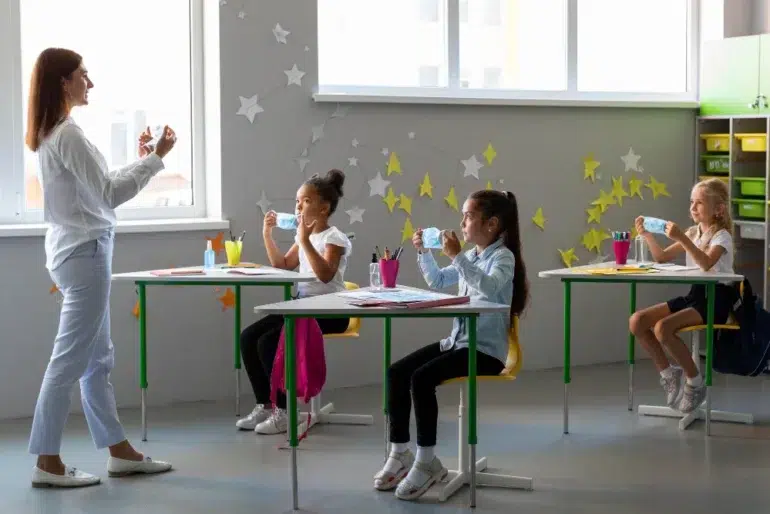
15% of all public-school students receive special education services under IDEA (National Center for Education Statistics, 2022-23). That’s 1 in 7 kids walking through the door each day with formal support needs on the books, and that doesn’t count ELL students, students in crisis related to mental health, or those displaying early warning signs of developmental delay without having had a formal evaluation yet. The question facing building administrators isn’t whether diverse classrooms need specialized support. It’s whether you’re going to plan for that support and build it into the day-to-day operation of the school or treat it as an afterthought.
It’s an important distinction. Schools where specialists are conceptualized as a Hail Mary emergency resource (‘send the kid to the office, we are out of other ideas’) lag behind schools where specialists are viewed as part of the core instructional infrastructure. The way the team is set up determines whether or not a kid gets help, not whether or not a kid needs it.
How Specialists Reduce the Instructional Gap
Having specialized support staff allows the lead teacher to focus on their teaching responsibilities. For example, when a speech-language pathologist is assisting a small group with communication skills, or a paraprofessional is providing one-on-one support to a student as mandated by their IEP, the classroom teacher can continue teaching core content. If this support is not available, the teacher is pulled in different directions and no student receives the necessary attention.
This does not mean that teachers are unwilling to adapt their teaching methods. Many teachers have been trained to differentiate their instruction and do so regularly. However, there is a limit to how much differentiation can be done when one teacher is responsible for managing twenty-five students with varying levels of readiness, language skills, and behavioral issues. Specialized support staff does not override the teacher’s decisions, instead, they help expand the team’s ability to implement those decisions.
The Push-in Model and What it Does for Inclusion
For a long time, the default approach was to pull students with IEPs out of the general classroom for specialized support. That model still has a place, particularly in resource rooms where intensive small-group instruction is needed. But the push-in model, where occupational therapists, school psychologists, or behavioral specialists work alongside students in the general education setting, has real advantages for how students see themselves and each other.
When support happens inside the classroom, it’s not marked. The student receiving occupational or speech therapy doesn’t have to leave the room and return with an explanation. The environment stays seamlessly integrated, and the stigma that can attach to students identified as other gets less traction. Social-emotional learning also benefits when specialists model how to navigate challenges in real time rather than in a separate setting. Anxiety is contagious, but so is confidence and calm.
Early Intervention is a Budget Argument, Not Just a Values One
Schools and districts facing fiscal constraints often see specialized staffing as an expense. The reality is quite different. For example, it costs far less to identify and address a communication disorder or behavioral issue early on, rather than waiting until it has compounded year after year. Similarly, a student receiving SLP (speech-language pathology) support in early elementary school should be far less likely to need placement in a more restrictive setting in middle school. A school psychologist identifying and addressing anxiety early makes it far less likely that the issue will escalate to a disciplinary matter or mental health crisis.
The presence of mental health professionals changes the climate and culture of the school in ways that are beneficial for all, not just those receiving direct services. A proactive safety net that builds before a crisis emerges helps decrease the administrative load of reacting to emergencies and creates the space for educators to teach rather than manage crises.
Bridging the Gap Between Need and Capacity
The challenge many schools face isn’t disagreement about the value of specialized staff. It’s supply. Qualified school psychologists, occupational therapists, and SLPs are in short supply, and smaller districts especially struggle to recruit and retain them. That’s where partnerships with specialist education services fill a real gap, giving administrators access to credentialed professionals in critical roles without requiring full-time headcount for positions that may only be needed a few days per week.
Working through an education staffing services partner also gives schools flexibility as student needs shift across a school year. A cohort that needs heavy SLP support in fall may need more occupational therapy hours by spring as IEP goals evolve. External staffing arrangements can accommodate that in ways that a fixed internal hire cannot.
Data Collection as a By-Product of Good Staffing
One aspect of specialized staff that is often overlooked is documentation. A classroom teacher responsible for thirty students all day long simply cannot keep track of the detailed behavioral and academic information needed to make MTSS decisions. But a paraprofessional who works closely with a student can. A school psychologist who meets regularly with a student or group of students can. This detailed information, when fed back into team planning, makes every subsequent intervention more targeted and likely to be successful.
Specialized staff don’t just make students more successful. They make the system smarter.
The classrooms that will be most successful in the coming decade will not necessarily be the ones with the most resources, generally defined. They will be those that deploy expertise most strategically, in response to specific students’ needs, and that intentionally build teams to be that way from the beginning.