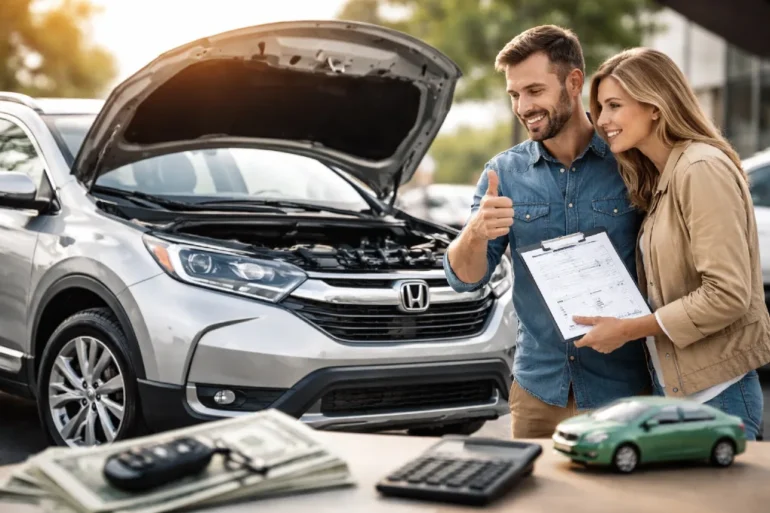
Shopping for a Used Honda CRV sounds simple at first. It is one of those SUVs people trust, dealers love to stock, and families keep for years. That popularity is exactly why buyers sometimes overpay. A Used Honda CRV can be an excellent value, but only if you know which model years make the most sense, what condition matters more than mileage, and where the real negotiation leverage lives.
The good news is that a Used Honda CRV usually gives buyers a strong mix of practicality, comfort, fuel efficiency, and resale strength. Kelley Blue Book recently highlighted the CR-V’s long-standing reputation for reliability and noted that strong resale value remains one of its biggest strengths. It also pointed to the CR-V’s roomy interior and up to 76.5 cubic feet of cargo space as major selling points.
Still, not every Used Honda CRV is a smart buy.
Some have patchy maintenance histories. Some are priced too close to newer units. Some look clean on the surface but hide recall issues, deferred service, or previous accident damage. If your goal is to get more value for your money, you need to buy with a plan, not just a budget.
Why a Used Honda CRV Holds Its Value So Well
There is a reason the Used Honda CRV stays high on used-car shopping lists year after year. It fits a wide range of buyers.
It works for commuters, small families, students, retirees, and anyone who wants an SUV without the size or fuel costs of a larger vehicle. On top of that, newer CR-V models offer impressive efficiency. FuelEconomy.gov shows that the 2025 CR-V hybrid can return up to 40 mpg combined in front-wheel-drive form, while the gasoline front-wheel-drive version is rated at 30 mpg combined.
That matters in the real world.
When a vehicle is easy to live with, affordable to fuel, and practical enough for daily errands and weekend travel, demand stays strong. That demand supports higher resale values, which is good if you buy carefully and even better if you plan to sell later. Kelley Blue Book also noted that a used 2025 Honda CR-V is likely to retain more value than many rivals over time.
For buyers, that means one thing: the Used Honda CRV is often worth buying, but it is not always worth overpaying for.
Start With the Right Buying Mindset
A lot of shoppers focus too heavily on one number, usually mileage. Mileage matters, but it is not the whole story.
A lower-mileage Used Honda CRV with poor maintenance can be a worse buy than a higher-mileage one with full service records, clean ownership history, and careful use. Think in terms of total value, not just odometer bragging rights.
Here is the better approach:
- Prioritize maintenance history over low mileage alone
- Compare pricing with trim level, condition, and model year
- Check if the seller is pricing the vehicle based on hype rather than actual value
- Budget for immediate post-purchase service
- Use the VIN to verify recalls, accidents, and title issues
- Stay flexible on color and minor cosmetic flaws to get a better deal
That is how smart buyers save money without sacrificing quality.
Best Used Honda CRV Model Years to Consider
A Used Honda CRV from the right generation can stretch your budget much further than a newer one with similar monthly costs.
2017 to 2022 models
These years are often attractive because they still feel modern inside, with better infotainment, updated safety tech, and the compact SUV shape many buyers want. For shoppers who want newer styling and better convenience features without paying near-new pricing, these years are usually a practical middle ground.
2023 and newer models
Honda redesigned the CR-V for the 2023 model year, and IIHS says its current safety ratings apply to 2023 to 2026 models. The redesigned CR-V earned good results in several major crash tests, though in the updated moderate overlap front test it received a poor overall rating because of rear passenger injury measures. That is the kind of detail serious buyers should know instead of relying on broad “safe car” labels.
These newer versions can be a strong buy, but only when the price gap versus a brand-new CR-V is wide enough to justify going used.
Older CR-V models on a tighter budget
An older Used Honda CRV can still make sense if the vehicle has been maintained properly and passes inspection. Just remember that lower purchase price can be offset by upcoming repairs, worn suspension parts, older tires, or missing maintenance records.
The lesson is simple. Do not shop by age alone. Shop by condition, maintenance, and total ownership cost.
How Much Should You Pay for a Used Honda CRV?
This is where buyers either win or lose.
The right price for a Used Honda CRV depends on five things:
- Model year
- Trim level
- Mileage
- Vehicle history
- Local market demand
In a hot market, sellers often ask premium pricing simply because the CR-V name attracts attention. Kelley Blue Book’s pricing data for the new 2025 CR-V shows starting MSRPs from the low $31,000 range into the $36,000 range depending on trim, while Honda’s own 2026 pricing begins at $30,920 for the LX and climbs much higher for hybrid trims.
Why does that matter when you are shopping used?
Because if a lightly used Used Honda CRV is priced too close to new, the value proposition weakens fast. You may lose out on newer warranty coverage, updated financing offers, and peace of mind without saving enough money to make it worthwhile.
A useful rule is this: the newer the vehicle, the more aggressively you should compare it to brand-new alternatives.
Quick Value Check Table
| What to Compare | Why It Matters |
|---|---|
| Price vs same-year listings | Helps spot inflated asking prices |
| Price vs new CR-V | Shows whether used savings are actually meaningful |
| Mileage vs maintenance records | Lower miles do not always mean better value |
| Trim vs features | Higher trims may justify a modest premium |
| Tire and brake condition | These can add major near-term costs |
| Accident and title history | Affects both safety and resale |
| Recall status | Can point to unresolved issues |
Check the Vehicle History Before You Fall in Love
This is one of the biggest money-saving steps in the whole process.
Before you commit to any Used Honda CRV, ask for the VIN and run history checks. A history report can reveal previous accidents, title branding, service gaps, or mileage inconsistencies. CARFAX notes that accident history, service history, number of owners, and recall status all affect a vehicle’s value.
You should also use the VIN to check recall status directly through NHTSA. NHTSA recommends VIN-based recall checks so owners can confirm whether a specific vehicle is affected.
Do not skip this because the seller says everything is fine.
A clean-looking Used Honda CRV can still have an open recall or a history that weakens its long-term value.
What to Inspect on a Used Honda CRV
A proper inspection saves money twice. It helps you avoid a bad car and gives you negotiating power on a good one.
When looking at a Used Honda CRV, focus on these areas:
Exterior and body
- Check paint consistency from panel to panel
- Look for uneven gaps between doors, hood, and tailgate
- Inspect the windshield and lights for cracks
- Look under the vehicle for rust or fresh undercoating that may be hiding damage
Tires and suspension
- Uneven tire wear can signal alignment or suspension issues
- Mismatched tires may suggest corner-cutting on maintenance
- Listen for clunks or rattles during a test drive
Interior and electronics
- Test the infotainment screen, Bluetooth, backup camera, and climate controls
- Make sure all windows, seat controls, and USB ports work
- Consumer Reports owner feedback snippets for recent CR-V models mention infotainment and connectivity complaints, so electronics deserve extra attention during inspection.
Engine and driving behavior
- Start the engine cold if possible
- Listen for rough idle, hesitation, or unusual noises
- Make sure acceleration is smooth and the transmission feels normal
- Watch for warning lights before and after the drive
A pre-purchase inspection by an independent mechanic is still worth paying for. On a vehicle that costs thousands of dollars, that inspection fee is cheap insurance.
Mileage Matters, But Condition Matters More
A lot of people search for a Used Honda CRV under 50,000 miles because it feels safer. Sometimes it is. Sometimes it is just more expensive.
A better question is this: what happened during those miles?
A CR-V driven mostly on highways and serviced on schedule can be a better buy than one with lower mileage but long service gaps, repeated short trips, poor tire maintenance, or minor collision repairs. Ask for oil change records, tire rotations, brake work, and any major service receipts.
If the seller has paperwork, that is a strong sign.
If the seller has excuses, be cautious.
Which Trim Gives the Best Value?
Not every Used Honda CRV trim is priced sensibly in the used market.
Base trims usually offer the best value if your priorities are reliability, cargo space, and fuel economy. Mid-level trims often hit the sweet spot for buyers who want better comfort features without paying luxury-level used prices. Top trims can be worth it, but only if the feature upgrades matter to you.
Pay attention to the basics first:
- Safety features
- Seat comfort
- Cargo flexibility
- Climate control
- Smartphone connectivity
- All-wheel drive, if you truly need it
If you are buying a Used Honda CRV for practical family use, it is easy to overspend on trim features you will stop noticing after a week.
Do Not Ignore Fuel Economy and Ownership Costs
One reason the Used Honda CRV remains popular is that it can be relatively efficient for an SUV.
FuelEconomy.gov shows meaningful differences between powertrains. The 2025 CR-V hybrid front-wheel-drive version is rated at 40 mpg combined, while the gasoline AWD version is rated at 28 mpg combined.
That gap can add up over time.
If you drive a lot, paying more upfront for a hybrid Used Honda CRV may be worthwhile. If you drive modestly and mostly want lower purchase cost, a gasoline version may be the better value.
Either way, think beyond the sale price. Estimate:
- Fuel costs
- Insurance
- Tires
- Brakes
- Registration
- Immediate maintenance after purchase
The cheapest listing is not always the cheapest vehicle to own.
Safety Should Be Part of the Value Equation
Buyers often separate safety from value, but they should not.
A Used Honda CRV that performs well in crash testing, includes modern driver-assistance features, and avoids major unresolved safety issues may justify a slightly higher price. IIHS ratings for the redesigned CR-V show strong results in driver-side and passenger-side small overlap tests and in the updated side test for 2023 to 2026 models.
That does not mean every used example is equally safe.
Safety also depends on tire condition, proper repairs after any accidents, recall completion, and whether driver-assistance features are still functioning properly. This is another reason inspection and recall checks matter so much.
How to Negotiate a Better Deal
Negotiating on a Used Honda CRV gets easier when your argument is specific.
Do not just say the price feels high. Show why.
Use points like these:
- Comparable listings with lower asking prices
- Worn tires or brakes that will need replacement soon
- Missing service records
- Open recalls
- Cosmetic damage
- Higher mileage than similar vehicles
- The small price gap between this used unit and a new one
You do not need to be aggressive. You need to be factual.
A seller is far more likely to move on price when you sound informed instead of emotional.
Best Places to Buy a Used Honda CRV
Where you buy matters almost as much as what you buy.
Franchise dealerships
These can offer more convenience, financing options, and sometimes certified inventory. Prices may be higher, but some buyers value the added structure.
Independent dealers
These can have lower prices, but quality varies more. Read reviews carefully and inspect everything.
Private sellers
You may find the best deal here, especially on an older Used Honda CRV, but you need to verify paperwork, history, and condition more carefully.
Wherever you buy, avoid rushing because inventory feels competitive. The CR-V is popular, but it is also common enough that patience usually pays off.
Common Mistakes Buyers Make
A lot of money gets wasted on avoidable mistakes.
Here are the biggest ones:
- Buying based only on monthly payment
- Choosing the lowest mileage unit without checking service history
- Skipping the pre-purchase inspection
- Ignoring recall checks
- Overpaying for a near-new vehicle
- Falling for cosmetic shine instead of mechanical condition
- Assuming every Used Honda CRV is automatically a good deal
The nameplate is strong, but the individual vehicle still matters more than the badge.
Is a Used Honda CRV Worth It?
For many buyers, yes.
A Used Honda CRV makes sense because it blends space, comfort, efficiency, and resale strength in a way that appeals to a very wide market. Honda’s official specifications for the current CR-V show generous cargo room, and Kelley Blue Book specifically called out its class-leading 76.5 cubic feet of cargo volume as one of its standout strengths.
That kind of everyday usefulness is hard to ignore.
Still, the best value does not come from buying the cheapest one or the newest one. It comes from buying the right one.
That means a Used Honda CRV with solid maintenance records, clean history, fair pricing, and condition that matches the seller’s claims. If you approach the deal that way, you are not just buying an SUV. You are buying lower risk, better long-term value, and a vehicle that is easier to live with every day.
In the end, a Used Honda CRV is often a smart choice for shoppers who want a dependable compact SUV without stepping into luxury-brand ownership costs. The key is staying disciplined enough to pass on overpriced or poorly documented examples.
A little patience can save you a lot of money.
Conclusion
The smartest way to buy a Used Honda CRV is to focus on total value, not surface appeal. Compare the asking price with both similar used listings and new CR-V pricing. Check the VIN for recalls. Review maintenance records closely. Inspect tires, brakes, electronics, and signs of previous damage. And if anything feels uncertain, pay for a professional inspection before signing anything.
Do that, and a Used Honda CRV can give you exactly what most buyers want: practical space, strong resale value, solid efficiency, and less financial regret after the purchase.