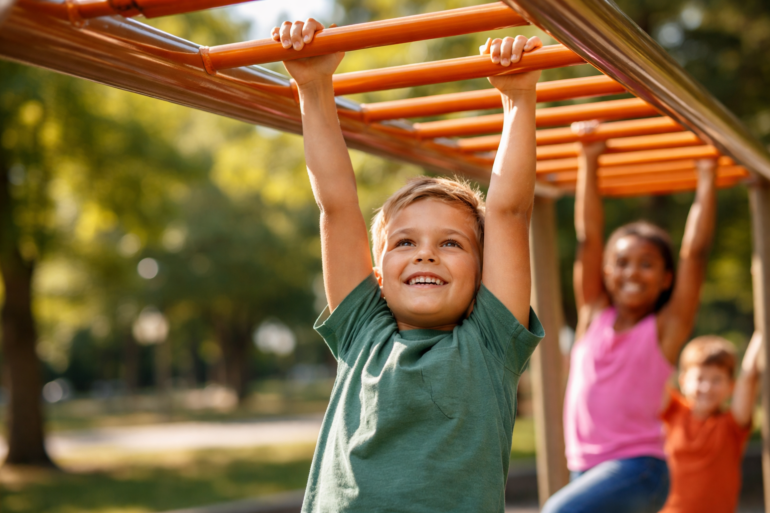
Monkey Bars have been a playground favorite for generations, and it is easy to see why. They look simple, but they challenge the body in ways that many pieces of equipment do not. A child hanging, swinging, reaching, and moving across the bars is doing much more than playing. They are building strength, coordination, confidence, and body awareness in a way that feels fun instead of forced. Regular active play matters because children ages 6 to 17 are recommended to get at least 60 minutes of physical activity every day, and climbing activities can count toward muscle and bone strengthening as part of that movement mix.
For parents, teachers, and even adults getting back into functional fitness, Monkey Bars are more than nostalgia. They are a practical tool for improving grip strength, upper-body endurance, and movement skills. For kids, they turn exercise into a game. For adults, they offer a surprisingly demanding workout that trains the body in a more natural, athletic way than many machines in a gym.
What makes Monkey Bars so valuable is that they combine effort and enjoyment. Kids rarely think of them as exercise. They think of them as a challenge, a race, or a personal mission to make it all the way across without dropping down. That sense of play is powerful because it keeps children moving, repeating, and improving without needing much encouragement.
What Are Monkey Bars?
Monkey Bars are a set of horizontal bars arranged overhead, usually on a playground or fitness structure, that users move across by hanging from one bar to the next. The movement may look basic, but it requires the body to work as a connected system. The hands grip, the shoulders stabilize, the back pulls, the arms support body weight, and the core helps control swinging.
That full-body demand is one reason Monkey Bars remain popular in playground design and adult obstacle-style training. They are accessible, challenging, and easy to understand. You do not need complicated instructions. You simply grab the bar and start moving.
Why Monkey Bars Still Matter in a Screen-Filled World
Children today have more indoor entertainment than ever. That makes outdoor play even more important. Active play supports physical development, helps children practice movement skills, and gives them opportunities to test their abilities in real space, not just on a screen. The American Academy of Pediatrics notes that play builds motor competence, including fine and gross motor skills, while research on playgrounds shows that these spaces can challenge balance, agility, and coordination.
Monkey Bars fit perfectly into that need. They are not passive equipment. A child has to decide when to reach, how to swing, how tightly to hold on, and when to let go. Each pass across the bars becomes a little lesson in timing, control, and persistence.
There is also the confidence factor. Many children cannot cross the full set on the first try. Then one day they make it two bars farther. A little later, they complete the whole thing. That kind of visible progress sticks with kids. It teaches them that hard things get easier with practice.
Monkey Bars Benefits for Kids and Adults
The biggest benefit of Monkey Bars is that they train several physical qualities at once. Instead of isolating one body part, they ask multiple systems to work together.
1. They build upper-body strength
Moving across Monkey Bars places body weight through the arms, shoulders, and upper back. Pulling and hanging patterns are widely used in strength training because they develop practical upper-body capacity. Grip-focused exercise is also strongly associated with upper-body strength, making hanging and traversing especially useful for developing that area.
For kids, this helps build foundational strength through play. For adults, Monkey Bars can be a functional strength exercise that feels more dynamic than standard gym work.
2. They improve grip strength
Grip strength is one of the first things people notice on Monkey Bars. If the hands and forearms tire out, the movement becomes harder fast. That is part of the value. Grip strength is not only important for sports and climbing tasks, but it is also used in health and performance settings as a practical indicator of broader muscle function.
For children, stronger grip supports everyday movement and play. For adults, it carries over to lifting, carrying, climbing, and general fitness.
3. They support coordination and motor skill development
Monkey Bars require rhythm, timing, and body control. A child has to coordinate the hands, shoulders, trunk, and legs while shifting weight through the air. That kind of movement supports motor development, and active climbing play is part of the broader mix of experiences that help children refine movement skills. The AAP highlights that running, leaping, and climbing help children develop motor skills, and playground research supports the role of playgrounds in challenging coordination and agility.
4. They challenge the core without making it feel like core work
Even though Monkey Bars are often thought of as an arm exercise, the core is heavily involved. The torso has to stay controlled while the body swings and rotates. Without core tension, the lower body swings wildly and each reach becomes less efficient.
This is one reason Monkey Bars are useful in both child development and adult fitness. They teach the body to stabilize during motion rather than only during static exercises.
5. They encourage active play naturally
Children do not need much convincing to use Monkey Bars. They are playful by design. That matters because the best exercise for kids is often the movement they will repeat willingly. Health guidance consistently emphasizes daily activity, and enjoyable play makes it more likely that children will get enough of it.
6. They can help reduce reliance on sedentary habits
Physical activity tends to drop when screen time rises. CDC data reported that during July 2021 through December 2023, 61.1% of children and adolescents got 60 minutes of activity most days or every day, and activity levels decreased with higher screen time. That does not mean Monkey Bars solve the whole problem, but they are one simple, appealing way to get children outside and moving.
Muscles Worked on Monkey Bars
If you have ever crossed a set of Monkey Bars and felt your arms shaking afterward, you already know the movement is more demanding than it looks. Several muscle groups are involved at once.
Primary muscles worked
Forearms and hands
These muscles handle the grip. Every second spent hanging increases the demand on finger, hand, and forearm strength.
Latissimus dorsi
Often called the lats, these large back muscles help pull the body and support shoulder movement in hanging and pulling tasks. Pulling exercises commonly target the lats as a major muscle group.
Shoulders
The shoulders stabilize and guide each reach. They help keep the arms in position while the body swings from one bar to the next.
Biceps
The biceps assist in elbow flexion and help support the pulling action as the body moves under the bars.
Supporting muscles worked
Upper back muscles
The traps, rhomboids, and nearby stabilizers help manage shoulder position and control.
Core muscles
The abdominals and deeper trunk muscles help reduce excess swinging and keep movement efficient.
Chest and triceps
These muscles are not usually the stars of the movement, but they contribute to stabilization and control depending on technique and body position.
In simple terms, Monkey Bars are mostly an upper-body and grip challenge with strong support from the core. That is why they feel so tiring so quickly, especially for beginners.
Why Kids Love Monkey Bars
Children are drawn to Monkey Bars for reasons that go beyond exercise. They feel adventurous. They create a small but exciting sense of risk. They allow children to test themselves in public and celebrate progress in a visible way.
There is also a strong play pattern built into the equipment. Kids turn Monkey Bars into races, dares, and mini competitions. One child tries to cross without stopping. Another tries to skip bars. Another simply hangs for fun. This flexibility keeps the equipment interesting for different ages and skill levels.
Monkey Bars also create a clear challenge with a satisfying finish line. That matters. Children often enjoy activities where success is easy to understand. You either made it across or you did not. Then you try again. That built-in feedback loop is one reason kids keep coming back.
Socially, Monkey Bars can be a shared experience. Children watch one another, cheer, copy, and learn. One confident child often motivates others to try. That kind of peer-driven play is part of what makes playgrounds valuable beyond just physical movement.
Are Monkey Bars Good Exercise for Adults Too?
Yes, and many adults underestimate them.
Monkey Bars train hanging strength, grip endurance, shoulder stability, and upper-body control in a very direct way. Adults who do obstacle course training, climbing, calisthenics, or functional fitness often use similar movements because they transfer well to real-life tasks and broader athletic ability.
For adults returning to Monkey Bars after years away, the experience is usually humbling. What felt effortless as a child can suddenly feel tough. That is not a bad thing. It shows how demanding bodyweight movement really is. Even short hangs, partial traverses, or assisted attempts can be useful training.
A practical approach for adults is to start with simple hanging, then move to one-bar reaches, then controlled movement across a few rungs. The goal is not to force a full crossing on day one. The goal is to rebuild strength and movement quality gradually.
Safety Tips for Using Monkey Bars
Monkey Bars are fun, but they need to be used with care, especially by younger children. Most playground injuries are related to falls, and fall protection matters. The Children’s Safety Network, citing CPSC data, reports that falls account for over 75% of playground-related injuries. CPSC and CDC materials also emphasize age-appropriate equipment and soft surfacing such as mulch, sand, or similar protective materials beneath equipment.
Here are the basics that matter most:
- Use age-appropriate equipment.
- Check that the ground surface underneath is shock-absorbing.
- Supervise younger children closely.
- Make sure hands are dry and bars are not slippery.
- Avoid clothing with drawstrings, scarves, or anything that can catch on equipment.
- Encourage children to progress at their own level instead of being pushed into difficult attempts.
Parents sometimes focus only on whether a child can do the bars. A better question is whether the setup is appropriate for the child’s current size, strength, and confidence. Safe progress is better than rushed progress.
How to Help a Child Get Better at Monkey Bars
Not every child can cross Monkey Bars right away, and that is completely normal. The skill develops with a combination of grip strength, shoulder control, timing, and confidence.
A few simple strategies can help:
- Start with dead hangs from a low bar.
- Practice swinging while both hands stay on the bar.
- Let the child move one bar at a time rather than trying to cross the whole set.
- Encourage reaching with control instead of rushing.
- Celebrate progress, not just full completion.
This matters because skill development often happens in small steps. A child who hangs for five seconds today may be crossing halfway in a few weeks. That visible improvement is part of what keeps the activity motivating.
Common Mistakes People Make on Monkey Bars
One common mistake is using too much speed too early. Swinging wildly may feel exciting, but it usually reduces control and increases the chance of missing a bar.
Another mistake is relying only on the arms. Good Monkey Bars movement uses the whole body. The shoulders stay active, the core stays tight, and the reach is timed rather than random.
For adults, jumping straight into repeated attempts without warming up the hands and shoulders can also be a problem. Even a few minutes of gentle shoulder mobility and light hanging can make the movement feel smoother.
FAQ About Monkey Bars
Are Monkey Bars good for building strength?
Yes. Monkey Bars build upper-body, grip, and core strength through hanging, pulling, and stabilizing movements. They are especially useful because they train multiple areas at once rather than isolating a single muscle group.
What age is best for Monkey Bars?
That depends on the equipment height, the child’s coordination, and the supervision available. The safest choice is always age-appropriate equipment designed for the child’s size and ability.
Do Monkey Bars help child development?
Yes. They can support motor competence, coordination, confidence, and active play habits. Climbing and playground play are both linked with opportunities to practice important movement skills.
Are Monkey Bars only for kids?
Not at all. Adults use Monkey Bars for functional fitness, obstacle course training, grip work, and upper-body conditioning. They can be scaled from simple hangs to more advanced traversing.
Final Thoughts on Monkey Bars
Monkey Bars have stayed popular for a reason. They turn movement into something challenging, playful, and deeply rewarding. For kids, they build strength, coordination, and confidence while making exercise feel like fun. For adults, they offer a simple but serious test of functional fitness.
In a world where many children need more daily movement and many adults want practical ways to build real strength, Monkey Bars still hold their place. They are timeless because they work. They ask the body to move, adapt, and improve, and they do it in a way that keeps people coming back.
That may be the real magic of Monkey Bars. They do not feel like a lecture about health. They feel like play. And when movement feels enjoyable, it is much more likely to become a lasting habit. For a bit of broader context on classic playground equipment, it helps to remember that the simplest structures often create the richest movement experiences.
Conclusion
Monkey Bars deserve more credit than they usually get. They are not just a playground memory or a quick recess activity. They are a smart, engaging way to build upper-body strength, improve grip, support motor skill development, and encourage children to stay active. Whether the goal is better play, stronger movement, or more confidence outdoors, Monkey Bars remain one of the easiest and most effective tools for getting there.