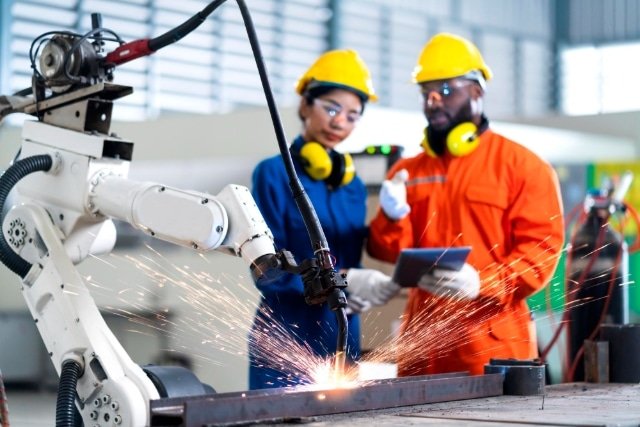
Modern manufacturing can now integrate speed and maintain precision, with the help of robotic arms. When welding is part of their processes, they can now increase their production to keep up with the demand of their customers, while meeting tight deadlines.
Businesses that are now constantly looking for ways to improve their overall processes while reducing labor costs can now find that robotic welding systems are the effective solutions that are perfect for their needs. They are advanced tools that can help with fabrication, and they can be automated.
Unlike traditional manual welds, robotic welding doesn’t rely on humans alone. Instead, it can incorporate methods that were programmed into it by skilled engineers, and this enables them to do highly repetitive welding tasks with accuracy. These systems are now transforming a lot of production warehouses where a business can take on more complex projects while maintaining uniform quality across every joint that they create.
Those companies that have once relied on manual welding may also find labor shortages and a lot of safety concerns during their production. They also need to increase strict standards, especially if they’re pushing towards automation. However, implementing robotics into an operation isn’t just a simple upgrade; it needs adaptation and a deep understanding of its limitations.
Technology is evolving, and so is the potential of robotic welding methods. Systems are now equipped with intelligent sensors with user-friendly software that can maximize their uptime. These features are able to make automation more accessible and customizable at the same time. Businesses are no longer settling for one-size-fits-all solutions, but they can now program the robotic arms according to their quality targets.
Understanding the Capabilities of the Systems
Many of these combine software intelligence with mechanical hardware in order to stay consistent with the results of the manufacturing. They were programmed to follow specific paths and control variables like temperature to adapt to the different materials that needed welding. See guides about welding when you go to this website here.
The advantages of these kinds of welds are the ability of the robots to deliver clean results in a fraction of the time that it would take humans to do everything manually. It’s going to reduce rework and also a significant amount of waste, and the number of units that can be produced within a given timeframe can be increased. It can also result in shorter delivery windows and greater customer satisfaction, which is important in today’s competitive landscape.
Benefits Outside the Welding Line
While increased productivity is the most obvious benefit, robotic welding provides a wider range of benefits. Perhaps the most underappreciated advantage is the enhancement of workplace safety.
Welding processes expose personnel to high heat, toxic fumes, and harsh circumstances that can lead to serious health damage over time. Automation relocates employees out of harm’s way, and this significantly reduces the risk of injury or long-term health issues.
Aside from safety, the robotic arms also make contributions to labor stability. Instead of replacing workers, they permit skilled welders to transition to inspection jobs or quality control operations. This transition not only maintains their careers but also creates a more versatile workforce that can keep up with the next wave of advancements in automation.
Challenges and Considerations in Implementation

Implementing robotic systems into a production line is not without its challenges. One of the most typical cons is the capital cost. Although the savings will be huge, the initial investment can also be high. Companies should be careful to consider total ownership costs, such as programming and staff training, before calling the right company for the installation of these additions.
Another difficulty is selecting the proper configuration for the task. Not every robotic welding system is equal, and you can find posts about robotics in this URL: https://www.science.org/journal/scirobotics. Geometry and weld complexity are all considerations that impact the correct system to use. Having a competent provider guarantees that the solution meets particular targets of production and future growth needs.
The Right Robotic Solution for Your Company
Selecting the right system means that flexibility should be present and customization must be a primary consideration. An excellent solution must be able to support a vast range of weld types, from fillet to butt joints, and suit different workpiece sizes. It must also conform to current infrastructure, ensuring seamless changeovers between manual and automated stations.
These systems can improve your business over time, and they can enable you to slowly upgrade as the demand increases. Begin with something versatile so you don’t need to deal with expensive system overhaul and stay competitive in the process.
Investing in a robotic system is going to be an innovative strategy that can help you achieve better parts. These pieces of equipment can continue working for hours without needing to take breaks and they can prevent burns in your workforce, so investing in them is now a must.