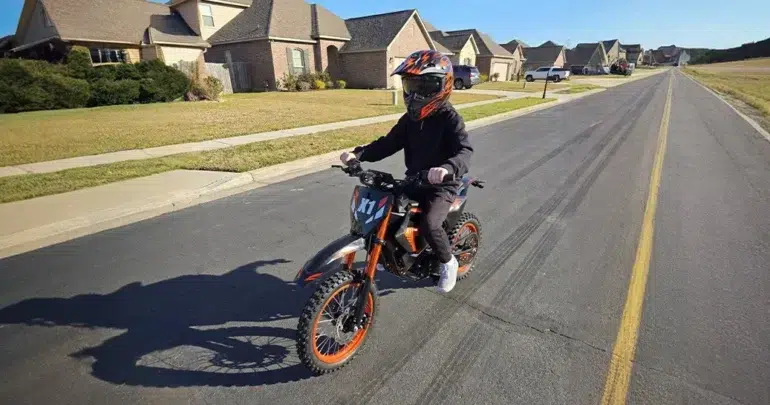
Electric mobility is moving beyond city streets and into more outdoor environments. In the past, electric vehicles were mostly seen as commuting tools. Today, improvements in batteries, motors, and control systems are bringing more electric off-road models into campgrounds, farm roads, private land, and light trail settings.
This change gives families a new outdoor option, but it also raises new questions. When choosing an electric motorcycle, parents should not focus only on appearance, top speed, or price. They need to consider whether the rider has the control ability required and whether the vehicle fits the place where it will actually be used.
Electric Power Makes Riding Easier to Start
Compared with gas-powered machines, electric off-road vehicles deliver power more directly and are often easier to understand at low speeds. There is no complicated shifting, and short-distance movement can feel more natural for new riders. This is one reason many young riders are interested in electric off-road riding.
But easier access does not mean there is no risk. Outdoor routes are not smooth pavement. Dirt, gravel, slopes, and turns all affect control. For teens, the most important question is not how strong the vehicle is, but whether they can manage it safely at the right speed and in the right environment.
The Riding Area Comes First
Before discussing the right model, families should first decide where the vehicle will be used. Public roads, sidewalks, city bike lanes, and regular park paths are usually not suitable for electric off-road vehicles. Better environments include private land, closed practice areas, farm roads, legal off-road parks, or outdoor routes where powered vehicles are clearly allowed.
Without the right riding area, strong specifications do not mean much. Teen riders should begin in open, lower-risk spaces under adult supervision. Basic practice should include starting, stopping, slow turns, and braking before moving toward longer or more technical routes.
Technology Should Support the Learning Process
An electric dirt bike for young riders should not be judged only by power or speed. Vehicle size, wheel setup, weight, riding modes, and braking feel all affect the learning experience. If a vehicle is too tall or too heavy, stopping, turning, and emergency braking become harder. If the power delivery is too aggressive, new riders may feel more pressure than control.
A lower-output mode can help riders build basic confidence. A balanced mode may fit campground roads or light forest routes after the rider gains experience. Higher-output settings should be reserved for more experienced riders in suitable areas. For teens, gradual progress is safer than starting with too much power.
Vehicle Fit Matters More Than Big Numbers
A teen off-road vehicle should not simply be treated as a smaller adult machine. A better fit allows the rider to sit naturally, reach the controls comfortably, and manage the vehicle at low speed. When size, power, and use case match, the rider can build confidence more steadily.
For young riders with some basic experience who need more stability and room to grow, X1 Spark L can serve as an electric dirt bike for teens, with 17″/14″ wheels, a 60V 28.8Ah battery, 4500W peak power, 283 Nm of torque, and riding modes for different stages of use.
Safety Habits Should Come Before Harder Routes
Teen riding should not begin with difficult trails. It should begin with safety habits. A helmet, goggles, gloves, knee protection, elbow protection, and proper off-road riding shoes should be part of every ride. Parents should also check tire pressure, brakes, battery level, throttle response, lights, and key fasteners before riding.
Rules for electric vehicles, off-road vehicles, and electric motorcycles vary by location. Some areas allow only specific vehicles, some may restrict teen riders, and some require permits. Checking local rules should be part of the routine before a family uses this type of vehicle.
Technology Should Come Back to Real Use
The development of teen electric off-road riding should not stop at vehicle specifications. Batteries, motors, and riding modes can make a vehicle easier for riders with different skill levels to understand, but the real experience still depends on how well the rider, the vehicle, and the riding area match.
For families, a suitable vehicle should help young riders begin with basic control, including starts, turns, braking, and route awareness, instead of pushing them too quickly into more demanding terrain. Qronge is part of a teen electric off-road segment that is becoming more connected to real uses such as campground activities, farm roads, and light outdoor routes.
Electric technology can make riding quieter, more direct, and easier to adjust. But for teens, technology is only the starting point. The right place, proper gear, adult supervision, and gradual practice are what make electric off-road riding more suitable for family outdoor use.