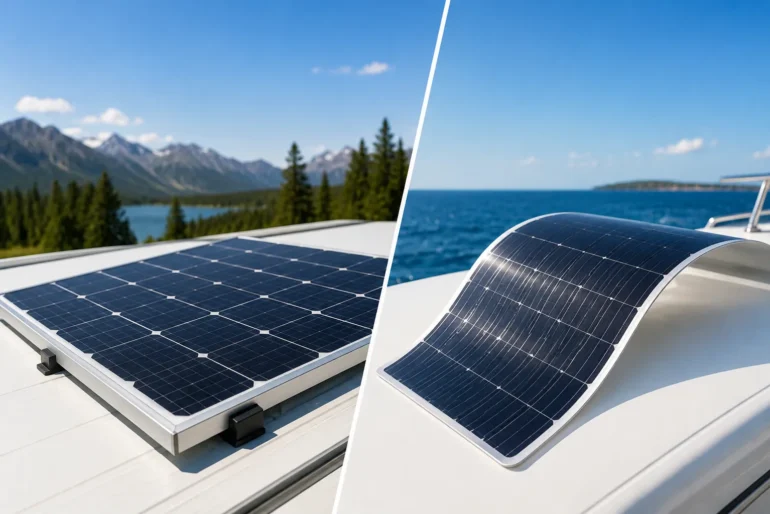
Choosing the right solar panel type matters, especially when a building has structural, weight, or design limitations. Two commonly considered options are semi-flexible and fully flexible panels. Although the names sound similar, the two technologies differ significantly in their design and performance characteristics.
Understanding those differences helps determine which option is most suitable for a particular structure, whether it has a curved roof or limited load-bearing capacity.
What Distinguishes Semi-Flexible From Flexible Solar Panels
Semi-flexible panels retain a core design constraint that can limit their application. These modules rely on silicon wafers encapsulated within polymer materials. The silicon-based construction allows limited flexibility but may be more susceptible to microfractures under certain conditions, particularly when exposed to vibration, wind stress, or impact from debris.
Some third-party testing has reported that certain semi-flexible panel designs experienced measurable efficiency degradation after environmental stress, while fully flexible alternatives demonstrated greater resilience under the same testing conditions. Results may vary depending on product design, testing methodology, and operating conditions.
Flexible solar panels, by contrast, use polymer-based materials with flexible solar cell technology. This construction eliminates the brittle silicon wafer component entirely. The result is a module designed to flex while maintaining structural performance. These panels can bend to conform to curved surfaces, withstand vibration and environmental stress, and help maintain performance across a range of applications.
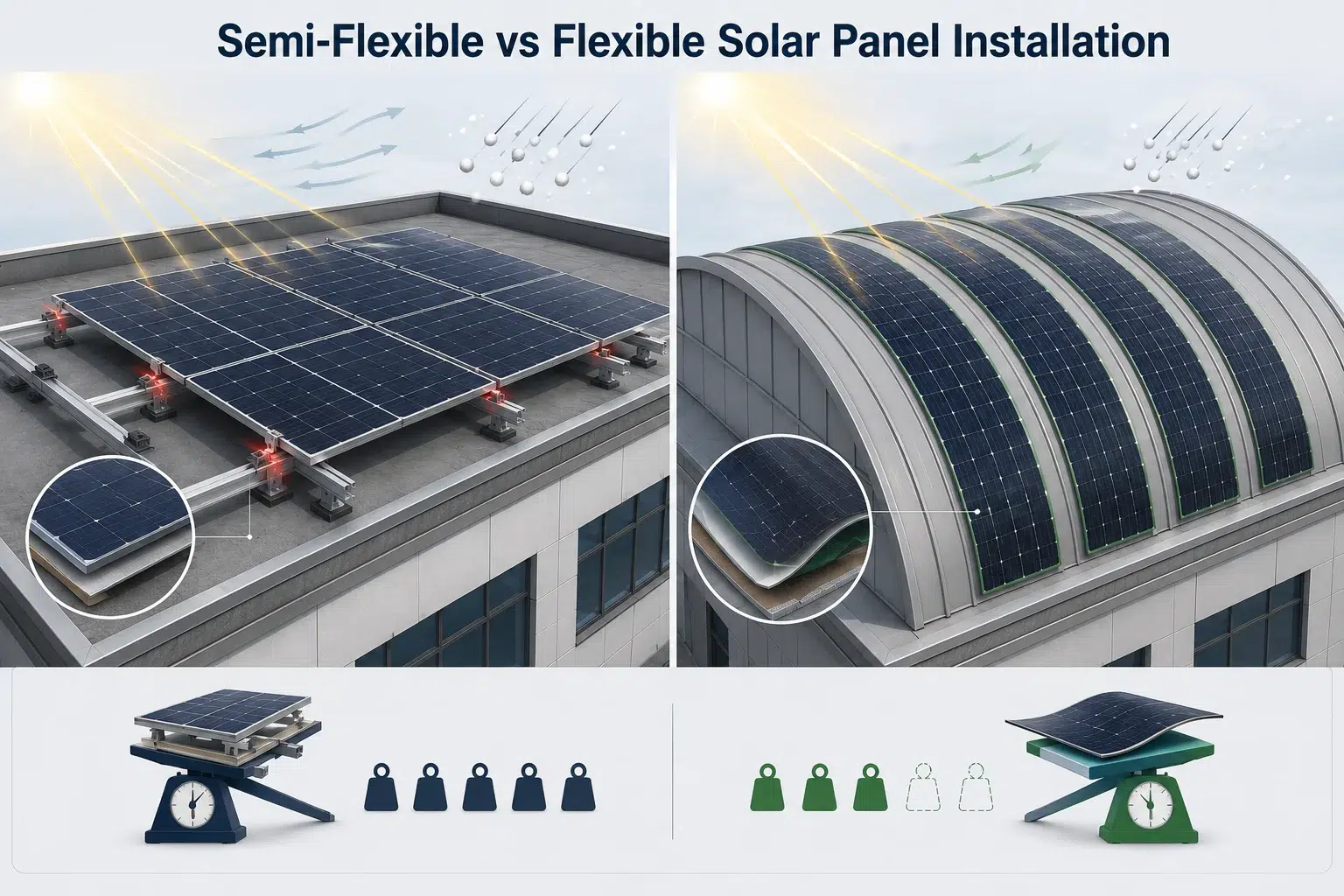
Why Flexible Panels Are Often Used on Complex Structures
Complex architectural designs often present challenges that standard panels may not address effectively. Curved roofs, dome structures, and buildings with irregular shapes frequently require solutions that can adapt without introducing additional engineering complications.
Semi-flexible panels, despite their name, still have limitations. Their moderate flexibility means they may be more susceptible to cracking when exposed to ongoing stress from wind loads or repeated thermal expansion and contraction on curved surfaces.
Flexible solar sheets are often well-suited to these conditions because they can conform more closely to a structure’s shape. The polymer matrix may help distribute stress rather than concentrating it, as can occur in more rigid systems. For greenhouses, industrial facilities with arched roofs, or historic buildings where roof modifications must remain minimal, flexible technology may help address constraints that can be more challenging for semi-flexible options.
Weight Considerations and Structural Safety
Weight is an important consideration for roofs with limited load-bearing capacity. Traditional rigid panels often require mounting systems that add both weight and installation complexity. Semi-flexible panels represent a lighter alternative but may still weigh more than fully flexible options.
The weight difference can amount to several kilograms per square meter between the two technologies, which may become significant across larger installation areas.
Lighter systems may make solar installations feasible for some buildings that would otherwise face structural limitations. Agricultural structures, lightweight commercial buildings, and certain metal-roof facilities can benefit from lower-weight solar solutions while still supporting energy generation goals.
Impact Resistance and Durability
Available testing data suggests performance differences between these technologies under certain conditions. When exposed to hail, impact, or vibration stress, semi-flexible panels have shown measurable efficiency losses in some testing scenarios. Certain fully flexible panels demonstrated lower degradation in the referenced testing conditions.
This may contribute to longer operational lifespans and more consistent energy production, although actual results depend on installation quality, environmental conditions, and manufacturer specifications.
The polymer construction used in some flexible solar sheets may offer fire-resistance characteristics, depending on product specifications and certifications. This characteristic may make them suitable for applications where additional fire-safety considerations are important, subject to local building codes and product ratings.
Installation Advantages of Flexible Systems
Flexible panels may reduce installation time and labor requirements in certain applications. Some flexible systems use adhesive-based mounting methods rather than traditional racking systems. This approach can reduce or eliminate the need for drilling into roofing materials, which may help reduce the risk of roof penetrations and associated leaks while also shortening installation time.
Semi-flexible panels, while lighter than rigid systems, often continue to rely on more conventional mounting methods depending on the installation design.
Semi-Flexible vs Flexible Solar Panels: Comparison
| Feature | Semi-Flexible Panels | Fully Flexible Panels |
|---|---|---|
| Core Material Construction | Silicon wafers with polymer encapsulation | Polymer-based construction without brittle wafer components |
| Stress Response | May experience performance loss under ongoing vibration and thermal cycling | Often demonstrates lower degradation from environmental stress |
| Surface Compatibility | Better suited to flat or minimally curved surfaces | Can adapt to curved and irregular architectural shapes |
| Installation Mounting | Generally requires conventional mounting systems | May utilize adhesive-based mounting alternatives |
| Structural Integrity Under Impact | May show efficiency reduction following environmental exposure | Often maintains more consistent performance metrics after impact testing |
| Roof Penetration Requirements | Typically involves fastening to the roof structure | Installation options may be available with minimal roof disruption |
| Maintenance Complexity | May require inspection for potential microfracture development | Generally involves fewer structural fatigue concerns |
| Suitable Building Types | Standard commercial and residential structures with adequate load capacity | Low-load buildings, historic structures, agricultural facilities, and irregular roof designs |
| Installation Timeline | Varies based on mounting requirements | May allow a shorter installation process in some applications |
Which Technology Suits Different Applications?
For buildings with structural limitations, curved surfaces, or low load-bearing capacity, flexible panels may offer advantages that semi-flexible options cannot always provide. The technology can be used across various surface materials, including metal roofing, plastic membranes, and concrete structures, depending on manufacturer recommendations and installation requirements.
Semi-flexible panels remain a viable option for many applications and are often best suited to flat or conventionally designed roofs with standard mounting capabilities.
The choice ultimately depends on the specific structural conditions of the building. Flat or conventionally designed roofs with sufficient load capacity may not require the additional flexibility offered by fully flexible technology. However, where architectural complexity or structural constraints exist, flexible panels may offer advantages in adaptability, installation flexibility, and long-term performance.
Frequently Asked Questions
How much weight difference exists between semi-flexible and fully flexible panels?
Semi-flexible panels typically weigh between 5 and 8 kilograms per square meter, while fully flexible panels often weigh approximately 2.5 to 3 kilograms per square meter. The difference can become significant across larger installation areas.
Can semi-flexible panels be used on curved surfaces?
Semi-flexible panels have some bending capability but are generally better suited to flat installations or surfaces with minimal curvature. Curved surface applications often benefit from fully flexible technology to reduce stress concentration and the potential for microfracture development over time.
What efficiency loss might occur with semi-flexible panels in harsh weather?
Some testing has indicated that semi-flexible panels may experience efficiency degradation following hail impact or prolonged vibration exposure. Fully flexible alternatives have demonstrated lower efficiency loss in certain testing scenarios, although results vary by manufacturer, product design, environmental conditions, and testing protocols.