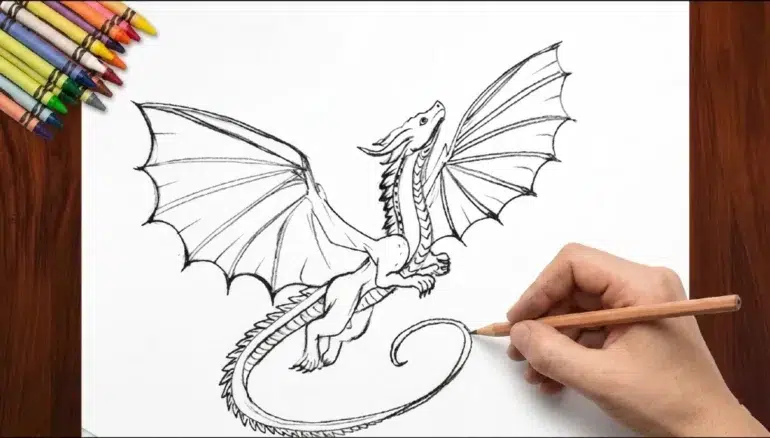
When I was eight years old, I drew a dragon on a piece of construction paper that my mom had brought home from her office. The paper was mustard yellow, the kind that feels slightly rough under a crayon, and I used every color in the box. The dragon had a red body, green wings, a purple underbelly, and a tail that curled into a spiral that looked less like a tail and more like a cinnamon roll. It was breathing fire, but the fire was orange squiggles that fizzled out halfway across the page. Above the dragon, in my worst handwriting, I had written “FLYING” with an arrow pointing to the wing, because the dragon was frozen mid-flap and I was worried nobody would understand what it was doing. I was incredibly proud of it. My mom put it on the refrigerator, where it stayed for maybe six months until a leak from the freezer turned it into a warped, water-stained relic. She threw it away eventually. Or so I thought.
Last Thanksgiving, I was helping my parents clean out their attic, and inside a box marked “Alex – School Stuff” in my mom’s loopy handwriting, I found the dragon. She hadn’t thrown it away. She had peeled it off the refrigerator, dried it out, and tucked it between two pieces of cardboard for safekeeping. The drawing was in rough shape. The mustard paper had faded to a sickly beige, the red crayon had bloomed with moisture into pinkish splotches, and the spiral tail had smeared into something that looked like a fingerprint on a crime scene. But “FLYING” was still legible, and the arrow still pointed at the green wing, and I sat there on the dusty attic floor holding my eight-year-old self’s masterpiece and feeling a lump in my throat that I wasn’t prepared for.
I took the drawing home with me. For weeks it sat on my desk, and I kept looking at it and thinking about that kid who really, really wanted someone to see the dragon in the air. I’d been experimenting with an AI image generator from image for a while—mostly restoring old family photos, cleaning up scans of my parents’ wedding album—and I started wondering what it would do with something that wasn’t a photograph at all. The tool I used works by taking your image as a structural anchor. You upload a picture, you write a prompt, and it generates a new version that stays tethered to your original composition, filling in detail and texture while respecting the bones of what you gave it. It’s not creating from scratch. It’s translating.
I scanned the dragon drawing, mustard paper and water stains and all, and uploaded it to the AI image generator from image. For the prompt, I typed: “Epic fantasy illustration of a dragon in flight, vibrant red scales and green leathery wings, breathing a stream of realistic fire, dramatic sky background with clouds, detailed oil painting style, keep the exact pose and composition of the original sketch.” I wanted the tool to understand that the pose was the point. The wing had to stay mid-flap.
What came back was nothing short of ridiculous. The dragon was no longer a crayon smudge. It was a creature with textured scales, individual wing ribs catching the light, a fire plume that glowed with orange and yellow heat. The background had resolved into a stormy sky, clouds parting around the dragon’s body as if it had just punched through them. But the pose—the angle of the wing, the curve of the neck, the spiral of the tail—was exactly the same. The AI image generator from image had looked at my eight-year-old scribble and recognized it as a dragon, understood it was flying, and filled in the gaps with a level of detail that felt like it had read my childhood mind. The word “FLYING” was gone now, but it didn’t need to be there. The dragon was flying. Anyone could see it.
I sent the result to my mom, who is seventy-two and still doesn’t entirely understand what I do for work. She replied: “That’s your dragon! The one from the fridge!” I said yes, it was. She said, “Can you print it for me?” I did.
But the thing about a dragon frozen mid-flap is that it makes you greedy. The AI image generator from image had given it scales and fire and a sky to fly through, but the wing was still a wing in a single frame. I wanted to see the wing come down. I wanted to see the dragon actually fly. And that’s when I remembered that I’d been hearing about something called animate image AI—a type of tool that takes a still image and generates a short video from it, inferring plausible motion from the content of the picture. There were more formal names too, like AI Image to Video Generator, but the phrase “animate image AI” was what kept showing up in the forums and Discord servers where people shared their results, usually with a mix of awe and horror.
I found an AI Image to Video Generator online—one of the ones that offers a few free seconds before asking for money. I uploaded my newly illustrated dragon and stared at the motion prompt field, suddenly aware that I was about to ask a machine to make my childhood drawing move, and that this was either the coolest or the most existentially confusing thing I’d ever done. I typed: “Dragon flying majestically through storm clouds, wings flapping slowly and powerfully, fire breath streaming backward, clouds drifting past, cinematic and dramatic.” I wanted the wingbeat. I wanted the fire to trail. I wanted the spiral tail to lash.
The video was four seconds long. When it played, I honest-to-god laughed and then immediately teared up, which is a weird combination but there it is. The green wing swept down through the air with a sense of weight and muscle, then rose again, the motion cycle smooth and natural. The fire breath pulsed and streamed, leaving a heat shimmer in the air. The clouds behind the dragon rolled past, and the dragon’s body shifted slightly with the rhythm of flight—the neck arching, the tail curling and uncurling, the head turning just a fraction as if scanning the ground below. It wasn’t a Pixar movie. There was a faint warping around the wing edges, and the fire sometimes looked more like glowing smoke than actual flame. But it was a dragon, my dragon, the one from the mustard-yellow construction paper, and it was flying. The word “FLYING” had finally become true in a way my eight-year-old self couldn’t have imagined.
I later dug into how the animate image AI technology works, because my brain won’t let me enjoy magic without understanding the trick. From what I gathered, these AI Image to Video Generator systems analyze a still image for motion cues—the angle of a wing implies the direction of a flap, the shape of a flame suggests the velocity of gas, the position of a tail implies the physics of a lashing motion—and then generate the intermediate frames that would connect the frozen moment to the next fraction of a second. It’s prediction, not creation. The model has seen enough dragons in flight (or at least enough animated creatures with wings) to know what a wingbeat looks like, and it applies that knowledge to the specific wing shape in your image. The same logic works for faces, for water, for flags in the wind. If the still frame contains a motion that was interrupted, the AI guesses how it would continue. It’s the temporal equivalent of what the AI image generator from image does with texture and detail: filling in the gaps based on context.
I tried the animate image AI on a few other things and got mixed results, which I think is important to mention because the internet makes this technology look flawless. A photo of my parents’ cat in mid-yawn turned into a video where the cat’s jaw unhinged like a snake and the tongue became a separate, sentient entity. Another attempt, with a landscape photo I’d taken of a waterfall, worked beautifully—the water cascaded with realistic physics, the spray caught the light—until I noticed that a rock in the foreground was slowly breathing. These AI Image to Video Generator tools are incredible, but they’re also deeply literal in ways that can go wrong fast. The ai animate image approach works best when the motion is predictable and the scene is simple. Give it complexity, and it gives you surrealist comedy.
But the dragon—the dragon is the one that lives on my phone, backed up in the cloud, and printed on a little card that I keep pinned above my desk. When I look at it, I see the scrawny kid who pressed too hard with his crayons and spelled “FLYING” in all caps because it was the most important part. That kid didn’t know what an AI image generator from image was. He didn’t know what an AI Image to Video Generator was. He just wanted the dragon to fly, and he did his best with the tools he had. Thirty years later, better tools showed up, and now the dragon flies. I watch the four-second clip sometimes when I’m stuck on a project or feeling like my best work is behind me. It’s a reminder that a drawing isn’t finished just because it’s on paper. Sometimes it’s just waiting for the right collaborator to show up and finish the wingbeat.