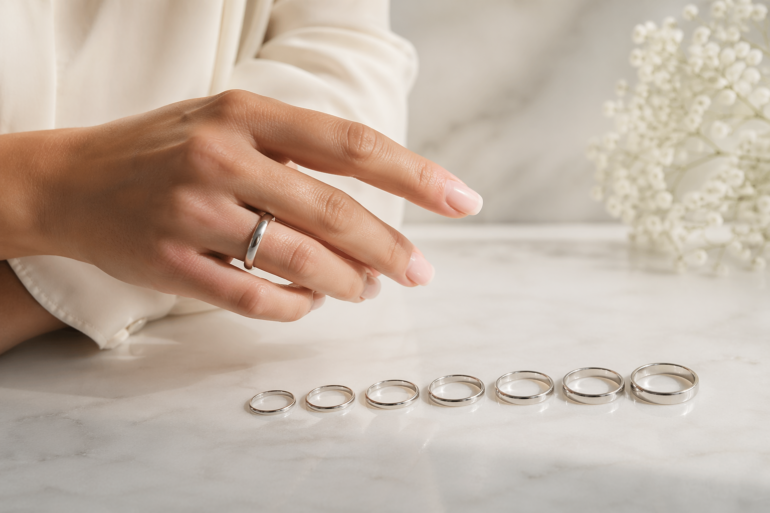
If you are shopping for a ring and wondering what the Average Ring Size for Women really is, you are not alone. It is one of the most searched jewelry questions for a reason. Whether you are buying an engagement ring, a birthday gift, a wedding band, or simply treating yourself, knowing the common size range can save time, money, and the frustration of resizing later.
In the United States, many jewelers and gem experts point to size 6 as a common average for women, while a broader typical range often falls between about 5 and 7 depending on body frame, finger shape, climate, and ring style. GIA also notes that wide bands, convex interiors, open designs, temperature, humidity, and time of day can all affect how a ring fits, which is why “average” should always be treated as a starting point rather than a final answer.
That is the key idea most buyers miss. The Average Ring Size for Women can help you make an educated guess, but the right size for one person depends on much more than a number on a chart. A size that feels perfect in the morning may feel tighter later in the day. A slim solitaire may fit differently from a wider wedding band. Even the same finger on the left and right hands can measure differently.
What Is the Average Ring Size for Women?
The short answer is this: the Average Ring Size for Women in the US is commonly cited as size 6. That benchmark is frequently used by jewelers when someone needs a starting estimate, especially for surprise gifts or engagement rings. GIA specifically notes size 6 as the average US women’s ring size in one of its engagement ring buying resources.
Still, average does not mean universal. Many women wear anything from a size 5 to a size 7, and some fall below or above that range. Slim fingers, broader knuckles, hand dominance, age, hydration, and band width all play a role in how a ring fits in real life. That is why experienced jewelers treat averages as helpful, but never as a guarantee.
If you are ordering without a professional fitting, size 6 is a reasonable place to begin. But if the ring style is wide or the recipient has larger knuckles, the final size may need adjustment.
Why Ring Size Is Not One Size Fits All
It is tempting to think ring sizing is simple, but it is more personal than most people expect. Two women with the same height and weight may still wear different ring sizes because finger shape matters. One person may have slender fingers with wider knuckles, while another may have fuller fingers with a more even shape.
GIA explains that different ring designs should be measured differently. A ring wider than 4 mm often fits tighter because more metal touches the skin. Convex interiors and open spaces above the finger can also change the way a ring feels, meaning the number stamped on the size chart does not always tell the whole story.
That is why the Average Ring Size for Women is useful as a starting point, but not as the final word. In real shopping situations, comfort and wearability matter just as much as the measurement itself.
Common Women’s Ring Size Range
A practical way to think about sizing is to separate “average” from “common range.”
Here is a simple overview many shoppers find helpful:
| Ring Size | How Common It Is |
|---|---|
| 4 to 4.5 | Less common, often found on very slim fingers |
| 5 to 5.5 | Common for smaller hands |
| 6 | Frequently cited average |
| 6.5 to 7 | Very common range |
| 7.5 and above | Common for broader fingers or larger knuckles |
This range is consistent with the way jewelers discuss average sizing in consumer education materials, even though the exact distribution varies by population and brand. GIA’s estimate of size 6 and its notes on body frame differences support the idea that common sizing stretches beyond a single average number.
For most buyers, the smartest takeaway is this: if you have no exact measurement, the safest estimate is often somewhere between 5.5 and 7, with size 6 sitting in the middle.
How Ring Style Changes the Fit
One of the biggest reasons buyers get the wrong size is that they focus only on the finger and forget about the ring itself. Ring style matters more than people realize.
A slim solitaire usually feels roomier than a thick band. GIA notes that wide rings fit more tightly because they create more skin contact, and that some ring shapes should be read differently on the mandrel depending on their design.
This means a woman who wears a size 6 in a thin ring might prefer a 6.25 or 6.5 in a wider band. Likewise, comfort fit interiors may feel smoother and slightly roomier to some wearers, while flatter interiors can feel more snug. If you are choosing between an engagement ring and a wedding band, it is wise to think about how both will sit together on the finger.
This is where the idea of the Average Ring Size for Women becomes more nuanced. The average may stay the same, but the wearable size can change based on the design.
The Best Time to Measure Ring Size
Finger size is not fixed all day. GIA and other jewelers note that weather, humidity, altitude, and time of day can all affect measurement. Fingers usually shrink in colder conditions and may swell in heat or later in the day.
That is why a proper sizing session should happen when the body is at a normal temperature, not right after exercise, during extreme heat, or when hands are very cold. Some jewelers recommend checking more than once. GIA’s quality assurance guidance says finger size should be taken on three different occasions to confirm the measurement because fingers swell and contract.
So if you are trying to pin down the Average Ring Size for Women for a real purchase, do not rely on a single rushed measurement. A few checks at different times can make a real difference.
How to Measure Ring Size at Home
Professional sizing is best, but many shoppers need an at home solution. Brilliant Earth outlines several practical ways to find a ring size, including measuring the finger with a paper strip or tape, using a ring size conversion chart, comparing an existing ring, or ordering a ring sizer.
Here are the most reliable home methods:
Use a Ring That Already Fits
If the person already wears a ring on the correct finger, this is one of the best clues. Place the ring on a size chart or have a jeweler measure it on a mandrel. Make sure it is actually worn on the same finger you are buying for, because finger sizes vary across both hands. Brilliant Earth specifically warns that borrowing a ring from another finger can lead to the wrong size.
Measure the Finger Directly
Wrap a flexible tape measure or narrow strip of paper around the base of the finger. It should feel snug, but not tight. Mark the point where it overlaps, then compare that measurement to a ring size chart. This works reasonably well when done carefully, though it is still less precise than professional sizing.
Use a Plastic Ring Sizer
Many jewelers offer low cost or free ring sizers. These are often more dependable than string because they mimic how a ring slides over the knuckle. GIA notes that jewelers usually use finger gauges for the most accurate fit, and home ring sizers are the closest consumer version of that process.
Buying a Ring as a Surprise
This is where the Average Ring Size for Women becomes especially useful. If you are planning a surprise proposal or gift, you may not have the option of asking directly.
A safe approach is to begin with the common average of size 6, then adjust based on what you know. GIA suggests that fine boned or more slender women may fall closer to the 4.5 to 5.5 range, while larger boned or taller women may fall closer to 6.5 to 7.5. It also notes that sizing down is often easier than sizing up in many situations, so when in doubt, slightly larger can be the safer guess.
That said, do not overdo the guesswork. If you can discreetly borrow a ring, compare it to a chart, or ask a close family member, that will be more reliable than relying only on averages.
Engagement Rings vs Wedding Bands
Not all ring purchases work the same way. Engagement rings often have thinner bands and more design variation, while wedding bands may be wider and sit more firmly against the finger. That affects sizing.
A woman who wears a certain size in an engagement ring may prefer a slightly different fit in a wedding band. Jewelers often account for band width, stacking, and how the ring feels over the knuckle. GIA’s sizing benchmarks for standard, tapered, wide, and convex bands show why ring type matters.
This is one reason a buyer should never assume the Average Ring Size for Women applies equally across all ring categories. The average may help you start, but ring construction shapes the final fit.
Signs a Ring Fits Correctly
A well fitting ring should feel secure without being uncomfortable. Blue Nile and Brilliant Earth both describe a good fit as one that slides over the knuckle with a bit of resistance, then rests securely at the base of the finger without spinning excessively or slipping off too easily.
A ring may be too tight if:
- It leaves deep marks
- It is painful to remove
- It causes swelling or numbness
- It feels restrictive throughout the day
A ring may be too loose if:
- It spins constantly
- It slips off with little resistance
- It feels unstable during daily wear
- It becomes much looser in normal room temperature
These signs matter more than chasing a “perfect” average size. In actual wear, comfort wins.
Mistakes Buyers Often Make
The most common mistake is assuming the average is enough. The Average Ring Size for Women is useful, but it is not a substitute for a real fit check.
Another mistake is measuring when the hands are too cold or too warm. That can easily skew the result. GIA also points out that humidity and altitude can affect fingers, which is why someone shopping while traveling or during unusual weather conditions should be extra careful.
A third mistake is ignoring ring width. Buyers often order the same size across every ring style and then wonder why a wider band feels tight. GIA’s guidance on wide bands makes it clear that design affects fit.
Real World Sizing Tips That Actually Help
If you are trying to get the best result without making the process stressful, a few practical habits go a long way.
Measure more than once. That simple step can prevent most common errors, and GIA explicitly recommends repeated measurements because finger size changes.
Think about the knuckle, not just the base of the finger. Some women need a ring large enough to clear the knuckle comfortably but secure enough not to spin too much after it is on.
Match the sizing method to the ring style. A thin promise ring and a thick eternity band do not always fit the same.
When you are truly unsure, buy from a jeweler with a clear resizing policy. That gives you room to refine the fit after the surprise or after a first try on.
FAQ About Average Ring Size for Women
Is size 6 really the average ring size for women?
Yes, size 6 is one of the most commonly cited averages in the US, including by GIA. But many women fall within the 5 to 7 range, so it is better seen as a starting estimate than a universal standard.
Is a size 7 too big for most women?
Not at all. Size 7 is still very common. Depending on finger shape, knuckle width, and ring style, it may be the ideal fit for many women.
Do fingers get bigger over time?
They can. Weight changes, aging, pregnancy, temperature, humidity, and daily body fluctuations may all affect fit over time. Jewelers routinely account for changing finger size in their educational materials.
Should I size up for a wide band?
Often, yes. Wider bands usually fit more tightly because they contact more skin. GIA specifically notes this issue in its ring sizing guidance.
What is the best way to secretly find someone’s ring size?
Borrowing a ring they already wear on the correct finger is usually the most dependable method. Brilliant Earth also notes that using a ring from the wrong finger can cause errors, so finger placement matters.
Final Thoughts on Average Ring Size for Women
The truth about the Average Ring Size for Women is refreshingly simple. Yes, size 6 is a common US average, and yes, many women fall somewhere between sizes 5 and 7. But ring sizing is still personal. Finger shape, knuckle size, weather, time of day, and ring style all influence how a ring actually feels once it is worn.
So if you needed one practical takeaway, it would be this: use the Average Ring Size for Women as a smart starting point, then verify with real measurements whenever possible. That approach is far more reliable than guessing blindly, and it leads to a ring that feels as good as it looks.
In the end, buying the right ring is not only about appearance. It is about comfort, confidence, and wearability over time. A little sizing knowledge goes a long way, especially when you are choosing something meant to be worn every day. Even understanding the anatomy of the ring finger can help you see why sizing is more individual than many shoppers expect.