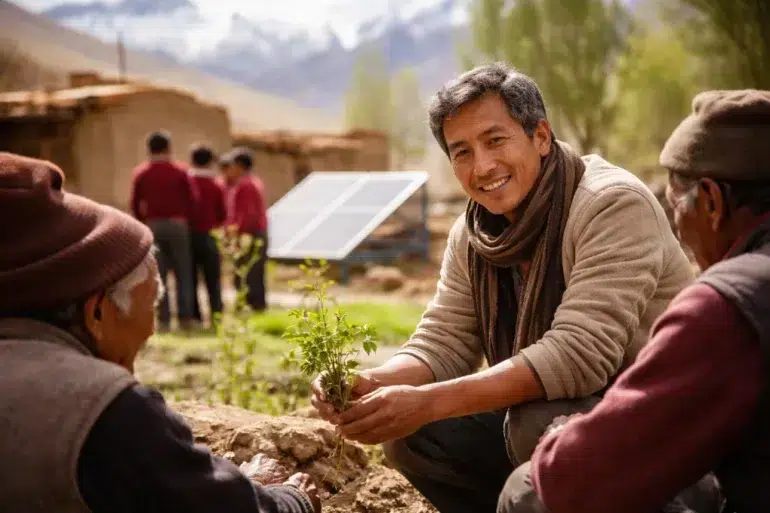
When people talk about Sonam Wangchuk’s Contributions to Social Causes, they often start with innovation. That makes sense. His work is associated with ideas like the Ice Stupa, alternative education, and sustainable architecture in Ladakh. But reducing his impact to invention alone misses the bigger story. What makes his work stand out is that his ideas were never built for applause. They were built to solve everyday problems faced by real communities.
His social impact comes from something deeper than visibility. He has consistently focused on education reform, youth empowerment, climate resilience, local self-reliance, and community-centered development. In a region as geographically demanding as Ladakh, that kind of work is not abstract. It affects whether children can learn in relevant ways, whether farmers have water at the right time, and whether local communities can shape their own future.
That is why Sonam Wangchuk’s Contributions to Social Causes remain so significant. His work shows what social change can look like when it is practical, local, and rooted in lived reality rather than theory. This article takes a close look at how his initiatives have influenced education, sustainability, civic thinking, and grassroots problem-solving.
Why Sonam Wangchuk’s social work matters
Many public figures are praised for speaking about change. Sonam Wangchuk has spent decades building systems that attempt to produce it. His approach has been especially important in Ladakh, a high-altitude region with severe winters, limited resources, and a history of educational and developmental challenges shaped by geography and policy. Britannica describes Ladakh as one of the world’s highest regions, which helps explain why conventional solutions often fail there.
What sets him apart is his belief that social progress should fit the place and people it serves. That principle runs through nearly all his work. Instead of importing urban solutions into a mountain desert, he has worked on local models that respond to local needs. That includes reforming schooling, creating eco-friendly campuses, promoting water-saving innovation, and supporting forms of learning that prepare young people for life in the Himalayas rather than for a disconnected textbook world. SECMOL states that it was founded in 1988 to reform Ladakh’s educational system, while HIAL frames its model around the “Bright Head, Kind Heart, and Skilled Hands” philosophy.
A quick look at who Sonam Wangchuk is
Sonam Wangchuk is an engineer, educator, and reformer from Ladakh who became widely known for his role in transforming local education and developing practical environmental solutions. He is closely associated with the Students’ Educational and Cultural Movement of Ladakh, better known as SECMOL, and with the Himalayan Institute of Alternatives, Ladakh, or HIAL. He also received the 2018 Ramon Magsaysay Award, which recognized his collaborative reform of learning systems and his work in harnessing science and culture for community progress.
His public image grew over time, but the foundations of his work were built long before wider media attention arrived. The story is less about celebrity and more about sustained institution-building.
The education reform that changed the conversation in Ladakh
If you want to understand Sonam Wangchuk’s Contributions to Social Causes, education is the clearest place to begin.
For years, many students in Ladakh struggled under a formal school system that did not reflect their language, environment, or lived reality. A rigid, one-size-fits-all model can be especially damaging in remote regions because it often labels students as weak when the system itself is misaligned. SECMOL was created to challenge that mismatch and build alternatives that respected local context. According to the organization, it began as a youth-led effort to reform Ladakh’s education system and support young people more meaningfully.
This was not just a critique of exams. It was a broader social intervention. Education affects confidence, employability, cultural continuity, and civic participation. When students are taught in ways that feel alien to their surroundings, they can become disconnected from both learning and community life.
How SECMOL became a social change model
SECMOL is often described as an educational movement, but it also functions as a social experiment in self-reliance and responsible living. Its campus near Leh is known for eco-friendly design, solar heating, and hands-on learning. It is not simply a school in the conventional sense. It is a place where students learn practical skills, problem-solving, communication, and shared responsibility. SECMOL says its campus activities support Ladakhi youth and help create more relevant learning pathways.
That matters because social causes are not addressed only through protests or policies. They are also addressed by creating institutions that restore dignity and agency. SECMOL did that by offering students an environment where they could gain useful knowledge without being judged solely by narrow academic metrics.
Operation New Hope and systemic reform
A major milestone in this journey was Operation New Hope, launched in 1994. It was designed as a collaboration between government, civil society, and local communities to improve schooling in Ladakh. The Ramon Magsaysay Award profile specifically highlights Wangchuk’s collaborative and community-driven reform of learning systems in remote northern India. That recognition is important because it confirms that his work was not limited to personal experimentation. It influenced larger systems and life opportunities for Ladakhi youth.
Operation New Hope is significant from a social-cause perspective for three reasons:
- It treated education as a public issue, not a private privilege
- It encouraged community participation rather than top-down control
- It connected learning quality with local relevance and accountability
In practical terms, that kind of reform can shape an entire generation. Better schooling does not only improve grades. It increases social mobility, strengthens local leadership, and reduces the quiet damage caused by chronic educational exclusion.
Youth empowerment beyond the classroom
One of the strongest aspects of Wangchuk’s work is his treatment of young people as active problem-solvers. That is a social contribution in itself.
Too often, youth development is discussed in abstract terms. In contrast, his institutions have created environments where students and young adults are expected to build, test, discuss, and lead. The idea is simple but powerful. A person becomes socially responsible not just by hearing lectures about society, but by participating in community life and solving real problems.
HIAL extends this vision further. On its official site, the institute describes itself as a collaborative learning space and highlights a model built around the head, heart, and hands. That language matters because it rejects the false divide between intellectual growth, ethical responsibility, and practical skill.
In a broader sense, this approach supports social causes by creating capable citizens. It encourages local entrepreneurship, responsible innovation, and context-sensitive leadership. These outcomes are harder to measure than exam scores, but they often matter more.
Climate resilience and the Ice Stupa idea
Education may be the foundation of Sonam Wangchuk’s Contributions to Social Causes, but his environmental work has also had a major social dimension.
Ladakh faces seasonal water challenges. Water may be available in winter when it is less useful for farming, and scarce during the spring planting season when it is urgently needed. The Ice Stupa project emerged as an attempt to address that timing problem by storing winter water as cone-shaped ice structures that melt later when communities need it more. The Rolex Awards profile reports that an early prototype lasted until early July and supplied 1.5 million liters of meltwater for 5,000 saplings planted by locals.
This is where Wangchuk’s work becomes especially compelling. The Ice Stupa is often described as a technological innovation, but its real purpose is social. It is about farmers, food cycles, water access, and adaptation in a fragile environment.
Why the Ice Stupa is more than an engineering story
The appeal of the Ice Stupa project is easy to understand. It is visual, inventive, and highly shareable. But the deeper value lies in what it represents:
- Climate adaptation designed for local conditions
- Low-energy thinking instead of resource-heavy intervention
- Support for agriculture and village livelihoods
- Public imagination used in service of public good
That combination is rare. Many climate solutions are either too expensive, too centralized, or too detached from the people expected to live with them. Wangchuk’s model attracted attention precisely because it translated environmental stress into a community-oriented response. The Council on Energy, Environment and Water and Rolex both describe the project as a practical answer to Ladakh’s water scarcity and note that it helped attract long-term support and wider experimentation.
Social impact of water innovation
Water security is never only an environmental issue. It is tied to livelihoods, migration, stress, and local stability. When spring water is unreliable, communities can face serious knock-on effects in farming and daily life. That is why climate adaptation can also be read as social protection.
Wangchuk’s water-related work shows an important lesson for development thinking. Social causes are often interconnected. A person may start by solving a technical challenge and end up improving education, environment, income, and community confidence at the same time.
Sustainable architecture as a social cause
Another underappreciated part of Wangchuk’s work is his focus on passive solar buildings and eco-friendly campus design. This may sound like an architectural preference, but it has a clear social purpose.
In harsh climates, buildings shape quality of life in very direct ways. A well-designed structure can reduce energy costs, improve health, support learning, and make public spaces more usable during long winters. Wangchuk’s work with SECMOL includes solar-heated buildings built with low-cost traditional methods. His profile and related coverage note that the campus was designed to function without fossil fuels for cooking, lighting, or heating.
This matters for at least three reasons:
| Social issue | Wangchuk’s response | Broader impact |
|---|---|---|
| High energy demand in cold climate | Passive solar and local building methods | Lower operating costs and more sustainable living |
| Inaccessible models of development | Simple, replicable design | Greater local ownership and learning |
| Disconnect between modernity and tradition | Blending innovation with indigenous wisdom | Cultural confidence and practical resilience |
That table captures something central to his philosophy. He does not present tradition and innovation as opposites. He tends to combine them. That makes his work especially relevant to grassroots change, where acceptance depends on whether communities can relate to the solution.
Local culture, identity, and dignity
A serious discussion of social causes must include dignity. And this is one area where Wangchuk’s work has had lasting cultural relevance.
When a region’s education, development, and public policy are shaped by outside assumptions, local identity can become marginalized. In Ladakh, that risk has long been present because of geography, political history, and administrative distance. Education reform that values local language, climate, work patterns, and knowledge systems is therefore not just pedagogical. It is cultural justice.
By pushing for context-based education and locally relevant innovation, Wangchuk helped affirm that Ladakhi realities deserve their own solutions. That may sound obvious, but it is often missing in policy design. His work has consistently argued, directly or indirectly, that development should not erase local identity in the name of progress.
That is one reason many people view his contributions as deeply social rather than merely technical. He has repeatedly linked problem-solving with self-respect.
Community collaboration instead of hero-centered change
There is a tendency in public storytelling to focus on one face and call it transformation. But Wangchuk’s most credible achievements seem to come from collaboration rather than heroism.
The Ramon Magsaysay Award citation is especially revealing here. It emphasizes his “systematic, collaborative and community-driven reform” rather than presenting him as a lone genius. That distinction matters. Social change rarely lasts when it depends on one charismatic individual. It lasts when communities, institutions, and local stakeholders participate in shaping it.
This collaborative dimension is one of the strongest parts of his legacy. It shows up in school reform, village-centered educational efforts, and climate adaptation experiments involving local participation. In a world crowded with personal branding, that model feels refreshingly grounded.
What readers can learn from his grassroots approach
Wangchuk’s work also offers useful lessons for people outside Ladakh. Even if the context is different, the underlying approach has wide relevance.
Practical lessons from Sonam Wangchuk’s social model
- Start with the real problem, not the fashionable solution
- Respect local knowledge before importing outside frameworks
- Treat education as a community issue, not only an institutional one
- Build small models that people can see, test, and improve
- Connect environmental thinking with human needs
- Create systems that communities can own, not just admire
These lessons are especially relevant for educators, nonprofit workers, local leaders, and sustainability advocates. Too many initiatives fail because they look impressive on paper but do not fit local life. Wangchuk’s work is a reminder that usefulness beats spectacle.
Common questions about Sonam Wangchuk’s social contributions
What is Sonam Wangchuk best known for in social work?
He is best known for education reform in Ladakh through SECMOL and Operation New Hope, as well as for environmental innovation such as the Ice Stupa project. Together, these efforts address youth development, water scarcity, sustainability, and grassroots empowerment.
Why is his work called grassroots change?
Because it focuses on community-level problems and locally workable solutions rather than purely symbolic advocacy. His initiatives are rooted in Ladakh’s real conditions, including schooling, climate, infrastructure, and rural livelihoods.
How did he contribute to education?
He helped create SECMOL, supported reforms that made schooling more relevant to Ladakh, and played a key role in Operation New Hope, a collaborative reform effort launched in 1994.
How does environmental work connect to social causes in his case?
Environmental stress directly affects farming, livelihoods, and community stability in Ladakh. Projects like Ice Stupa attempt to solve water timing problems in ways that support people, not just ecosystems.
The lasting significance of his work
The reason Sonam Wangchuk’s Contributions to Social Causes continue to attract attention is not only because they are innovative. It is because they are rooted in a strong moral and social logic. He has consistently worked on the link between dignity and development, between education and self-reliance, and between sustainability and everyday survival.
That combination is rare. Some reformers focus on schools. Others focus on climate. Others focus on public awareness. Wangchuk’s work crosses these boundaries in a way that feels coherent rather than scattered. He has treated social change as an ecosystem where education, culture, environment, and local agency all affect one another.
In the final analysis, his legacy is not just a set of projects. It is a way of thinking about public good. Build from the ground up. Listen to the place. Keep solutions practical. Let communities participate. That is what gives his work lasting relevance.
For readers who want a wider sense of his public journey, his biography offers additional background, but the core point remains simple. His influence matters most not because he became well known, but because he kept returning to problems that many people overlook and tried to solve them in ways that communities could actually use.