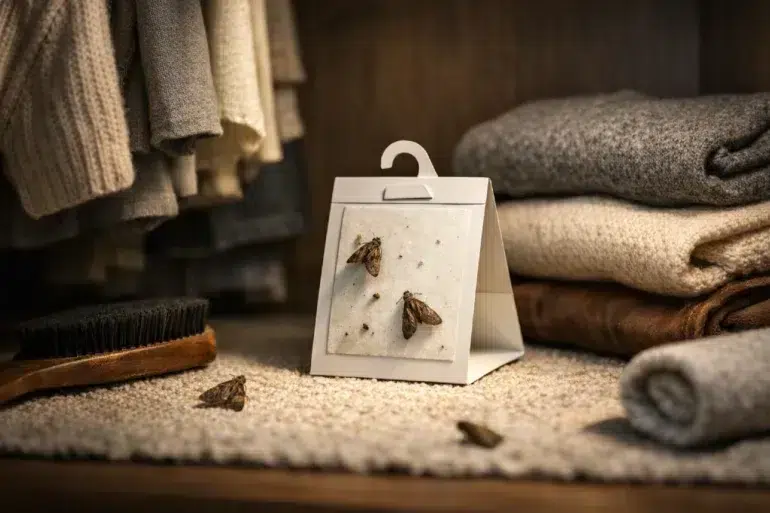
If you have ever pulled out a favorite wool sweater and noticed tiny holes that were not there last season, you already know how frustrating moth damage can be. The annoying part is that you might not even see the culprit. Clothes moths are shy, they avoid light, and they can quietly turn a calm closet into a feeding zone, explains LRES Property Management experts.
That is why Webbing Moth Traps have become such a go to option for homeowners. They are simple, low mess, and they give you something most moth control methods do not: clear proof of activity. Instead of guessing, you can confirm whether moths are present, where they are coming from, and whether your cleanup plan is working.
In this guide, we will walk through how Webbing Moth Traps work, where to place them in closets and carpeted areas, how to use them alongside cleaning and fabric care, and how to avoid the common mistakes that make people think traps “do nothing.”
What are webbing clothes moths, and why do they target wool?
When people say “moths ate my clothes,” it is almost always the larvae doing the damage, not the adult moth flying around the room. Extension entomologists regularly emphasize that the feeding stage is the immature caterpillar like larva, and it prefers animal based materials that contain keratin.
These larvae are especially drawn to:
- Wool, cashmere, alpaca
- Silk and blends that include animal fibers
- Fur, feathers, felt
- Rugs and carpet edges where lint and pet hair collect
- Upholstery that contains natural wool or animal based components
Another detail most people miss: larvae do better when fabrics have small traces of sweat, skin oils, food, or other organic residue. In other words, the “clean looking” sweater you wore once and put back can be more attractive than the freshly washed one.
Webbing Moth Traps: what they are and what they actually do
Webbing Moth Traps are typically sticky traps paired with a lure that releases a sex pheromone. The pheromone attracts adult male webbing clothes moths, pulling them into the trap where they stick.
What Webbing Moth Traps are great for
- Confirming you truly have clothes moths (not carpet beetles or another pest)
- Locating the “hot spot” room, closet, or storage bin
- Measuring whether your cleaning and storage steps are reducing activity over time
- Catching active males so you can reduce mating pressure (helpful, but not a standalone fix)
What Webbing Moth Traps cannot do by themselves
Traps catch adults, but the damage comes from larvae hidden in folds, seams, rug edges, baseboards, and under furniture. Public health and extension sources often describe traps as useful for detection and monitoring, while elimination requires cleaning and treatment of the places larvae live.
Think of traps as your “moth dashboard.” They show you what is happening. Your cleaning and fabric protection steps are what change the outcome.
The biggest myth: “I see moths, so I need traps in the middle of the room”
It feels logical to put a trap where you notice moths flying. But webbing clothes moths are weak fliers and tend to stay close to the source of infestation, especially in quiet, dark areas where fabrics sit undisturbed.
So the best placement is usually closer to:
- Closet corners and floor edges
- Under bed storage zones
- The baseboard line near rugs or carpet edges
- Inside wardrobes near wool items (without touching clothing)
Where to place Webbing Moth Traps in closets
Closets are prime moth territory because they are dark, still, and full of the exact fibers larvae want.
Use this placement logic:
Closet placement checklist
Place Webbing Moth Traps:
- Low and toward the back of the closet (moths often move near edges)
- Near the closet floor where lint gathers
- Near stored wool coats, blankets, or scarves (but not stuck directly on fabrics)
- Near doors or corners where air is still
Avoid placing traps:
- Right next to strong airflow (vents, fans)
- In direct sunlight
- On top shelves right under bright lights
Manufacturers and pest monitoring guides generally emphasize using pheromone traps in areas where the target pest is likely to be found and where the larval food sources exist.
Where to place Webbing Moth Traps for carpets and rugs
If the problem seems to be rugs, carpet edges, or a room that “smells a bit musty,” traps can help you locate the real feeding zone.
Good spots include:
- Along baseboards near carpet edges
- Under sofas, beds, or heavy furniture (if safe and accessible)
- Near wool rugs, especially in low traffic corners
- Near pet sleeping spots (hair and dander can feed larvae when mixed with lint)
The goal is not to decorate the room with traps. The goal is to put them where moths travel quietly.
How many Webbing Moth Traps do you need?
For most homes, a practical starting point is:
- 1 to 2 traps per closet that stores wool, silk, or natural fiber blends
- 1 trap in each room where you suspect carpet or rug activity
- 1 trap near stored textiles (blanket chest, under bed bins)
If you are unsure where the source is, distribute traps across suspected zones for two weeks, then concentrate traps where catches are highest.
A simple 4 step plan that makes traps work better
If you only do traps, you will learn you have moths. If you combine traps with the steps below, you can actually stop the damage cycle.
Step 1: Identify the pest correctly
Clothes moths are not the only fabric pest. Carpet beetles can cause similar damage, but their control strategy is different. University resources often cover both together because people confuse them.
Signs that point toward webbing clothes moth activity:
- Silky webbing in corners or on fabric
- Tiny tube like cases or clinging debris (varies by species)
- Holes concentrated in hidden areas: under collars, cuffs, folds
- Damage to rugs near edges or under furniture
Step 2: Remove what larvae feed on
This is the unglamorous part, but it works.
Do a deep clean of the exact zones where traps catch moths:
- Vacuum closet floors, baseboards, corners, shelf edges
- Vacuum carpet edges and under furniture using a crevice tool
- Empty and vacuum drawers and storage bins
- Immediately discard vacuum contents outside (so eggs do not hatch inside the machine)
Extension guidance commonly stresses thorough cleaning of cracks and undisturbed areas because larvae develop where lint and fibers accumulate.
Step 3: Treat textiles the right way
Different fabrics need different approaches, but the goal is always the same: kill eggs and larvae.
Commonly used options include:
- Washing items on a hot cycle if the fabric allows
- Dry cleaning for structured wool or delicate garments
- Freezing items sealed in a bag for a sustained period (often used for delicates)
Public health guidance for clothes moth infestations highlights laundering, cleaning, and treating stored items as part of control, not just trapping.
Step 4: Use Webbing Moth Traps to track progress
Once you clean and treat the textiles, traps become your progress tracker.
A simple tracking habit:
- Check traps weekly
- Record how many moths you caught and where
- If catches remain high in one closet, focus cleaning and inspection there again
Museum pest monitoring resources also discuss replacing traps on an appropriate schedule based on lure life and saturation.
Common mistakes that make people hate moth traps
Here is the honest truth: traps fail most often because of setup mistakes, not because pheromone trapping is “fake.”
Mistake 1: Expecting traps to kill larvae
Larvae are the fabric chewers. Traps catch adults. You still need cleaning and textile treatment.
Mistake 2: Placing traps where moths are not traveling
If you put a trap in a bright hallway, you may catch nothing and assume you have no moths.
Mistake 3: Using one trap for the whole house
Moth problems are usually localized. Use multiple traps to locate the source.
Mistake 4: Leaving traps up too long
Sticky surfaces get dusty. Lures expire. Replace traps as directed so results stay meaningful.
Mistake 5: Ignoring blended fabrics
Many people protect wool sweaters but forget wool blend suits, rugs, or coats with animal based linings. Some sources note damage can still occur on blends, especially when animal fibers are present.
Webbing Moth Traps vs other moth control options
Here is a clear comparison so you can see where traps fit.
| Method | What it targets | Best use | Limits |
|---|---|---|---|
| Webbing Moth Traps | Adult males | Monitoring, locating infestation zones | Does not kill larvae directly |
| Vacuuming and deep cleaning | Eggs, larvae habitat | Reduces food, removes life stages | Must be thorough, repeatable |
| Washing or dry cleaning | Eggs, larvae on items | Treats garments and textiles | Fabric care limits vary |
| Freezing sealed items | Eggs, larvae on items | Great for delicate wool | Requires time and space |
| Airtight storage | Prevents access | Long term prevention | Needs clean items first |
A real world scenario: why traps can reveal the hidden source
Imagine this: you see a moth near your living room lamp at night. You put a trap in the living room and catch one moth. You assume the living room is the problem.
But then you place two Webbing Moth Traps, one near the living room rug edge and one in the hallway closet. A week later, the hallway closet trap has eight moths, and the living room trap has zero.
That result usually means the living room moth was a wanderer, and the hallway closet is the breeding source. Now you know exactly where to clean, inspect seams, treat wool items, and improve storage.
This “source finding” role is one of the most practical benefits of pheromone based monitoring, especially when sticky traps without lures are not sensitive enough.
Quick inspection guide for wool, carpets, and closets
Use this as a fast checklist when you are not sure where to start.
For wool clothing
- Check under collars, cuffs, and armpit seams
- Look for gritty dust, webbing, or uneven thinning
- Inspect items that were worn once and stored unwashed
For carpets and rugs
- Lift corners and inspect the underside edge
- Check under heavy furniture where vacuuming is rare
- Look for webbing and pellet like debris
For closets and storage
- Inspect floor corners and shelf edges
- Check old storage bins, rarely used drawers, and blanket chests
- Focus on quiet, dark, undisturbed zones
FAQ: Webbing Moth Traps
Do Webbing Moth Traps attract more moths into my home?
In normal home use, traps are designed to attract moths already present in the area. They are best used indoors near the suspected source rather than near open windows or doors. Monitoring guides stress placement in the pest’s likely activity zones to keep results meaningful.
How long does it take for a trap to catch moths?
If moths are active in that space, catches can appear within days. If you see no catches after two weeks, either the placement is wrong, moths are not active there, or the problem is a different pest.
Why do I still see damage if traps are catching moths?
Because the larvae may already be present in fabrics or carpets. Traps help you confirm activity, but cleaning and textile treatment are what stop ongoing damage.
Can I use Webbing Moth Traps for pantry moths too?
No. Pantry moth traps use different lures designed for stored product moths. Clothes moth traps should be used around wool, hair, feathers, and natural fiber textiles.
The simplest way to think about it
If you want a calm closet and intact wool, you need two things working together:
- Webbing Moth Traps to reveal moth activity and guide your focus
- Cleaning, inspection, and textile treatment to eliminate larvae and remove the conditions that let them thrive
When you use traps as a tool for clarity rather than a miracle cure, they become incredibly effective. You stop guessing. You start acting based on evidence.
In the last step, it helps to understand the pest itself. The webbing clothes moth is widespread and strongly associated with keratin based materials, which explains why closets, carpets, and wool storage can become repeat problem zones if cleaning and storage habits slip.